
Britain
Gibbs Technologies
Automotive manufacturer of Nuneaton,Warwickshire. UK from 1996 on

Since 1996 the automobile manufacturer company Gibbs Technologies. In the sector of unusual amphibious vehicles .
History
Founder of the company was Alan Gibbs , who had been working on a vehicle concept since 1995. Chairman of Gibbs Technologies is Neil Jenkins , who played an important role in the development of the Jaguar XJ220 . The company is located in Nuneaton .
The following vehicles are manufactured by Gibbs Technologies:
Gibbs Aquadas
The Gibbs Aquada is an amphibious vehicle from Gibbs Technologies , which is equipped with the six-cylinder engine from the Land Rover Freelander , and according to its manufacturer in the years 2003 and 2004 as a small series of about 50 copies originated.
Visually, the Aquada is reminiscent of the Mazda MX-5 , from which its headlights come, but has a plastic body, an aluminum chassis, and a mid-engine . The V-type engine provides 120 kW (177 hp), the rear-wheel drive or the water jet propulsion serving. As a maximum, the manufacturer gives over 100 mph (over 160 km / h) and over 30 mph (over 25 knots ) on land . For high speed to water, the wheels of the Aquada similar to many aircraft can be folded at the touch of a button.With 60 patents registered for the vehicle. One of these patents is called HSA, which stands for High Speed Amphibian.
Richard Branson crossed the English Channel in an Aquada from Dover to Calais in about 90 minutes. He broke the record for crossing the channel with an amphibious vehicle, which was previously held for 40 years by the French, who took about six hours for the crossing.
Gibbs Humdinga
The Gibbs Humdinga is also an amphibious vehicle based on the Hummer H1 . The Gibbs Humdinga is available in a civilian and a military variant.It was developed for use in rough terrain, by the native New Zealander Alan Gibbs. The company Gibbs Technologies , which produces the vehicle has its headquarters in Warwickshire, near the English Coventry .
The Humdinga can accelerate from 0 to 60 mph in 9.2 seconds. It has a curb weight of 2000 kg and a wheel-independent air suspension. The vehicle is 5400 mm long, 1850 mm high and 2000 mm wide. On land, the Humdinga reaches 160 km / h with 260 kW / 350 hp. He brings it to the water, due to the jet pump ( jet propulsion ) and its underbody architecture, to 65 km / h. As with the Gibbs Aquada, the wheels fold at the touch of a button and the car turns into a boat in 12 seconds. This mechanism is locked during operation in "land mode" and will only be released when the vehicle is in "water mode". This ensures that the wheels do not fold in while driving on land.
Gibbs Quadski
The Gibbs Quadski is an amphibious vehicle that combines the characteristics of a quad and a jet ski .
On land and at sea, the Quadski achieves 72 km / h with its 1.3-liter four-cylinder engine ( BMW , 103 kW / 140 hp). The vehicle weighs 605 kg and its maximum torque is 118 Nm . The Quadski is driven in the water by a water jet drive. Like the Gibbs Aquada or the Gibbs Humdinga the wheels fold at the push of a button and the quad turns into a jet ski in five seconds. This mechanism is locked during operation in "land mode" and will only be released when the vehicle is in "water mode". This ensures that the wheels do not fold in while driving on land. The range on land according to the manufacturer is 600 km. In the water, the vehicle should progress for two hours.
The manufacturer has registered 300 patents for the vehicle in 15 years . The Quadski was already built in 2006 in small series and is since 2012 in a revised version as a production vehicle in the US to acquire. In Europe, the market a second model Quadski XL was introduced, which offers space for two people.
Classic ERA (Classic English Racing Automobiles)
Automotive manufacturer of Hampshire UK from 1991 to 2005
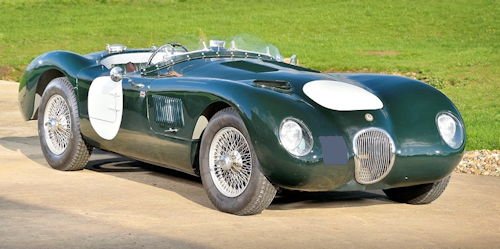
Classic ERA was a British manufacturer of automobiles . The brand name was CERA (Classic English Racing Automobiles)
History
John Gregson founded the company in the county of Hampshire in 1991 . He started producing automobiles and kits . 1999 came the production of models, which previously produced Proteus Cars . In 2000, the own brand name was abandoned. In total, over 45 copies were made. By 2005 ended production. No connection to the orignal E.R.A. (English Racing Automobiles Ltd).That was an English manufacturer of sports and racing cars from 1933 to 1954.
The offer included expensive quality replicas of the race type Jaguar models C-Type and D-Type . Many parts came from the orignal Jaguar design and features a tubular steel spaceframe chassis, hand-formed aluminium bodywork so not your normal replica. Between 1991 and 2000, about 45 vehicles were created and built to order.
Between 1999 and 2005, the company manufactured the replica models C-Type , D-Type and 300 SLR , which were sold under the brand Proteus .
Grenville steam Carriage

The Grenville steam car is a very early British steam Carriage automobile first built in 1875 .
History
The Briton Robert Neville Grenville Butleigh Court at Glastonbury in Somerset introduced in 1875 with the help of George Jackson Churchward, who later became head of the locomotive department in the Great Western Railway , was a steam car forth.
The vehicle has three wheels, a small front and two large rear. The three wheels each consist of 16 segments of solid teakwith an iron band. The vehicle has a frame that carries the boiler , the engine and the wheel suspensions. The suspensionis via leaf suspension on the wheels. The steam boiler, which has more than 50 water pipes, probably comes from Shand Mason & Co. The steam boiler operates at 8 bar pressure and has a heating surface of 2.7 m². A water pumpsupplies the boiler with water from a water tank located under the vehicle. The water capacity in the boiler is 158 liters, as well as 227 liters in the tank. Originally a single-cylinder engine was mounted, which was later replaced by a two-cylinder engine. The cylinder bore is 127 mm, the piston stroke 152.4 mm. The engine drives the rear axle via a two-speed gearbox and a differential . The driver controls the tiller steering and the engine power.
According to the then law, a second person, the brakeman, had to operate the brake. When the brake pedal is pressed, a wooden block brake ensures a delay. The vehicle can accommodate four passengers. The maximum speed is stated at arund 19 mph about 32 km / h. The consumption of the vehicle is about 14.2 liters of water and 1.7 kg of coal per kilometer. The vehicle is 350 cm and 170 cm wide. The source indicates as vehicle height 8 feet and 3 inches and in the metric system 320 cm, but these values do not match, because 8 feet 3 inches are only 251 cm. The vehicle weighs 2330 kg.
The vehicle was used until 1902. Before the Second World War it received as a result of a complete overhaul a new steam boiler and a new rear axle. In 1947, the nephew of the builder donated it to the Bristol Industrial Museum . After another overhaul in 1976, the vehicle was occasionally in some events such as the London to Brighton Veteran Car Run in November 2000 commissioned. After the Bristol Industrial Museum was dissolved, the vehicle came to the National Motor Museum in Beaulieu in the UK.
Listair Cars (Dash)
Automotive manufacturer of Eardisley , Herefordshire from 1989 to 1994

Listair Cars from Wrexham in Wales made from 1985 to 1989 vehicles that were marketed as Dash.This was a British manufacturer of kit type automobiles .
History
The predecessor was the Pelland Sports of Pelland Engineering , later Graham cars .
Simon Parker In 1989, the company in Eardisley in the county of Herefordshire . With the support of Diane Parker, took over projects from Listair Cars and Minari Engineering . The production of automobiles and kits began. The brand names were Dash and MCA . Lawrence Harold Wilson was also director from 1993 at the latest. 1994, the production ended. In total, over 50 copies were made.
Dash: This model was the successor to the Dash of Listair Cars. It was an open roadster . Initially, a four - cylinder boxer engine from the VW Beetle powered the vehicle. From 1990 was also an engine of Alfa Romeo available. Special feature was the mid-engine . Dash made between 1989 and 1993 about 55 made .
The Dash Sports 600 was originally a small coupe from Minari Engineering. The basis was a ladder frame chassis from Jago Automotive . On it a body made of fiberglass was mounted. A two-cylinder engine from the Fiat 126 in the rear with 594 cc displacement propelled the vehicle. Dash also developed a convertible version.
Beardalls of Nottingham

Beardalls of Nottingham was a British company in the automotive and former automobile manufacturer. The brand name was Beardalls .
History
The company from Nottingham from 1954 sold vehicles ,crash repairs and parts from Volkswagen and from about the late 1960s built VW buggies from GP . 1971 began the production of automobiles. 1973 ended production. In total, about six copies were made.
This was only available as a complete vehicle. The model was a beach buggy . This was a buggy similar to the GP buggy.
