
Britain
Seddon commercial vehicles History
Great Britain from 1938 to 2009

The Seddon Company Produced commercial vehicles in Lancashire Britain, from the 1930 to the 2000s under various name changes and Company take overs.
History
The company Foster & Seddon, in Salford, decided to enter the commercial vehicle market in 1938, the origin reverts back to 1919, when as Foster & Seddon operated as road transport hauliers and commercial vehicle distributors.The founders were E.W. Foster, T. Seddon, PEI. Seddon and H. Seddon all held the position of Chairman of the board during this time.
As road transport operators Foster and Seddon gained excellent experience of the vehicle requirements of operators.Then in 1938 the group of people agreed to build their, own commercial vehicle using the knowledge they possessed, this was Foster and Seddon.
The first vehicle was a 6-ton payload capacity chassis, diesel engine powered, designed for a full-length platform, and at the sametime endeavouring to keep within the unladen weight of 50 cwts for the maximum allowable speed of 3 a 6-ton payload forward-control Perkins P6-engined diesel truck for legal operation at up to 30 mph 48km/h from the time.
Later the company realising that a single wheelbase limited the vehicle's operating capabilities, decided therefore to offer a shorter wheelbase, making two wheelbases available.
By 1940, this model line was still being produced up to World War II. Although the Ministry of Supply did restrict the company to constructing commercial vehicles for the country's civilian operations under a specific authorization, Seddon produced trailers for the combat forces during the war.Unfortunately, Seddon's received their first export contract for four vehicles for Corsica in 1940 these were destroyed at the London docks awaiting shipment during the first full scale bombing attack on the city.
After the war the company decided to change their name to Seddon Motors Limited, and eventually restarted production,now reaching around 8 chassis per week.
The premises in the Pendleton area of Salford was now too small so 1947 production was transferred to Oldham. it was necessary to acquire new compact premises. resulting in the choice of Woodstock factory, Oldham, Lancashire. now as Seddon Lorries Ltd,
In 1950 a 3-ton rigid using a 4-cyl Perkins diesel engine was and once more changed their name to Seddon Diesel Vehicles Limited in 1951 with passenger versions offered on the export market.in 1952 a new passenger chassis with mid- mounted 6-cyl Perkins diesel engine was introduced.Production grew steadily but Seddon’s required more capital and by 1974 now offered shares to the public.

In 1954 Seddon’s devoted time to research into fibre glass for the manufacture of components It was 1964 when the major break-through came, it was the introduction of the very successful the 1 1/4-ton bonneted '25' model was announced and fibreglass introduced in cab construction.Four ranges introduced at the Commercial Motor Show of the same year. By 1956 wrapround windscreens had begun to appear and in 1957 new lightweight plastics cabs were advertised for Mk 12 and Mk 15 models. It was a great tribute to the designers and engineers to produce such a range. models included a 14 tons GVW version of the Mk 15 and the 'Pennine' Mk 19 passenger chassis powered by a 98bhp horizontal under-floor AEC diesel engine. For 1959 trailing-axle 6-wheeled rigid goods models and a 30-ton version of the 'Sirdar' offered, while a bonneted 6 x 4 artic for up to 45 tons GCW was added in 1961.

More updates occurred in 1964 when the '13: Four' rigid, using a new Motor Panels cab and Perkins 6.354 diesel engine. In 1965 the '16: Four' was announced, this with a powerful Perkins V8 diesel producing 170bhp. By 1967 a V8-engined artic tractor, the SD4, had been up-rated to 28 tons gross and was joined by Gardner and Rolls-Royce engine versions for 32 or 38 tons gross.
In 1970 the company was now as Seddon Motors Ltd and the 32/38-ton tractor, carrying a version of the standard Motor Panels cab, could be had with a turbocharged Rolls-Royce diesel engine.Passenger chassis was now built by Pennine Coachcraft Ltd, and a new version The 'Pennine RU', with rear-mounted Gardner engine.

Next came the amalgamation of the company's activities with those of Atkinson Vehicle Limited forming the well-known Seddon Atkinson Vehicles Limited probably one of the best high quality vehicle manufacturers in the country from the time. led to its takeover in 1970, the two ranges remaining separate.
A liaison was with Magirus-Deutz (Great Britain) Ltd which led to a single Seddon-Deutz goods model.
A further merger in 1974 of the company with the American International Harvester Corporation in the same year as the merger had just been completed with Atkinsonsbecoming Seddon Atkinson Vehicles Ltd.The heavyweight models introduced in 1975 was available in 4-6 and 8- wheeled form as the Seddon-Atkinson '400'-Series. Using Cummins, Gardner and Rolls-Royce diesel engines, The 200'-Series, using a 134bhp International 6-cyl diesel engine, added and in 1978 the first '300'-Series 6-wheeler for 24 GVW was constructed.
Later, a '300'-Series artic tractor unit was also offered. The smaller '200'-Series could only be had in this form as a conversion.in 1980 the '401 '-Series artic tractor, a modified version of the '400'-Series, employing light- weight components.
By 1984, International Harvester sold Seddon Atkinson to Enasa of Spain, which had failed to materialize.Sales of Seddon Atkinsons dwindled through the 1980s. Both the 400 and 401 series received heavy complaints over quality with insufficient rust protection on the cabin. In 1991 Iveco took over Enasa and acquired Seddon Atkinson as part of the deal. In December 2009, Iveco announced that the Seddon Atkinson brand would be withdrawn.

Vi-Car Gordon (Vernon Industries Ltd.)
Former Automobile Manufacturer Bidston, Cheshire United Kingdom from 1952 to 1958

Vernon Industries Ltd. was a British manufacturer of small automobiles in the 1950s.
History
The company from Bidston began in 1952 with the production of automobiles. The designer was Erling Poppe, who previously worked for Sunbeam . The brand names were Vi-Car and from 1954 Gordon .Between 1952 and 1953, the company produced invalid vehicles called Vi-Car . The design was the same as the Gordon, but there was only one front headlight. The cover of the rear wheels with motorcycle-like fenders was designed simpler.
As the Brand Name Gordon: This was a microcar with three wheels, of which the single wheel was at the front. Price for the basic car was £301 and for the De Luxe version $315. Built with a sturdy and strong body made of steel and had a roll roof construction with tubular steel chassis, it was notable for compactness and simplicity. fitted with independent suspension on all wheels. for sevice The complete engine and gearbox can be removed in 10 minutes.Steering is by means of a Burman steering unit. Wheels are large car type and interchangeable A single-cylinder engine from Villiers Ltd with 197 cc displacement was mounted to the right of the driver (right-hand drive) outside the body and powered by a chain on a rear wheel. Access to the interior was therefore only possible through a door on the left side.
At the time it was then the cheapest car in the UK market. But by 1958 ended production. In total, a few hundred copies were created.
Performance
- output of 8 b.h.p. at 4,500 revs
- Maximum speed 45 m.p.h.
- Fuel consumption 70-80 m.p.g.
Shadow Racing history
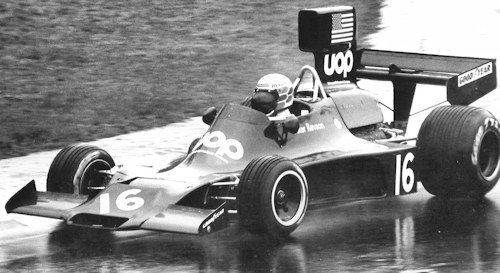
Shadow Racing Cars was a US and British Formula 1, Can-Am and sports car team from the early 1970s to the 1980s.
History
In 1971, Don Nichols founded the company Advanced Vehicle Systems, but he called his cars Shadow. The first Shadow was the Mk.1, an advanced Can-Am car with small tires for low drag. Initially based in the United States with the later Formula One operations were run from Northampton England UK
In Formula 1, the team debuted in 1973 at the Grand Prix of South Africa with a car designed by Tony Southgate. There were two cars with the drivers Jackie Oliver and George Follmer used and Graham Hill. In 1974, Peter Revson - son of the founder of the cosmetics company Revlon - killed in tests for the Grand Prix of South Africa in Kyalami with a Shadow Ford DN3 deadly. The cause of the accident was a suspension failure. The DN5 models used Ford Cosworth DFV engines, with around 490 bhp
At the Grand Prix of Austria in 1977, the team won its first and only one victory with the eventual World Champion Alan Jones, after a few months earlier its predecessor Tom Pryce at the 1977 South African Grand Prix in a Shadow DN8 collided with a marshal and been killed by its fire extinguishers was.
During the 1980 season, the team cooperated with Theodore Racing, however, retired the team after the Grand Prix of France for financial and athletic reasons from Formula 1 back. Theodore pursued an independent Formula 1 project for the season 1981 and gave the Shadow DN12 no great development prospects anymore.
In 2020, it was announced that the Shadow Racing Cars name will be used by Italian racing driver Bernardo Manfrè as an Italian car tuning and luxury car brand.
Lester-MG
Automotive manufacturer of the Hertfordshire;United Kingdom From 1949 to 1955.
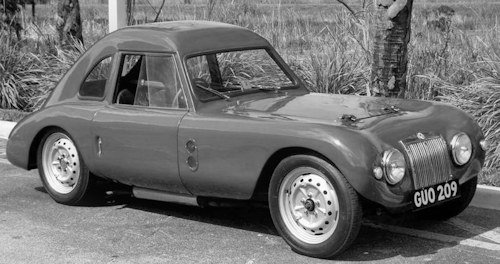
Lester-MG was a British race car brand from Harry Lester in the 1950s. The brand name was Lester-MG .
History
Harry Lester a expert tuner of MG cars began in 1949 in his company in Knebworth Hertfordshire with the production of automobiles. In 1949 the move to Thatcham and in 1951 a change of name to Lester Cars (1951) Ltd. Overall, emerged about 20 copies untill the mid 1950s now by the The Monkey Stable that also won races back in the 1950s.
The vehicles were intended for club races, but also as street legal cars. Built on a designed rigid tubular chassis frame by Lester with a open or closed two-seat body in lightweight aluminium . Fitted with highly tuned engines from MG . Depending on the racing class, the cubic capacity was reduced from originally 1250 cc but also built as 1087 cc or to 1467 cc.
Lester-MG is not to be confused with Lister another British company.
MG cars History
Automotive manufacturer of the United Kingdom From 1924 to 2005.
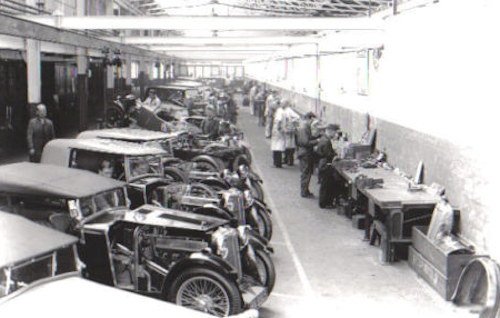
MG was a famous British car brand with a long history,owned by the MG Rover Group until 2005.
History
1920s
Morris Garages was created in 1923 in Oxford (England), with Cecil Kimber as the first director. He moved to Abingdon, Oxfordshire, in the late 1920s. The first model was based on the Morris Oxford sports tourer, which was sold under the designation MG 14/28 beginning in 1924. Sporty sedans followed, with the MG 14/40, introduced in 1927, being the first vehicle to bear the octagonal MG symbol.
Starting in 1928, the M-Type Midget was the first time a simple, two-seat sports car was built, which was typical of the offer of the brand. The Morris Minor- based sports car with ohm engines became the first truly successful model of the brand because it was reasonably priced and offered very good performance.

1930s
With the C-Type Midget 1931 in Montlhéry the first sports success of the brand retracted. Further developments were the models J3 / J4 with supercharged engines, which were designed specifically for racing use, and their successors Q-Type and R-Type.
Until the mid-1930s included the model range next to the small Midget the larger models Magna and Magnetite with ohm six-cylinder engines of less than 1.5 litres. Although the simple but reliable and powerful roadster was the company's main field of activity, there were always sporty coupes and sedans, all of which were derived from Morris constructions. From about 1935, the T-Type replaced the Midget with simpler designed ohv engines and the larger four- and six-cylinder models SA, VA and WA the magnet.
Post war
After the Second World War, the small sports roadster was offered again from 1945 with the TC. From 1950, joined with the Series Y again a sporty sedan - like the Roadster equipped with a 1.25-liter four-cylinder engine. Mid-1950s, the old T-type roadster (MG TF last) were replaced by a completely new, modern design, which indicated a new start as MGA. This car was also the first time increasingly exported and opened MG above all the important American market.

1960s 1970s
The name Magnettee merged again and referred to the mid-1960s, the large sedans that - equipped with four-cylinder engines - were just slightly more luxurious versions of the sister brands Morris and Austin, which belonged to MG since the mid-1950s to Nuffield Corporation. From 1961 there was again the smallest model of the brand a midget, which was derived from the Austin-Healey Sprite. Also, from mid-range model of the group, the Austin / Morris 1100 / 1300, there was always a better equipped MG variant.
In May 1962 replaced the MGB with self-supporting body from the successful MGA. The meanwhile grown to 1.8 l four-cylinder engine was at the end of the 1960s, a MGC with 2.9 -l six-cylinder side aside in the mid-1970s, even an MGB V8 with the acquired from Rover 3.5 -l V8 -Engine. In addition to the Roadster, the MGB was also available as a GT model with a fixed roof. Until the end of 1980 remained MGB and MGC on offer, then disappeared for a long time last independent MG-construction.

1980s
From 1981, the MG were just top versions of models of the sister company Austin, such. B. the Metro, the Maestro and the Montego. These three models are also referred to as MG-M series and were manufactured until 1990. The Nuffield Group initially operated as British Motor Corporation (BMC), following the acquisition of Leyland as British Leyland Motor Corporation (BLMC). In 1984, the last Morris was built and out of the BLMC conglomerate, which included almost all British automakers, the Austin-Rover Group and then the Rover Group emerged after several economic turmoil.

1990s
After there had been no MG vehicle for three years, put on the MG RV8 in 1993, a closely related to the 1980 disappeared MGB similar vehicle again. This was only offered in the home country in a total of 2000 copies for two years Roadster had a 4.0 -later V8 engine from Rover.
In 1994, the German car manufacturer BMW took over the Rover Group and encouraged by the sales success of the MG RV8 in 1995 with the MG F again an independent new MG construction out. As the first MG, the F had a built-in behind the front seats mid-engine, a four-cylinder with 1.8 later displacement.

2000s
Already in 2000, BMW sold the Rover Group (including the MG brand, but excluding the Mini and Land Rover brands) to the British Phoenix Venture Group, which for marketing reasons now owns its new car division MG Rover Group due to sustained earnings weakness at its UK subsidiary called.
As of mid-2001, the sporty MG versions ZR, ZS and ZT were built in familiar fashion by the Rover models 25, 45 and 75, respectively. These models are also summarized as MG-Z series. The MG F received a revised successor model (including classic suspension instead of Hydra gas and a torsion-resistant chassis) with the traditional name MG TF of its predecessor from the 1950s. In 2001, Lola even built a racing car for the 24 Hours of Le Mans, the MG-Lola EX257. In 2003, the MG Rover Group bought the Italian small series manufacturer Qvale Automotive produced in the sequence 50 pieces of mid-engine sports car MG XPower SV.
Ultimately, the MG Rover Group was unable to hold its own in the international automotive market, as market share and capitalization were too low. In April 2005, she had to file for bankruptcy.
Chinese MG
In July 2005, the Chinese Nanjing Automobile Group was awarded by the insolvency administrator PricewaterhouseCoopers for the purchase of the company. The Modena site was acquired by a newly formed company called MG XPower and produced the XPower WR model in a small batch production. Nanjing Automobile was taken over by SAIC Motor, who had previously taken over the Rover part but not its name.
From 2008 to 2016, the British MG Motor UK Limited was the final installer of the MG vehicles, which were delivered as almost finished kits from China. The final assembly with last 25 employees was discontinued in autumn 2016. Longbridge is also home to the SAIC Motor Technical Centre (SMTC), which designs and develops 400 models of the Chinese MG brand. Currently, the models MG 3, MG GS and MG ZS are distributed in the United Kingdom.
