
Germany
FMR (Fahrzeug und Maschinenbau Regensburg)
Automotive manufacturer Regensburg Germany from 1953 to 1964

The company Automotive and Mechanical Engineering Regensburg (FMR) was a vehicle manufacturer based in Regensburg .
FMR was from 1957 successor to the Regensburg steel and engineering , the manufacturer of the Messerschmitt cab KR 175 and from 1955 his successor, the KR 200 .
FMR continued to produce the KR 200 and developed the Tg 500 , called Tiger. The production of the Tg 500 in 1961 ,while the KR 200 was built until 1964.After then demand was so to low for production. Similarly, a motorized load tricycle "Mokuli" was produced.
Messerschmitt microcar scooter
|
dates |
KR 175 |
KR 200 |
Tg 500 |
|
engine type |
1-cylinder 2-stroke |
1-cylinder 2-stroke |
2-cylinder 2-stroke |
|
capacity |
173 cc |
191 cm³ |
493 cc |
|
PS at 1 / min |
9 at 5250 |
10.2 at 5250 |
19.9 at 5000 |
|
Dimensions mm LxWxH |
2820×1220×1200 |
2820×1220×120o |
3000×1270×1240 |
|
wheelbase |
2030 mm |
2030 mm |
1885 mm |
|
Curb weight |
220 kg |
240 kg |
390 kg |
|
construction time |
1953 to 1955 |
1955 to 1964 |
1958 to 1961 |
|
Price 1955 and 1958 |
2470.00 DM |
2395.00 DM |
3650.00 DM |
Alpina History
Automotive manufacturer of Buchloe , Germany From 1965 on.

Alpina is a German car manufacturer based in Buchloe .Alpina has been active in BMW tuning and motorsport since the 1960s and in 1978 became a manufacturer of passenger cars based on products from BMW AG .
History
Since 1983, the company based in Buchloe in the Ostallgäu district has been registered as an official automobile manufacturer at the Federal Motor Transport Authority in Flensburg .The company was officially founded on January 1, 1965. The founder, Burkard Bovensiepen, who was born in 1936, is still in charge of the management today, to which his sons Andreas and Florian now also belong. Burkard Bovensiepen's father already ran a production company for office machines under the name Alpina .
The BMW automobiles that serve as the basis are equipped by Alpina with modified chassis, brakes, interior fittings, etc. The core of an Alpina automobile is the engine, which is based and modified on a BMW engine block and cylinder head .
From 1963 to 1977, Alpina was a vehicle tuner . BMW granted the Alpina vehicles the full factory warranty. The cooperation with BMW AG is still a decisive factor in the company's ability to occupy a market niche in the passenger car sector.
The starting point for the refinement of BMW automobiles was a tuning kit for the BMW 1500 of the " New Class ". The BMW 02 series soon formed the core of the tuning activities. But the 6-cylinder models (BMW E3, BMW E9, later BMW E12 and E21) were also popular tuning objects. The vehicles were converted either by Alpina or by BMW dealers; however, all parts were also available individually. For this reason, it is now difficult to understand when and where a renovation took place. The 4-cylinder versions ( BMW M10 ) all had an A in the designation, the small 6-cylinder versions a C ( BMW M20 ) and the large 6-cylinder versions a B ( BMW M30 ).
An Alpina A4S engine is a BMW 2002 tii 4-cylinder engine (M10) with a 300-degree camshaft, revised valve and crank mechanism, individual throttle system (mechanical Kugelfischer injection with one throttle valve per cylinder) and, Recognized by the S , with forged pistons and adapted hemispherical combustion chambers. Instead of the standard 96 kW achieved with a central throttle valve, depending on the camshaft, this resulted in around 129–147 kW (without forged pistons as Alpina A4 with 300-degree camshaft approx. 118 kW), and this with very good exhaust gas and consumption values.
Even the 118 kW version of the A4 was able to clearly outperform the BMW 2002 turbo, which was nominally more powerful with 125 kW, on the Nürburgring-Nordschleife in the car, engine and sport test , which shows the capabilities of the Alpina vehicles of that time.
This single throttle system developed by Alpina itself marked the transition from tuner to manufacturer. Since that time, the single throttle system has also adorned the Alpina logo on the left, together with the crankshaft on the right. Before that, the Alpina logo consisted of a double carburetor on the left and a camshaft on the right. Business had started with these parts at the time of the BMW 1500. The house colors were initially Colorado orange and matte black, later a bright green and royal blue .
At that time, all tuning levels were offered, from improved series vehicles to circuit racing vehicles, with which Alpina itself also participated very successfully in racing events.
In cooperation with BMW M , which still manufactures the M models, the BMW 3.0 CSL was developed as a homologation model for motorsport in the early 1970s .
In the 1960s and 1970s, Alpina successfully participated in international touring car racing. Professionals such as B. Niki Lauda and Derek Bell were driving the Alpina cars at this time. In 1987 and 1988 Alpina took part in the DTM . At the end of 2007, Alpina announced that it wanted to return to motorsport with a model based on the Alpina B6S. The car should comply with the FIA GT3 regulations and start mainly in the FIA GT3 European Championship and the ADAC GT Masters . The Alpina B6 GT3 race car called debuted in 2009 and upgraded in 2011.
The first vehicles that Alpina built as a manufacturer were the Alpina B6, the Alpina C1 (both based on the first 3 Series, the BMW E21 ) and the Alpina B7 Turbo (based on the 5 Series BMW E12 and later the 6 Series E24 and the new 5 Series E28 ). The four-door version of the B7 Turbo with a displacement of 3 liters and 221 kW (300 PS) was the fastest sedan in the world at that time , later there was the B7S Turbo with a 3.5-liter engine and 243 kW (330 PS) .
Probably the best-known representative from Alpina and also Burkard Bovensiepen's favorite car was the Alpina B10 Bi-Turbo, based on the BMW 535i E34, presented in 1989 . With a top speed of over 290 km / h, the vehicle was the fastest production sedan in the world. The output of 265 kW (360 PS) (the BMW 535i E34 had 155 kW / 211 PS) was achieved even at high outside temperatures. Paul Frère , well-known racing driver and journalist, wrote about the B10 Bi-Turbo in Road & Track magazine : "For me this is the car ... I think this is the best 4door in the world."
Another special feature was the B6 3.5 S, which was only produced 62 times on the basis of the BMW M3 (E30) and had a 3.5-liter 6-cylinder with 187 kW (254 hp).
In the 1990s, Alpina manufactured the Alpina B8 , among other things . Here, the Alpina engineers built a 232 kW (later 245 kW) 4.0 l or 4.6 l 8-cylinder engine (based on BMW M60 ) into the body of a 6-cylinder engine. Engines provided for the 3 series ( BMW E36 ). A total of 221 units of the B8 4.6 were manufactured from January 1995 to November 1998 (93 sedans, 78 coupés, 23 convertibles and 27 touring). The first Alpina diesel made its debut at the 1999 Geneva Motor Show, the D10 Biturbo (180 kW). A second diesel followed in autumn 2005 with the D3. The basic model for the D3 (147 kW) was the BMW 320d. Its successor, the D3 Biturbo, has an output of 157 kW. The product range currently consists of the models D3 S , B3 Bi-Turbo , D5 S , B5 Bi-Turbo , XD3 , XD4 and the B7 .
Externally, the Alpina models can often be recognized by the special Alpina wheels with 20 spokes, characteristic front and rear spoilers and the Alpina decorative stripes. These are contour adhesive strips in a special design that are attached around the vehicle or on the front spoiler, in a silver or gold finish, depending on the customer's requirements.
Multicar History
 |
|
|
resolution |
2005 |
|
Seat |
Waltershausen , Gotha , Thuringia , Germany |
|
business |
commercial vehicles |
Multicar is a model series designation for commercial vehicles of Hako GmbH , which are manufactured in the branch factory in Waltershausen . The company Multicar has merged into Hako and is part of the Possehl Group. Multicar is now the only existing motor vehicle brand from the former GDR .
History
In 1920, the present company was founded as ADE-Werke . There were agricultural equipment, vehicle trailers and trailer hitches for trucks and tractors produced. After the Second World War , production was resumed in 1946 as Gerätebau Waltershausen .
In 1948 the company was named VEB Fahrzeugwerk Waltershausen , which it carried until its privatization in 1991. The original diesel ant DK 2002 was manufactured from the year 1951 in the VEB Brand-Erbisdorf . The vehicle was designed for the yard transport, made 5.6 hp and the steering was done by means of foot pedal in the open cab. 1956, the production of diesel ant DK 3 was added, which had previously been built in Ludwigsfelde and Brand-Erbisdorf. In addition to the flatbed version , the vehicle was already available as a dump truck and three-way tipper .1958, the first multicar was produced, which also still foot-steered M21 . By 1964, 14,000 had left the factory in Waltershausen. The following ten years 42,500 vehicles of the M 22 series ranoff the line.
By 1978, the successor M 24 was produced, of which 25,659 copies (of which 48% for export) left the factory. The M 25 was an export hit; 70% of the vehicles went to the states of the CMEA and to the west. In the UK, a two-way vehicle was built in cooperation with Harsco -Permaquip. The production of the M 25 was continued in 1991 with VW engine. About 100,000 pieces were produced. In 1991, the state-owned plant was privatized. Decisive driving force in the turnaround- and reunification was the former director of materials management at Multicar, Manfred Windus, who was named Manager of the Year in 1993. From 1993 to 2010, the successor model M 26 was produced.
In 1998, Hako-Werke took over the shares of Deutsche Beteiligungsgesellschaft and thus became the majority shareholder. The products TREMO (formerly Kramer ) and UX 100 (formerly Unimog 409 ) were merged in Waltershausen. In 2001, the construction of the new series began M30 Fumo ( Fu nction and Mo bility). In cooperation with Krauss-Maffei Wegmann , since 2004 the special vehicle ESK Mungo has been used for the Bundeswehrmanufactured. By 2009, the production of 396 vehicles was planned. Despite appearing deficiencies and appropriate criticism in the troop, additional vehicles were ordered in 2009 and 2011.
In 2005, the company was merged with Hako-Werke GmbH as the acquiring company, the company dissolved and Multicar was only a trademark of Hako. Since spring 2013, Multicar has only been managed as a product series under the umbrella brand Hako . The product range comprises since 2017 four civilian models: M27compact , M29, M31 and M31H
Current and recently discontinued series
The M 31 series has been fitted with E6 emission standards since 2015. The products M 27 , FUMO , the particularly narrow TREMO and partly the M 31 series are equipped with engines homologated according to Euro 5 standard . Multicar depends, inter alia on two different common rail - diesel engines .
On the one used in the models M 27 and TREMO the Volkswagen - four-cylinder diesel engine is EA 189 in model CJDA as a drive, which is at 3000 min -1 to 75 kW (102 hp) brings and in similar form in facegelifteten VW Crafter , the VW T5 and in numerous car models of the VW Group ( VW , Audi , Škoda , Seat ) under the name 2.0 TDI is used. The maximum torque of this motor is of 285 Nm at 1750 min -1on. In addition to the Euro 5 version, the TREMO and M 27 series are also available in the previously unlisted EEV homologation .
On the other hand, the FUZO and M 31 series are equipped with the F1C diesel engine from Fiat Powertrain Technologies ( Iveco / FPT F1C). Like the VW engine is also in this Euro 5 and EEV certification available and provides in versions Tipper , body and carrier 107 kW (145 hp) at 3500 min -1 and 320 Nm at 1400 min -1 , in the Carrier H, however, he comes to 90 kW (122 hp) at 3000 min -1 (310 Nm at 1400 min -1 ). It is used identically in the Iveco Daily .
Hille-Werke AG
Automotive manufacturer Dresden , Germany 1898 to 1962 Germany from 1898 to 1926
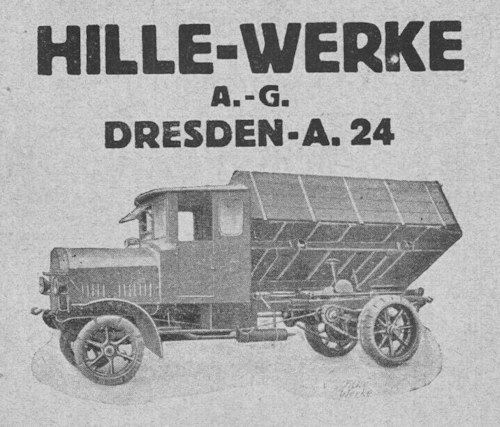
Hille-Werke AG was a German manufacturer of early engines ,automobiles and commercial vehicles .
History
The company took over from Moritz Hille founded in 1884 and in 1888 significantly expanded gas engine factory.company to April 24, 1918: Dresden gas engines factory Moritz Hille.the name was renamed Dresdner Gasmotoren factory before. Moritz Hille and the transformation into a stock corporation . in 1898 started the production of automobiles. The brand name was Hille . 1900 ended the passenger car production, for later emerged commercial vehicles . Another company was renamed on April 24, 1918 in Hille-Werke AG .
The Hille Ges. fabricated mainly trucks and the apparatus of the suction gas systems for those manufactured in the main factory naturally aspirated engines .The vehicles produced from 1898 to 1900 were 3 wheel cars . They resembled the De Dion Bouton motorcycle tricycles with 1.25 PS performance.
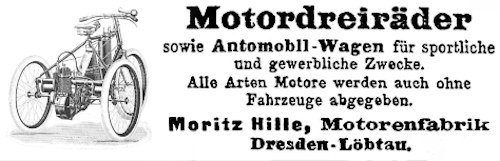
Hille presented such a motor tricycle at the motor show, which took place in Düsseldorf from 17 to 24 September 1898 . The motor has made approximately 2 PS. The vehicle weighed 80 kg. The maximum speed was specified at 40 km / h. The commercial vehicles produced starting from 1911 developed after plans of Joseph Vollmer . The payload was 2.5 to 3.5 tonnes . The monobloc engine with OHC valve control made 45 hp.
Only after the First World War department of trucks in the Chemnitzer Strasse 22. Produced was made .It started with a 3.5 tonner (35 hp), optionally with cardan Or chain drive and a 4.5 t Tracked truck (45 hp).were produced between 1924 and 1926 . The model K 3 was designed for 3 tons of payload. Its four-cylinder engine made 45 hp. The L 5 with 4.5 tons payload had a two-block engine. The vehicles were bodyworked as vans , tankers , wagons , dump trucks , furniture transporters and timber transport. From 1923 Hille improved models. The type K 3 with Cardan drive for 3 t payload had a 22/45 hp four-cylinder petrol engine.With 31/52 hp engine and chain was the type L 5 for 4 to 5 t commercialload provided. while at the 5-ton truck Delivered to special commercial vehicles
Hille built the last innovation in 1925 the K 3 a newly developed 45-PS four-cylinder block engine with removable cylinder head and camshaft also started development of a 5-ton After the end of the Second World War , the company was converted into public property and was called VEB Hille-Werke Dresden in the VVB Machine Tools and Tools (WMW). 1926 ended the commercial vehicle production.
Neander Motorfahrzeug
Vehicle manufacturer Germany from 1924 to 1954
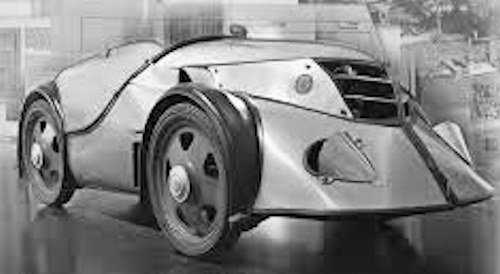
The Neander was a German enterprise, which later manufactured motorcycles and automobiles.
History
Ernst Neumann-Neander founded the company in 1924 in Euskirchen. In 1926 he moved to Düren - Rölsdorf . Production was interrupted in 1939 due to the war, and finally stopped in 1954 only about 25 cars were built.
These small cars with the essentials that today might be characterized as roadsters. In the early 1930s started the development of his Fahrmaschinen. they avoided the name “car" and called his vehicles "Fahrmaschinen”, which means driving-machines in German. The car was Just a frame fitted with rudimentary silver metal body, carrying the engine at the front and driven by the axles for three or four-wheel format. The small cars, the production was low, because of the outbreak of WWII and after the war, Neand started producing vehicles for disabled persons injured in the war. The company was pursuing the goal of creating a simple and affordable "Volkswagen" with the designs it deliberately did not want to label as an automobile but with troubled time in Germany this never happened.
