
Germany
Brutus
 |
|
|
Year: |
2006 |
|
Class : |
race car |
|
Body design : |
Roadster |
|
Engine: |
Gasoline:47.0 liters (550 kW) |
|
Empty weight: |
2537 kg |
Brutus is an experimental racing car built between 1998 and 2006 by the Auto- und Technikmuseum Sinsheim in the form of early twentieth-century cars. A BMW aeroplane engine with a capacity of 47 litres is a unique feature of this vehicle.
History
The engine was discovered by a member of the Museum Association at a junkyard in Spain, where it had resided for decades. The engine was eventually acquired by the museum via a collector in exchange for another aircraft engine from a Messerschmitt Bf 109. Originally, the engine was supposed to be just another museum component in the show. He was technically overhauled in the museum's workshop in four years for this. The actual size of the engine were unknown at first.
If one went first of "only" about 25 liters of displacement, turned out in the course of overhaul that there are probably 47 liters. The director of the museum, Hermann Layher, found it a pity to show only the engine alone in the exhibition. Therefore, he decided to install the engine in a car. A few missing parts of the engine drove the fundus at the museum. So also a suitable momentum starter, which was exhibited in a showcase of the museum and of the so far no one knew exactly what it was originally intended for.
The name "Brutus" is an allusion to Marcus Iunius Brutus , who was involved in the joint murder of Julius Caesar . Caesar was Brutus' mentor, foster father and, in a sense, his boss. Hermann Layher is convinced that the Brutus racing car is certainly the most dangerous vehicle in the world and always out to kill his driver, so his boss.
The original goal was to design a car with the Brutus, which reaches a speed of 100 km / h at a speed of 800 / min . The idle speed of the engine is 400 / min.
With the Brutus several times speeds between 120 and 140 km / h were reached, a driver accelerated the car to about 200 km / h. According to the test drivers, there are still plenty of power reserves for much higher speeds.
Historically, such a construction is quite plausible and not uncommon. After the peace treaty of Versailles, which was concluded at the end of the First World War , Germany was forbidden to build up air forces . But as many aircraft engines were available, they were often used in racing cars. For example, the Sinsheim Auto and Technik Museum will also be exhibiting a Mercedes 45 hp engine from 1907, which was fitted with a Maybach 19.5-liter engine and 220 kW (299 hp) as early as 1917 .The Brutus was presented in 2006. The construction period totaled about eight years, with four years alone accounted for the overhaul of the engine.
The drive is BMW VI - Aircraft Engine inline 8. It has a large capacity of 46,930 cm³ (47 liters) and performs short-term 750 hp (552 kW ) at 1650 / min. As a continuous output by the manufacturer BMW 550 hp (405 kW) at 1530 / min specified. The V-engine has 12 cylinders in two rows with an angle of 60 ° to each other, each with six main and Nebenpleueln . This was a popular design at the time of engine design around 1925, which made it possible to construct such a powerful engine in a relatively compact manner. Due to the differently articulated Connecting rod shows that the cylinders have four liters on the right side and 3.82 liters on the left side. The specific consumption of the engine at full load should be 215-230 g / PSh (292-313 g / kWh).
As a chassis that serves a fire hose carriage from American LaFrance from the year 1908. The motor force is transmitted through the original transmission with three gears and a chain transmission to the rear axle. Between the engine and gearbox, an intermediate gearbox was installed to adapt to the low-lying crankshaft. As a counterweight to the severe engine of several hundred liter tank is housed in the rear. The brakes work only on the rear axle. The body was in the workshop of the Auto & Technik Museum Sinsheim made in which a group of enthusiasts who are Brutus Motorwagenbau , built also the entire vehicle called. The car has no bulkhead ; The driver sits directly behind the engine, whose moving parts (for example the flywheel ) are only separated from the driver's compartment by a grille. The hot exhaust heat and any leaks of the engine, the driver is more or less exposed directly and vulnerable.The Brutus weighs 2537 kg empty.
Mia electric (2010-2014)

The mia electric GmbH in Merzig (Germany) and Cerizay (France) was responsible for the strategic alignment and marketing of the electric car Mia.
History
Mia electric GmbH was the majority shareholder of a subsidiary located in the western French town of Cerizay, which was formed in June 2010 from the electric vehicle division of the French vehicle developer Heuliez . This production plant employed about 210 people and had an annual capacity of 10,000 vehicles.
The majority of the French production company mia electric held the German mia electric GmbH. The sole shareholder of mia electric GmbH was the Saarland pharmaceutical entrepreneur Edwin Kohl ( kohlpharma ). The formerly involved Essen con | energy AG had already left at the end of 2011. 2012, the company has taken over the distribution of mia electric as general importer for Germany.
Mia (own spelling: mia) is an electrically driven micro car with three or four seats in the form of a minivan . The vehicle was produced from 2010 to 2014. The manufacturer, Mia electric , declared insolvency in 2014; In 2018, the Swiss company Fox Automotive, headquartered in Herisau, declared that it had acquired assets including trademark rights and patents in the settlement for Mia; production in Hungary was targeted for 2019.
The Mia was from 2007 by the coachbuilder Heuliez developed and manufactured as a prototype . In 2008, the car was presented at the Paris Motor Show in Paris under the name Friendly . In Germany, among other things, it was exhibited in 2009 at the first German Electromobile Congress in Bonn. As a sales promotion Heuliez offered in 2009 first buyer registrations for 10 EUR, later then pre-reservations of the vehicle for 500 EUR. Following the bankruptcy of the Heuliez electric vehicle division on July 1, 2010, of the Franco-German company electric Mia taken under the main shareholder and pharmaceuticals entrepreneur Prof. Edwin Kohl (73.4%) The design was further developed under the direction of the designer Murat Günak . In the spring of 2010, the vehicle was exhibited at several trade fairs.
Originally, the vehicle with a 6 kWh battery should cost 14,990 EUR. At the beginning of 2011, the nominal capacity of the small battery variant was specified as 8 kWh, with the option of a 12 kWh battery. For June 2011, the start of the delivery was announced by first 1,500 vehicles, this deadline was later postponed. According to information from the company, production of Mia began in June 2011 at the French plant in Cerizay, The first vehicles received factory employees for the test. From December 2011, 1,000 vehicles will be built in series production each month. The sale is initially to commercial or fleet customers, only from 2012 to be supplied to private buyers. On February 14, 2011, eleven Stadtwerke companies from Ostwestfalen announced that they intend to use Mia models for their fleets in the future. In April 2013, the mia was next to France , Germany and. a. European countries also offered in Austria . 2014, the sale was discontinued due to insolvency of the company.
A special feature of the concept is the seating arrangement, in which two or three passengers can sit behind the driver sitting in the middle. The vehicle has two sliding side doors and a tailgate. The concept includes the choice between batteries of different sizes when ordering. This should be possible later upgradable, cheapest possible basic models. So should the price of the smallest variant "pure" with an 8 kWh battery amount to about 19,500 EUR.Also, one of a hydrogen - fuel cell -powered electric drive was developed. Customers of mia vehicles complain that the vehicle electrics are prone to failure.
In June 2013, Edwin Kohl sold its 88 percent stake in Focus Asia GmbH, based in Darmstadt. Behind the latter are international investors , specifically a Sino-Korean consortium . of equity fund companies The reason given was that the number of electric cars sold had fallen short of expectations.
The minority shareholder with 12% shares remained the French region of Poitou-Charentes . On October 7, 2013, mia electric's new boss, Michele Boos, announced that the company's revenues should be increased through lower prices through "more aggressive pricing policies" and "make Mia affordable for more interested buyers." The new majority owner planned to market the electric car Mia future will be in China. In Cerizay, France, the development department and a small series production should remain.
On 12 February 2014, judicial bankruptcy protection was applied for. The company's activities were continued by the Executive Director Michelle Boos. She has been assigned a court-appointed administrator. The company should be restructured within the next six months.Mid-March 2014, the proposed restructuring plan by the competent bankruptcy court was in doubt. A thorough restructuring did not happen anymore. In the second half of September 2014, mia electric's car brand, patents and production facilities were sold to the highest bidder, a consortium, for insolvency purposes at an auction price of € 1.35 million. The consortium, which was called "Mia Génération", consisted of the company Kokam, Fulmen and Focus Asia. This sale annulled the Court of Appeals of Poitiers in May 2015. Thus, an auction was scheduled on 8 July 2015 again. This time, an initially anonymous bidder had prevailed for the price of 800,000 euros. In 2018, the Swiss company Fox Automotive, based in Herisau, declared that it had acquired assets including trademark rights and patents in the liquidation of the Mia; production was targeted for 2019 in Hungary.
- with 12 kWh battery 93 km range and 15.3 kWh / 100 km from socket with mixed test operation
- Acceleration 0-50 km / h: 8.3 s
- no ESP, allegedly also no ABS, which is doubtful, since it lists the manufacturer as standard equipment
- Mini bus concept with two side sliding doors, opening wide into the roofline, therefore convenient entry
- Central driver position with large storage compartments and pre-equipment for smartphones and tablet PCs
- optional: MP3 radio with USB connection and Bluetooth
- Central locking with remote control
- frameless rear window, at the same time tailgate
Model Variants
In addition to the basic models, various special models and design variations are offered. So the miAmore upgraded by orange 16-inch rims and color elements. With the design solution "Cadabra" you can combine 480 color variants yourself.
Mia
- Curb weight incl. 8 kWh battery: 765 kg and with 12 kWh battery: 815 kg
- Length: 2.87 m
- Width: 1.64 m
- Height: 1.55 m
- Loading volume: 260 l
- Seats: 3, rear seats expandable
- Payload (depending on the battery 8 or 12 kWh): 320-370 kg
Mia L.
- Curb weight incl. 8 kWh battery: 786 kg and with 12 kWh battery: 836 kg
- Length 3.19 m
- Width: 1.64 m
- Height: 1.55 m
- Loading volume: 420 l / 998 l with the seat folded down
- Seats: 4, rear seats foldable
- Payload (depending on the battery 8 or 12 kWh): 285-335 kg
Mia K
- Curb weight incl. 8 kWh battery: 765 kg and with 12 kWh battery: 815 kg
- Length: 3.19 m
- Width: 1.64 m
- Height: 1.55 m
- Loading volume: 1500 l
- Seats: 1 (possibility of installing an additional seat)
- Payload (depending on the battery 8 or 12 kWh): 310-360 kg
The special model mia K "BLUE STAR" is essentially in line with the Mia K model, but with some extra extras in its features, including a roof rack, a fuel-efficient power heater, PVC floor mats, a multimedia radio, and a different color from the base model Mia K contrasting body colors.
Mannesmann Automobile Plant KG
Vehicle manufacturer Remscheid Germany from 1910 to 1929

The Mannesmann automotive KG was founded in 1919 by brothers Alfred and Carl also Reinhard Mannesmann in Remscheid as Mannesmann Motor Werke GmbH . They had been operating the automobile company Mannesmann-MULAG in Aachen since 1910, although the company had specialized primarily in the development of trucks and buses.
History
They produced passenger cars of the upper luxury class and for racing purposes.Parallel to this, Carl Mannesmann and his brother.
The Mannesmann Motor Werke GmbH emerged from the Mannesmann light Werke AG , which before the First World War produced with about 4,000 employees gas and Hängeglühlichter and served with about 2,000 employees as arms and munitions factory during the war under Carl Mannesmann as director. After the war, the production of freezers and motorized plows began, but soon after the repair of war damaged trucks and their conversion for civilian use. Soon after, the brothers also dealt with the development of automobiles and traded from 1919 as Mannesmann Motorenwerke GmbH . In 1923, the Remscheider factory finally became Mannesmann Automobil-Werk KGrenamed and produced four-cylinder passenger cars of the lower middle class . By 1928, around 2000 vehicles were built here.
The reliability of the vehicles could be proven with damage-free Alpine crossings on hot days. In addition, converted vehicles also took part in the Eifel Race at Nideggen, where they won the German Tourist Trophy in 1925, 1926 and 1927 .
From 1928, they relocated to the production of eight-cylinder luxury vehicles. After just one year and about 200 copies, the company was insolvent in August 1929. The last model, the Type 8 Mb Model 100, had a Rickenbacker engine supplied by DKW .
In 1930, a few vehicles from existing individual parts were created in a rescue company.
Hataz Automotive manufacturer
Zwickau ,Germany from 1921 to 1925
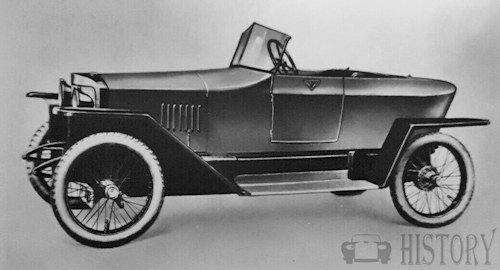
The Hataz automobile factory Hans Tautenhahn in Zwickau manufactured small cars under the brand name Hataz from 1921 to 1925 .
History
Hataz built from 1921 to 1925 an open sports two-seater with tandem seats, which was already sold very well in the first year of production and had many sporting successes. Hans Tautenhahn, owner and avid racing driver, built two Hataz racing cars in 1922, achieving great racing success in his class. The Hataz cars were always in the front row in their class. The single-seater had an external gear shift, handbrake and forged axles. The four-cylinder Steudel (Kamenz) block engine 4/18 hp had 972 cc capacity, double ignition, 60 mm bore, 92 mm stroke, 2200 / min, 790x90 Wulstreifen , a gross vehicle weight of 700 kg and a top speed of 80 km / h. There is only one copy of this rare racing car from the private collection of Tautenhahn. The second race car was totally destroyed in 1926 in a race accident.
The Car had a four-cylinder 4/12-horsepower Steudel block engine. Due to the relative to other cars large gauge this vehicle of the lowest tax class had a very good road holding. Later, the displacement was increased and now there were even 14-horsepower engines. Despite the extremely large small car competition, especially in Saxony, the factory increased its production capacity in 1923 in order to satisfy the strong demand for the sports two, three and four-seater. In 1925, they even presented a Hataz with an 18-horsepower engine at the Leipzig fair .However, the factory in 1925 had to stop production and was taken over by Horch Zwickau.
- Engine: Four-cylinder four-stroke engine, make H. Steudel. Kamenz bore / stroke 60/92 mm. Cubic capacity 972
- Power transmission:Power 12 HP at 2200 rpm, SV. Pressure circulation lubrication. Multi-disc clutch, locked gear transmission, 3/1 gears, clutch cardan drive.Magnetic fuel lighting, light and starter system 6 V.
- Construction: wheelbase 2600 mm. Sheet steel frame, semi-elliptical springs, outer belt transmission and Internal shoe brakes, worm steering, Rudge wire spoke wheels, tires 710 X 100,
- Top speed: 75 km / h.
Nacke (Automobile Factory E. Nacke)
Automotive manufacturer Kötitz , Germany

The automobile factory E. Nacke was a German manufacturer of automobiles and commercial vehicles from Kötitz near Coswig .
History
Emil Nacke was owner of the "Maschinenfabrik E. Nacke" in Kötitz since 1891 for the production of machines for the paper industry .
There was no great interest in the newly developing automobile industry. From his visit to the Paris Motor Show he brought a two-seater from the French brand Panhard & Levassor . As a result, a department for automobile construction was set up in the machine factory, and in 1900 the first Saxon passenger car was completed. It was a two-seater with 2-cylinder gasoline engine of 8-10 hp with chain transmission and a top speed of 30-35 km / h. Nacke named his first automobiles after the then neighboring municipality of the production site Coswiga . Just one year later, this car was on the automobile exhibition in Berlindisplayed. Production in 1901 consisted of four different types of cars, and in the 1910 prospectus the program already includes seven different types of passenger cars.
In 1902, Nacke invented the principle of the inner shoe brake . In order to prove the safety and reliability of the passenger cars, there were several Europe-wide competing rides. Particularly well known were the three Herkomer competitions (1905-1907) and the Prince Heinrich rides from 1908. The automobile factory E. H. Nacke not only participated in it, but also successfully won plaques. This shows their rank among the former car manufacturers. At the age of 63, Nacke himself drove the Herkomer Ride 1907. For further races he was able to win well-known racing drivers like Alexander Graumüller .
Particularly important was the reliability of the vehicles, such as the Nacke Double-Phaeton 35 HP. 1908 received the car of the Emperor Menelik II of Abyssinia (now Ethiopia ) as a gift from a German businessman. As can be seen in the brochure, it had to be overcome on the way there rather impassable routes. At the same time, a British expedition with the same destination was traveling in Ethiopia. The Siddeley 18 HP car did not fare so well. Therefore, Menelik II decided for the German vehicle, which was delivered in 1913 to the Ethiopian Kaiserhof. At this time Emil Hermann Nacke already belonged to the board of the Association of German motor vehicle industrialists, Despite his good reputation, Nacke was unable to gain a foothold in the field of passenger cars. The car production was therefore discontinued in 1913.
The truck and bus manufacturing
As early as 1905, truck construction was added to the car construction. Buses, municipal vehicles, fire brigades and motorized fire engines were also manufactured in the Automotive Division , and the production of the machinery factory was maintained. It served as a solid financial pillar against the rather as " hobby " operated motor vehicle construction.
A special gem from Coswig was built in 1906 for the Saxon king ten-seat Jagdomnibus. This bus was ordered by the royal Oberstallamt of the Dresdner Hof. The bodywork was supplied by the Dresden luxury car manufacturer H. Gläser . In the bodyshops associated with their own factory, other well-known bodywork factories also produced superstructures for the Nacke buses and trucks.
It is also noteworthy that Nacke set up its own omnibus lines. The Nacke bus for 12 people with 40-horsepower engine ran in 1912 on the route Königstein - Swiss mill in Saxony, where he took over the successor to the 1904 set Bielatalbahn . So there was 1912 the first scheduled trial operation on the route Meissen - Brockwitz - Weinböhla, which was finally taken over in 1913 by the Saxon Railway Administration. Used were two Nacke buses, equipped with the developed in the machine factory Pekrun in Coswig, novel screw drive , a mountain supportmade superfluous; the bodies were built by the company Schumann in Zwickau. It followed on 12 July 1912, the power bus line Tharandt - health resort Hartha , which replaced a 1900 established horse bus line and after several times changing ownership today still as line 345 of regional transport Dresden (RVD) in operation.
During the First World War, Nacke supplied the imperial army with a large number of 4-ton trucks. Chain drive was required for these subsidy trucks .
In the post-war period, the company strengthened the construction of commercial vehicles. Many famous Dresden factories, breweries and freight forwarders bought their vehicles from Nacke. Examples are Feldschlößchen , Felsenkeller and Universelle . But also in Calcutta, Porto and London used Coswig. The 1926 model range included 2.5-, 3.5- and 5-ton truck chassis with their own gasoline engines and several body variants. Among other things, Nacke produced fire trucks, timber transporters, dump trucks, brewery vehicles and buses and sold its trucks worldwide.
In 1929, the global economic crisis and obsolete production methods became noticeable in the company, which at that time had 250 employees, and in 1930 commercial vehicle production had to be discontinued. After that, Naked's sister Clara and her son Reinhold Toller continued the machine factory. In 1945, the company was placed under trusteeship and almost completely dismantled. With the acquisition in public property extinguished in 1948 the company name Maschinenfabrik E. Nacke in the commercial register .
