Germany
Freia Automobil AG
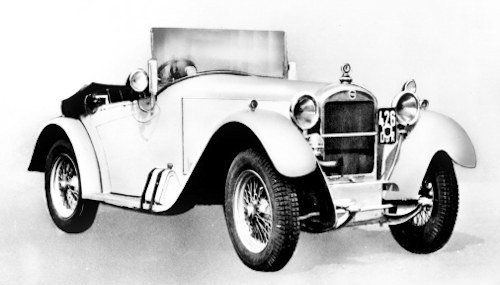
The Freia Automobile AG was a German car manufacturer, in the 1920s from Greiz, Germany. Between 1922 and 1927.
History
Under the direction of Arthur Schuh . In 1920, the construction of a small car with a two-cylinder two - stroke engine was started. This was used only as a test vehicle. From 1921 Arthur Schuh took over the technical management and developed until 1922 a new small car, which came under the brand name Freia as type S 5 on the market, the first a side - drive four - cylinder inline engine with 1.3 l displacement. The crankshaft was roller bearing and the engine made 14 hp. Striking was the Underslung frame, which gave the car a low centre of gravity and thus a safe road holding.1923 was renamed Freia automobile AG. In the same year, the type S 23 appeared with a 1.3 l four-cylinder engine of about 25 hp at 2500 / min. The valves suspended in the non-removable cylinder head were actuated by an overhead camshaft driven by a kingpin. In 1925, the camshaft drive was changed and used for the first time in Germany, a chain drive. The crankshaft was guided in two ball bearings.
From 1926, the type S 24 was built with a larger engine. This had 1460 cc capacity and made 30 hp, as a competition vehicle 45 hp. From the S 24 only a few vehicles were built. For sports events, the engines were higher compressed (7.5: 1) and provided with a special camshaft. These engines reached around 35 hp and were installed in Freia sports cars with aluminium body and rear end, which reached a top speed of 135 km / h.]
For economic reasons, the production of the Freia had to be discontinued in 1927. Arthur Schuh joined Rasmussen's DKW Group and became technical director of Audi in Zwickau.
Heylandt Gesellschaft für Apparatebau (Heylandt-Werke)
Automotive manufacturer Berlin-Mariendorf Germany from 1921 to 1931

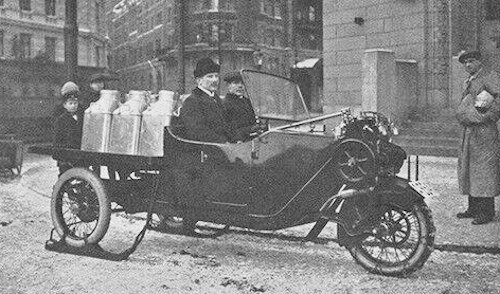
The Heylandt Society for Apparatus mbH was a German manufacturer of oxygen generation systems and vessels for liquid gases. After the First World War , the company also temporarily produced electrically powered trucks.
History
Company founder and namesake was Paul Heylandt,inspired by the experiments of Carl Linde , while working as a mechanic with the liquefaction of oxygen .After two short-lived start-ups in Hanover and Hamburg Paul Heylandt took over in 1919 the company for apparatus engineering AR Ahrendt & Co mbH, in which he was previously involved as a partner and their seat on Burggrafenstraße in Berlin- Mariendorf . Heylandt Gesellschaft für Apparatebau supplied liquid oxygen and produced equipment for the production of nitrogen and oxygen .
Around 1921, Heylandt built electrically powered five-ton lorries. In the 1920s, Heylandt became a leader in tank construction for liquid gases and produced systems for liquefying oxygen under high pressure. In 1929, the expanding company moved its business to Berlin-Britz , Gradestraße 91-107, where previously the opto-mechanical institution CF Voth & Co. had its headquarters. With the participation of Heylandt, the public limited company for industrial gas utilization was founded here around 1931 as a group company.
At the beginning of 1930, the rocket scientist Max Valier was given the opportunity to develop a liquid rocket engine at Heylandt in Britz. He was assisted by the Heylandt development engineers Alfons Pietsch , Walter Riedel and Arthur Rudolph , who built the rocket motor in a test vehicle called "hellhound" after Valier's accidental death and thus successfully carried out test rides at the Tempelhofer Feld in early May 1931 .
In October 1931, Heylandt began a collaboration with the army testing station, at the beginning of 1932 a liquid rocket engine was created, which was used there until about 1937 for testing purposes.
Elite-Werke AG
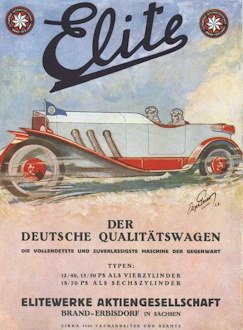
The Elite-Werke AG was a German manufacturer of automobiles from Brand-Erbisdorf, Germany from 1913-1929 under the name Elite.
History
Founded in 1904 in Berlin. Gradually, the production of parts for the automotive industry and marine engines was relocated to the new location. Georg Günther, another entrepreneur from the young automobile industry and founder of the Chemnitz Presto-Werke, took over together with Jørgen Skafte Rasmussen 1913 Emile Lueders Maschinenfabrikand thus continued the company started by Luders in Brand-Erbisdorf starting in February 1914 as Elite-Motoren-Werke AG. The contract saw the construction of motor vehicles and bicycles, as well as engines, including machinery and equipment z. B. for the construction of motor vehicles.
1928 Opel acquired the majority of shares and produced in the factory Opel motorcycles. In 1929, Opel retired from the company. That was the end of Elite-Werke AG. In total, over 16 years about 3000 passenger cars and 1000 trucks were produced.
Kayser Primus
Automotive manufacturer Kaiserslautern Germany from 1900 to 1903

Pfälzische Nähmaschinen und Fahrradfabrik Former Gebrüder Kayser AG (sewing machines and bicycle factory) was an early German manufacturer of automobiles. The brand name was initially Kayser then Primus.
History
The company from Kaiserslautern began with sewing machines and had a Bicycle factory in 1890.By 1899 with the production of automobiles. From 1902 Primus. The company introduced in 1901 on a motor show in Frankfurt and in March 1903 on the German Automobile Exhibition in Berlin.
The four-wheeled model under this brand name was the model, Primus. This was a small car. For the drive provided a single-cylinder engine with 5 hp, which was mounted lying in front of the vehicle. The vehicle had thermosiphon cooling, electric ignition, a three-speed gearbox and chain drive. The open body could accommodate two people. In addition, 3-wheel motor tricycles were created. The previous model was offered from 1902 under the brand Primus and the model’s name Doctor Car. As for the engine, there was no difference. It followed a model with two-cylinder engine and one with four-cylinder engine.
By 1903 ended the automobile production.
Phänomobil (Phänomen-Werke)
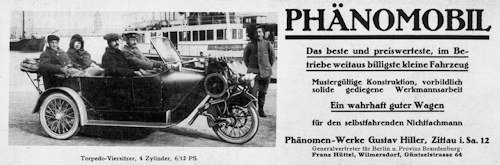
Phänomen-Werke was an early small Vehicle manufacturer from Germany from 1907 to 1927
History
Phänomobil was manufactured by the Phänomen-Werke in the German town of Zittau in the state of Saxony.
Various models were available as passenger cars as well as delivery vans. The Netherlands company Baakman in Assen , which also distributed the cars. Later In 1927 the firm switched to producing lorries called the Granit. The cars were extremely successful with a number of thousand being produced between 1907 and 1927
The Phänomobil 4/6 hp was a 3-wheel car, the Phenomenon brought as the first car model in 1907 on the market by the Zittau motorcycle manufacturer.This had a 2-cylinder SV -V engine with 0.9 litres of displacement, the 6-7 hp (1910: 9 hp) made and his power via a 2-speed planetary gear to the single front wheel on which he was built, passed through a chain. The car had a steel tube frame and a rear rigid axle, which was hung on C-springs, later on semi-elliptic leaf springs. The front fork had encapsulated coil springs. The foot brake acted on the rear wheels as an outer band brake. Open two-seaters and wheelbarrows were produced.
In 1912, a four-seater replaced this first vehicle this was equipped with a similar concept with a 4-cylinder SV- series engine, which developed from 1.55 litres displacement 12 hp. The outside band brake had been replaced by a normal drum brake. The tubular frame had given way to a sheet steel frame that was pulled up and tapered to accommodate the front fork.
The light van. had an air-cooled, four-cylinder, 1.5-litre engine used for delivery’s, later almost without modifications, this car was replaced in 1920 by the type V phenom, which was manufactured until 1927, also as a taxi.
After the end of production, the phenomenon plants turned to the production of commercial vehicles as Granit.