
Vehicle Body
- Details
- Parent Category: Tech Guide
- Category: Vehicle Body
- Hits: 144
Vehicle Body Parts Terms & Meanings
(English & American)

0-9
- 1-box form
- A categorization based on overall form design using rough rectangle volumes. In the case of the 1-box, it is a single continuous volume. Slight wedge formed front or rear are still generally placed in this category. e.g., Bus, original Ford Econoline. The equivalent French term is volume, which you will sometimes see used by the British: "1-volume form".
- 2-box form
- A categorization based on overall form design using rough rectangle volumes. In the case of the 2-box form, there is usually a "box" representing a separate volume from the a-pillar forward and second box making up the rest. e.g., Station Wagon, Shooting-brake, Scion xB(2006) The equivalent French term is volume, which you will sometimes see used by the British: "2-volume form".
- 3-box form
- A categorization based on overall form design using rough rectangle volumes. In the case of the 3-box form, there is a "box" delineating a separate volume from the a-pillar forward, a second box comprising the passenger volume, and third box comprising the trunk area — e.g., a Sedan. The equivalent French term is volume, which you will sometimes see used by the British: "3-volume form".
A
- A-line
- The line running over the car, from headlight to taillight, tracing the car's silhouette.
- Axis-to-dash ratio
- The critical relationship between front wheels and the windshield. The most notable differences can be seen between cars with front-engine, front-wheel drive layout and front mid-engine, rear-wheel drive layout: the former tend to have longer front overhangs with a smaller axis-to-dash ratios, while the latter have shorter front overhangs with much greater axis-to-dash ratios.
B
- Backlight
- The rear glass window glass.
- Beltline
- The line going from the hood which usually follows the bottom edge of the windows and continues to the trunk.
- Bling
- (contemporary) See brightwork. May also refer to the strong use of jeweled lighting. Comes from the term bling-bling.
- Bonnet
- The hood of the vehicle.
- Boot
- The trunk or liftgate of the vehicle.
- Brightwork
- Anything reflective added to a car to enhance appearance. May also be called chrome.
C
- Cab
- Short for cabin. The enclosed compartment of a vehicle which contains the driver and passengers.
- Cab back
- The cab of the vehicle is moved to the rear of the vehicle. Cars such as a 1970's Corvette could be considered cab back design.
- Cab forward
- The cab of the vehicle is pushed forward. This design aesthetic was popular with Chrysler in the 1990s with the introduction of their LH platform cars.
- Character line
- A line creased into the side of a car to give it visual interest. (interchangeable with swage line) Sometimes implemented by a rubbing strip.
- Chrome
- Brightwork using chrome plating.
- Cladding
- Material (usually plastic) added to exterior of the car which isn't structurally necessary. May be functional to keep out dirt/debris as in underbody cladding, or may be cosmetic.
- Control Panel
- Generally used in a Car/Truck for heating and cooling inside car environment according to the passenger requirements. Basically it is divided in to Different modes, Blower speed functions, AC, Temperature, Fresh recirculation of air. World wide control panel manufacturers are BHTC, Delphi, Visteon, Valeo, etc.
- Cowl
- The base of the windshield.
D
- Daylight Opening (DLO)
- US DOT Term: For openings on the side of the vehicle, other than a door opening, the locus of all points where a horizontal line, perpendicular to the vehicle longitudinal centerline, is tangent to the periphery of the opening.
- US DOT Term: For openings on the front and rear of the vehicle, other than a door opening, daylight opening means the locus of all points where a horizontal line, parallel to the vehicle longitudinal centerline is tangent to the periphery of the opening.
- Dead Cat Hole
- The space between a car's tire and the wheel well. Currently there is a trend towards smaller dead cat holes.
- Deck
- The horizontal surface at the rear of the car, which usually serves as the trunk lid.
- Down Road Graphic
- The styling of the front end of the car, which people will instantly recognize and associate with a manufacturer. For example, the grille, lights and sometimes the DLO.
- Droptop
- A convertible.
F
- Fascia
- The body-skin panel at the front of the car.
- Fender (wings, UK)
- Term for cowl covering the wheels of the vehicles. In more modern automobiles, this refers generally to the body panel or panels starting at the front "bumper" to the first door line excluding the engine hood. The opposite of the fender is the "quarter panel".
- Frame-on-rail
- A design used in older (pre-unibody) cars, trucks, and SUVs. The power train and body are mounted to a rigid structural framework called a rail.
G
- Gill
- A vent on the side of the fender that can be used as hot-air outlet, but usually decorative.
- Greenhouse
- The glassed-in upper section of the car's body. Daylight Opening (DLO) in turn describes the actual window areas only.
H
- Hardtop
- a coupe or sedan lacking a center window post between the front windshield post and the rearmost window post or body section.
- Header
- (1) The structural roof beam above the windshield. The section of exhaust piping attached to the cylinder head.
- Hofmeister kink
- BMW's trademark reverse-sweep kick at the bottom of last roof pillar.
- H-point (or HP (Hip Point)
- the pivot point between the torso and upper leg portions of the body, either relative to the floor of the vehicle[1] or relative to the height above pavement level, as used in vehicle design.
- Hood (Bonnet in English speaking countries outside North America with the exception of the Canadian Maritimes)
- The engine cover on vehicles when the engine is located forward or aft of the passenger compartment.
I
- IP
- Instrument Panel. The Dashboard is termed as Instrument Panel in Automotive Industries, sometimes this term is confused with the Instrument Cluster that is the group of speedometer, odometer and similar devices generally behind the steering wheel.
N
- NACA duct
- A distinctively shaped inlet that is flush and begins with a narrow, shallow inset and becomes progressively wider and deeper.
O
- Overhang
- The distance which the car's body extends beyond the wheelbase at the front (front overhang) and rear (rear overhang). In car style design terms, this is the amount of body that is beyond the wheels or wheel arches.
P
- Phaeton
- An open vehicle, usually with 4 doors, with a removable and/or retractable cloth top and a windshield characterized by the lack of integrated glass side windows. Contemporary uses of this name do not always follow this original description or apply to an open vehicle.
- Pillar
- A structural member that connects the roof to the body of the car. Pillars are usually notated from front to back alphabetically (e.g. A-pillar joins the windshield to the frontmost side windows, B-pillar is next to the front occupants' heads, etc.).
- US DOT Term: Means any structure, excluding glazing and the vertical portion of door window frames, but including accompanying molding, attached components such as safety belt anchorages and coat hooks, that supports either a roof or any other structure (such as a roll-bar) above the driver's head or (2) is located along a side edge of a window.
- Plenum
- The area at the base of the windshield where the wipers are parked. Also refers to the main chamber in an intake manifold.
- Ponton styling
- a 1930s–1960s design genre when distinct running boards and fully articulated fenders became less common and bodywork began to enclose the full width and uninterrupted length of a car in a markedly bulbous, slab-sided fashion.
- Plug-in hybrid electric vehicle
- A hybrid vehicle that can be plugged into the electric grid to recharge its battery to reduce gasoline usage.
- Powertrain
- All the components that generate power and deliver it to the tires.
Q
- Quarter-panel
- (or rear quarter panel) refers to the panel at the back sides starting at the rear edge of the rearmost doors, bordered by at top by the trunk (boot) lid and at bottom by the rear wheel arches ending at the rear bumper. This is the opposite of the fender.
- Literally, the term originally referred to the rear quarter or the car's length.
R
- Rake
- The tilt of a windshield. An extremely low or flat rake angle is considered to be "fast", as in fastback. Note that a "steeply raked" windscreen is close to horizontal.
- Roadster
- An open vehicle, usually with 2 doors, with a removable and/or retractable cloth top and a windshield characterized by the lack of integrated glass side windows. Contemporary uses of this name do not always follow this original description.
- Rocker
- The body section below the base of the door openings sometimes called the "rocker panels", or "sills".
- Rocker Rail
- Body armor protecting the Rocker, found mostly in off road vehicles. Term coined by engineers at MetalCloak.
- Rubbing Strip
- Plastic/rubber line or moulding to prevent side-swiping along the doors.
S
- Scoop
- Inset or protusion that implies the intake of air. May be functional for cooling/ventilation or purely ornamental. Also Shaker scoop.
- Scowling headlamps
- Headlamps styled along a V-shape as viewed from the front, giving the impression of a scowl.
- Shooting-brake
- Once a vehicle designed to carry hunters and sportsmen; now a station wagon or vehicle combining features of a station wagon and a coupe.
- Shoulder line
- The line or "shoulder" formed by the meeting of top and side surfaces extending from hood/fender shoulder to boot-lid/quarter-panel shoulder. The strongest example of this feature can be found on more modern of Volvo Cars.
- Sill
- The body section below the base of the door openings sometimes called the "rocker panels", or "rockers".
- Sill line
- Imaginary line drawn following the bottom edge of the greenhouse glass.
- Six line
- A line extending from the C-pillar down and around the rear wheel well.
- Softtop
- a convertible top which is made out of flexible materials like PVC or textile.
- Spats
- side covers for wheel arches, hiding the wheel - usually rear only. Also called Fender skirts.
- Spoiler
- A raised lip or wing which is used to 'spoil' unfavorable air movement across the body. Some designs are more functional than others.
- Staggered wheel fitment
- The front and rear wheels are different widths. On sporty rear wheel drive cars, the rear tires are usually wider than the front.
- Strake
- Crease in the sheet metal intended as a "speed line" styling feature. Exemplified in the doors of the Ferrari Testarossa.
- Suicide door
- rear-hinged type, opening from the front of the car. If accidentally opened while driving at a high speed, doors would be blown backward.
- Swage line
- Crease or curvature in the side of the body used to create visual distinction. Sometimes the crease is functional and improves rigidity of the outer body (interchangeable with character line).
T
- Track
- The distance across the car between the base of the left and right wheels. (Like wheelbase, but side to side.)
- Truck
- A typically large vehicle built using frame-on-rail construction consisting of a cab and a separate bed for cargo.
- Trunk
- (Boot in UK) Compartment for storage of cargo which is separate from the cab.
- Tube Fender
- Replacement fenders found on off road vehicles designed as part of body armor for off road vehicles. Used to protect the thin sheet metal bodies from damage while off-roading.
- Tumblehome (tumble home)
- Generally refers to the way the sides of a car rounds inward toward the roof, specifically of the greenhouse above the beltline. This term is borrowed from nautical description of naval vessels.
- Turn under
- The shape of the rocker panel as it curves inward at the lower edge.
V
- Valvetrain
- The mechanisms and parts which control the operation of the valves.
W
- Wedge
- Shape of the car as seen in the side profile. May be positive, negative or neutral. If the front is lower than the rear, then it is wedge-positive. If the rear is lower it is wedge-negative. If the car appears level from front to rear, then it is wedge neutral.
- Wheel arch
- The visible opening in the side of a car allowing access to the wheel.
- Wheelbase
- The distance front to back measured from where the front and rear wheels meet the ground.
- Wheel well (or bucket)
- The enclosure or space for the wheel.
- Windshield Trim
- US DOT Term: Molding of any material between the windshield glazing and the exterior roof surface, including material that covers a part of either the windshield glazing or exterior roof surface.
- Wings
- See Fender.
- Details
- Parent Category: Tech Guide
- Category: Vehicle Body
- Hits: 117
Car semaphore signals (Trafficators) explained
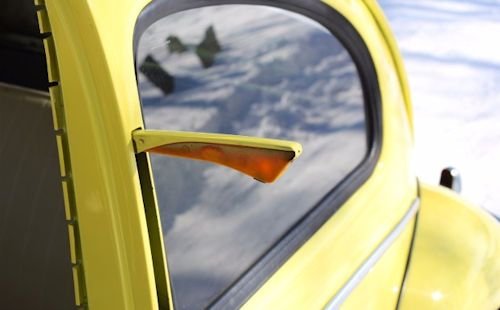
Trafficators are semaphore signals which, when operated, protrude from the bodywork of a motor vehicle to indicate its intention to turn in the direction indicated by the pointing signal. Trafficators are often located at the door pillar.
History
They first appeared in the 1900s, when they were actuated either mechanically or pneumatically. In 1908 Alfredo Barrachini in Rome had added electric lights inside the arms, that turned on as they extended, but operation was still by a cable system. Electric operation came in 1918 when the Naillik Motor Signal Company of Boston added electric motor drive. This system was superseded by two French inventors, Gustave Deneef and Maurice Boisson, who used a linear solenoid in 1923. The final complete system came in 1927 when Berlin-based Max Ruhl and Ernst Neuman combined internal illumination and solenoid operation.
The shape of the Trafficator arm is closely based upon the shape of the semaphore signal arm used by the Royal Bavarian Railway beginning in 1890. The only difference from the railway arm is that it is halved down its length so as to fit flush with the vehicle's exterior.
They were common on vehicles until the introduction of the flashing amber, red or white indicators at or near the corners of the vehicle (and often along the sides as well). They have been increasingly rare since the 1950s, as ever-tightening legislation has prescribed the need for the modern type of flashing signal. Many historic vehicles that are used on today's roads have had their trafficators supplemented or replaced with modern indicators to aid visibility and to meet legislative requirements.
Turn indicator stalk
The turn indicator stalk or turn signal lever is the control lever which operates the turn signal or indicator lights on the front, sides and rear of the vehicle. It is usually operated by lifting or lowering the lever, the direction being commensurate with the clockwise or anticlockwise direction in which the steering wheel is about to be turned.
In left hand drive vehicles, the turn indicator stalks are located on the left of the steering column.
In right-hand-drive (RHD) motor vehicles, the indicator stalk is located on either the left or right of the steering column, depending on the manufacturer. European RHD cars generally have the stalk on the left (often using the same component as LHD cars), while Asia-Pacific RHD cars generally have the stalk on the right (mirroring the configuration of a LHD vehicle). Some manufacturers such as Subaru still have variations in the model lineup as to where the turn indicator stalk is located.
Innovations
Many other functions have been added to the turn signal stalk. Frequently headlamps and high beam controls are integrated into the turn signal control, the former requiring either a twisting motion or the use of a small switch, and the latter requiring movement of the control fore and aft.
Many modern cars have a "one-touch" feature on their stalks. This is primarily based on (motorway) lane-switching, where a single flick of the indicator will cause it to flash between two and six times.
Some cars have forgone the traditional stalk-mounted indicators for either a switch (as used on a motorcycle) or a button. Examples are the Caterham 7 and the Ferrari 458.
- Details
- Parent Category: Tech Guide
- Category: Vehicle Body
- Hits: 148
Space frame chassis

Spaceframes are sometimes used in the chassis designs of automobiles and motorcycles. In both a spaceframe and a tube-frame chassis, the suspension, engine, and body panels are attached to a skeletal frame of tubes, and the body panels have little or no structural function. By contrast, in a unibody or monocoque design, the body serves as part of the structure.
Tube-frame chassis pre-date spaceframe chassis and are a development of the earlier ladder chassis. The advantage of using tubes rather than the previous open channel sections is that they resist torsional forces better. Some tube chassis were little more than a ladder chassis made with two large diameter tubes, or even a single tube as a backbone chassis. Although many tubular chassis developed additional tubes and were even described as "spaceframes", their design was rarely correctly stressed as a spaceframe and they behaved mechanically as a tube ladder chassis, with additional brackets to support the attached components, suspension, engine etc. The distinction of the true spaceframe is that all the forces in each strut are either tensile or compression, never bending. Although these additional tubes did carry some extra load, they were rarely diagonalised into a rigid spaceframe.
The first true spaceframe chassis were produced in the 1930s by designers such as Buckminster Fuller and William Stout (the Dymaxion and the Stout Scarab) who understood the theory of the true spaceframe from either architecture or aircraft design.
The first racing car to attempt a spaceframe was the Cisitalia D46 of 1946.This used two small diameter tubes along each side, but they were spaced apart by vertical smaller tubes, and so were not diagonalised in any plane. A year later, Porsche designed their Type 360 for Cisitalia. As this included diagonal tubes, it can be considered the first true spaceframe.
The Maserati Tipo 61 of 1959 (Birdcage) is often thought of as the first but in 1949 Dr. Robert Eberan-Eberhorst designed the Jowett Jupiter exhibited at the London Motor Show in 1949 and taking a class win at the 1950 Le Mans 24hr. Later the small British car manufacturers developed the concept TVR produced an alloy-bodied two seater on a multi tubular chassis, which appeared in 1949.
Colin Chapman of Lotus introduced his first 'production' car, the Mark VI, in 1952. This was influenced by the Jaguar C-Type chassis, another with four tubes of two different diameters, separated by narrower tubes. Chapman reduced the main tube diameter for the lighter Lotus, but did not reduce the minor tubes any further, possibly because he considered that this would appear flimsy to buyers. Although widely described as a spaceframe, Lotus did not build a true spaceframe chassis until the Mark VIII, with the influence of other designers, with experience from the aircraft industry.
Other notable examples of tube-frame cars include the, Audi R8, Ferrari 360, Lamborghini Gallardo, and Mercedes-Benz SLS AMG.
A drawback of the spaceframe chassis is that it encloses much of the working volume of the car and can make access for both the driver and to the engine difficult. Some spaceframes have been designed with removable sections, joined by bolted pin joints. Such a structure had already been used around the engine of the Lotus Mark III. Although somewhat inconvenient, an advantage of the spaceframe is that the same lack of bending forces in the tubes that allow it to be modelled as a pin-jointed structure also means that such a removable section need not reduce the strength of the assembled frame.
Audi R8 Spaceframe

- Details
- Parent Category: Tech Guide
- Category: Vehicle Body
- Hits: 66
Car Subframe explained

A subframe is a structural component of a vehicle, such as an automobile or an aircraft, that uses a discrete, separate structure within a larger body-on-frame or unit body to carry certain components, such as the engine, drivetrain, or suspension. The subframe is bolted and/or welded to the vehicle. When bolted, it is sometimes equipped with rubber bushings or springs to dampen vibration.
The principal purposes of using a subframe are, to spread high chassis loads over a wide area of relatively thin sheet metal of a monocoque body shell, and to isolate vibration and harshness from the rest of the body. For example, in an automobile with its powertrain contained in a subframe, forces generated by the engine and transmission can be damped enough that they will not disturb passengers. As a natural development from a car with a full chassis, separate front and rear subframes are used in modern vehicles to reduce the overall weight and cost. In addition a subframe yields benefits to production in that subassemblies can be made which can be introduced to the main bodyshell when required on an automated line.
There are generally three basic forms of the subframe.
- A simple "axle" type which usually carries the lower control arms and steering rack.
- A perimeter frame which carries the above components but in addition supports the engine.
- A perimeter frame which carries the above components but in addition supports the engine, transmission and possibly full suspension. (As used on front wheel drive cars)
A subframe is usually made of pressed steel panels that are much thicker than bodyshell panels, which are welded or spot welded together. The use of Hydroformed tubes may also be used.
The revolutionary monocoque transverse engined front wheel drive 1959 Austin Mini, that set the template for modern front wheel drive cars, used front and rear subframes to provide accurate road wheel control while using a stiff lightweight body. The 1961 Jaguar E-type or XKE used a tubular spaceframe type front subframe to mount the engine gearbox and long bonnet / hood, to a monocoque 'tub' passenger compartment. The sub frame saw regular production in the 60's and 70's General Motors X and F cars.
Subframe are also prone to misalignment.espcially at the spot were it is bolted to the chassis.which can cause vibration,alignment issues on the suspension and steering components.misalignment is cause by the mounting bolts inherent space between the bolt and the mounting hole.which overtime tends to move
