
Vehicle Body
- Details
- Parent Category: Tech Guide
- Category: Vehicle Body
- Hits: 52
The Motor Car Early Beginnings Steam

Although there were probably earlier attempts at designing a self-propelled vehicle, the first successful design of which there is a record, was in 1769. This was a steam cart, designed to haul field artillery, the work of a French army officer, Nicolas Cugnot. It consisted of a three-wheeled cart with a large bowl-shaped boiler at the front, connected to the front
wheel and cylinders by rods.
In 1784, William Murdock built a model steam carriage driven by a beam engine connected by a rod to a cranked axle between the wheels. He did not, however, continue with his experiments but turned his energies towards railway engines. In 1787, a licence for a steam wagon was granted to Oliver Evans, an American living in Pennsylvania. He also produced an amphibious steam powered dredger in 1805. Another steam engineer, Richard Trevithick, built a steam car in 1802, which could carry eight people. It was accidentally
destroyed by fire and owing to lack of money Trevithick was unable to continue with his inventions. This steam coach ran between the City of London and Paddington. Walter Hancock's team of steam coaches ran regularly for several months during 1834 The three-wheeled beam engine built by William Murdock in 1784 was not designed to carry passengers.
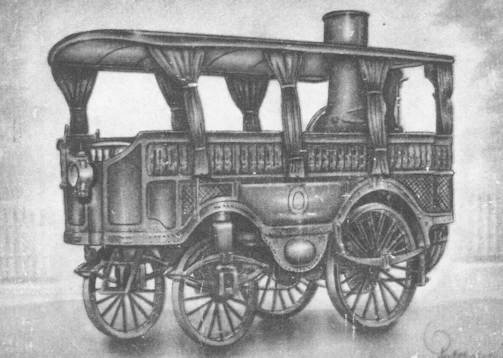
The development of the steam vehicle was continued on the Continent of Europe. In France, Amédée Bollée built his first steam car L'Obéissante in 1873. This was coal-fired and carried 12 passengers. The Marquis de Dion and M. Bouton produced a small steam carriage in 1883 with the boiler in front and with front wheel drive.
In 1887, Léon Serpollet introduced a new method of steam propulsion on his single cylinder, coke-fired tricycle. This was the flash boiler system, in which water, passing through the heated flash coil, was vaporised into steam instantaneously. The use of liquid fuel enabled a much lighter type of vehicle to be produced in the nineties and steam cars and wagonettes were being built in France and Germany and firms were already experimenting in the United States.
The first motoring event was organised by a French newspaper Le Petit Journal in 1894, from Paris to Rouen. Open to "propellers of all kinds and carriages of all shapes", it was won by a De Dion steam drag.
- Details
- Parent Category: Tech Guide
- Category: Vehicle Body
- Hits: 79
Steam Coaches The Early History

Here we take a look at the Forgotten passed of the Road going Steam Coaches from 80 years before the modern Motor car.
History
With development of early steam engines in the earl 1800s it was not long before early steam propulsion was applied to road transport.
From 1820 onwards, a large number of steam coaches were built in England. Owing to the work of men like Telford and Macadam, who introduced new methods of road construction. English roads were extremely good and fast coaches were able to operate.
Dasid Gordon, Macerone and Squire, James, and Goldsworthy Gurney were among early coach builders. Gordon's steam carriage of 1824 had mechanical feet as well as wheels to help it up hills SK Goldsworthy Gurney's steam coaches body resembled a stage coach, and a water-tube boiler was mounted tn its rear end. The rear wheels were driven by two horizontal cylinders. while the fore-carriage was turned by a pole having at its front end a pair Of small wheels steered by a tiller . Macerone and Squire's hackney coach, carrying nine passengers, put up average speeds of 15 to 16 m.p.h. James and Gurney were the first to put coaches into regular service.
By 1833, Sir Charles Dance was operating a service between Gloucester and Cheltenham. Also, in 1833 Mr. Roberts of Manchester invented a differential gear which relieved the strain on driving wheels when cornering, although a Frenchman, the Marquis de Chasseloup Laubat, is said to have invented it some six years earlier. The most successful coach builder was Walter Hancock, who produced a fleet of nine steam carriages capable of speeds up to 20 m.p.h. They ran between the City of London and Paddington for a period of about ten years.

By 1840, steam coaches used differential gears, dry steam and condensers. Their decline in England during the next two decades was due to the antagonism of landowners and the new railways. Savage road tolls were levied. On the Liverpool to Prescot road, for example, a horse-drawn coach paid a toll of only 4/-, but a steam carriage was forced to pay £2/8/-. The workers as a whole were opposed to machinery and sabotage was frequent.
A few steam cars were built during the 1860s, notably by Thomas Rickett, who built a gear-driven model for the Earl of Caithness, and by Yarrow and Hilditch.
In 1865, the Road Locomotives (Red Flag) Act imposed a speed limit of 4 m.p.h. in the country and 2 m.p.h. in towns, while a man had to walk in front of the machine carrying a red flag. As a result, the development of the motor vehicle virtually ceased in England until the repeal of this crippling Act in '1896, when motoring in the country was legalised.

- Details
- Parent Category: Tech Guide
- Category: Vehicle Body
- Hits: 30
Car Trim and badge removal

Note some parts such as bumpers, number plates, mirrors and screen wipers can be simply unbolted or unscrewed where possible . But door trim, body strips and name badges are slightly less straight forward to remove. Car manufacturers use a variety of different clips and fittings to secure badges and door side trim. The most common types of clip and how remove the trim are shown below.
If the fittings come off easily then remove them. If not, leave them in place and mask them carefully on older classic cars you may not be able to get replacements.
Side trim.
Side trim strips and name badges are fixed to bodywork in a number of ways and may need to remove for bodywork repairs, or when damaged.
Strip trim is usually a tight push over clips which are attached to body. These clips may be plastic or on older cars metal and are usually quite flimsy and easily broken, so take care when removing trim.be prepared for a breakage, clips are inexpensive and push on to or screw into bodywork so can be replaced.
Trim usually has to prised off metal clips (use a thin flat block of wood if no trim removal tools available so that you do not damage the paintwork), or for slide off plastic clips, working from one end of the strips at a time.
Glued-on badge
These have powerful adhesive backing try and warm up the badge first and use strong cord and or plastic trim tool to avoid paint damage. If badge glue does come off, remove all traces of glue off the paintwork with lighter fuel. When you come to stick the badge back on, check that the glue you use will not react with the paintwork. Its possible test it on a small area which not show, such the inside of the boot.

Clip-on badge
important first open and check interior some badges may be fixed or have interior small screws or riveted from the inside.
badges on older cars are usually a push fit into holes in the bodywork or held by trim fixing clips or plastic plug push in fixings follow side trim guide work from corners on larger badges to avoid any damage clean the area on badge and bodywork before fixing to remove grime and wax.

- Details
- Parent Category: Tech Guide
- Category: Vehicle Body
- Hits: 70
History of the electric vehicle

View all Electric vehicles in related items Below.
Electric vehicles first appeared in the mid-19th century. An electric vehicle held the vehicular land speed record until around 1900. The high cost, low top speed, and short range of battery electric vehicles, compared to later internal combustion engine vehicles, led to a worldwide decline in their use; although electric vehicles have continued to be used in the form of electric trains and other niche uses.
At the beginning of the 21st century, interest in electric and other alternative fuel vehicles has increased due to growing concern over the problems associated with hydrocarbon-fueled vehicles, including damage to the environment caused by their emissions, and the sustainability of the current hydrocarbon-based transportation infrastructure as well as improvements in electric vehicle technology.
Early history First practical electric cars
Rechargeable batteries that provided a viable means for storing electricity on board a vehicle did not come into being until 1859, with the invention of the lead–acid battery by French physicist Gaston Planté. Camille Alphonse Faure, another French scientist, significantly improved the design of the battery in 1881; his improvements greatly increased the capacity of such batteries and led directly to their manufacture on an industrial scale.
An early electric-powered two-wheel cycle was put on display at the 1867 World Exposition in Paris by the Austrianinventor Franz Kravogl, but it was regarded as a curiosity and could not drive reliably in the street. Another cycle, this time with three wheels, was tested along a Paris street in April 1881 by French inventor Gustave Trouvé
English inventor Thomas Parker, who was responsible for innovations such as electrifying the London Underground, overhead tramways in Liverpool and Birmingham, and the smokeless fuel coalite, built the first production electric car in London in 1884, using his own specially designed high-capacity rechargeable batteries.Parker's long-held interest in the construction of more fuel-efficient vehicles led him to experiment with electric vehicles. He also may have been concerned about the malign effects smoke and pollution were having in London.
Production of the car was in the hands of the Elwell-Parker Company, established in 1882 for the construction and sale of electric trams. The company merged with other rivals in 1888 to form the Electric Construction Corporation; this company had a virtual monopoly on the British electric car market in the 1890s. The company manufactured the first electric 'dog cart' in 1896.
France and the United Kingdom were the first nations to support the widespread development of electric vehicles .The first electric car in Germany was built by the engineer Andreas Flocken in 1888.
Electric trains were also used to transport coal out of mines, as their motors did not use up precious oxygen. Before the pre-eminence of internal combustion engines, electric automobiles also held many speed and distance records.Among the most notable of these records was the breaking of the 100 km/h (62 mph) speed barrier, by Camille Jenatzyon 29 April 1899 in his 'rocket-shaped' vehicle Jamais Contente, which reached a top speed of 105.88 km/h (65.79 mph). Also notable was Ferdinand Porsche's design and construction of an all-wheel drive electric car, powered by a motor in each hub, which also set several records in the hands of its owner E.W. Hart.
The first American electric car was developed in 1890-91 by William Morrison of Des Moines, Iowa; the vehicle was a six-passenger wagon capable of reaching a speed of 14 miles per hour (23 km/h). It was not until 1895 that Americans began to devote attention to electric vehicles, after A.L. Ryker introduced the first electric tricycles to the U.S., by that point, Europeans had been making use of electric tricycles, bicycles, and cars for almost 15 years.
Golden age
Interest in motor vehicles increased greatly in the late 1890s and early 1900s. Electric battery-powered taxis became available at the end of the 19th century. In London, Walter C. Bersey designed a fleet of such cabs and introduced them to the streets of London in 1897. They were soon nicknamed 'Hummingbirds’ due to the idiosyncratic humming noise they made. In the same year in New York City, the Samuel's Electric Carriage and Wagon Company began running 12 electric hansom cabs. The company ran until 1898 with up to 62 cabs operating until it was reformed by its financiers to form the Electric Vehicle Company.
In 1911, the first gasoline-electric hybrid car was released by the Woods Motor Vehicle Company of Chicago. The hybrid was a commercial failure, proving to be too slow for its price, and too difficult to service.

Columbia Riker Electric Car from 1901
Due to technological limitations and the lack of transistor-based electric technology, the top speed of these early electric vehicles was limited to about 32 km/h (20 mph). Despite this slow speed, electric vehicles had a number of advantages over their early-1900s competitors. They did not have the vibration, smell, and noise associated with gasoline cars. They also did not require gear changes. (While steam-powered cars also had no gear shifting, they suffered from long start-up times of up to 45 minutes on cold mornings.) The cars were also preferred because they did not require a manual effort to start, as did gasoline cars which featured a hand crank to start the engine.
Electric cars found popularity among well-heeled customers who used them as city cars, where their limited range proved to be even less of a disadvantage. Electric cars were often marketed as suitable vehicles for women drivers due to their ease of operation; in fact, early electric cars were stigmatized by the perception that they were "women's cars", leading some companies to affix radiators to the front to disguise the car's propulsion system.
Acceptance of electric cars was initially hampered by a lack of power infrastructure, but by 1912, many homes were wired for electricity, enabling a surge in the popularity of the cars. At the turn of the century, 40 percent of American automobiles were powered by steam, 38 percent by electricity, and 22 percent by gasoline. 33,842 electric cars were registered in the United States, and America became the country where electric cars had gained the most acceptance. Most early electric vehicles were massive, ornate carriages designed for the upper-class customers that made them popular. They featured luxurious interiors and were replete with expensive materials. Sales of electric cars peaked in the early 1910s.
In order to overcome the limited operating range of electric vehicles, and the lack of recharging infrastructure, an exchangeable battery service was first proposed as early as 1896. The concept was first put into practice by Hartford Electric Light Company through the GeVeCo battery service and initially available for electric trucks. The vehicle owner purchased the vehicle from General Vehicle Company (GVC, a subsidiary of the General Electric Company) without a battery and the electricity was purchased from Hartford Electric through an exchangeable battery. The owner paid a variable per-mile charge and a monthly service fee to cover maintenance and storage of the truck. Both vehicles and batteries were modified to facilitate a fast battery exchange. The service was provided between 1910 and 1924 and during that period covered more than 6 million miles. Beginning in 1917 a similar successful service was operated in Chicago for owners of Milburn Light Electric cars who also could buy the vehicle without the batteries.

Rauch Lang Electric Car from 1908
Decline
After enjoying success at the beginning of the 20th century, the electric car began to lose its position in the automobile market. A number of developments contributed to this situation. By the 1920s an improved road infrastructure required vehicles with a greater range than that offered by electric cars. Worldwide discoveries of large petroleum reserves led to the wide availability of affordable gasoline, making gas-powered cars cheaper to operate over long distances. Electric cars were limited to urban use by their slow speed (no more than 24–32 km/h or 15–20 mph.) and low range (30–40 miles or 50–65 km), and gasoline cars were now able to travel farther and faster than equivalent electrics.
Gasoline cars became ever easier to operate thanks to the invention of the electric starter by Charles Kettering in 1912, which eliminated the need of a hand crank for starting a gasoline engine, and the noise emitted by ICE cars became more bearable thanks to the use of the muffler, which Hiram Percy Maxim had invented in 1897. Finally, the initiation of mass production of gas-powered vehicles by Henry Ford brought their price down. By contrast, the price of similar electric vehicles continued to rise; by 1912, an electric car sold for almost double the price of a gasoline car.
Most electric car makers stopped production at some point in the 1910s. Electric vehicles became popular for certain applications where their limited range did not pose major problems. Forklift trucks were electrically powered when they were introduced by Yale in 1923. In Europe, especially the United Kingdom, milk floats were powered by electricity, and for most of the 20th century the majority of the world's battery electric road vehicles were British milk floats.Electric golf carts were produced by Lektro as early as 1954. By the 1920s, the early heyday of electric cars had passed, and a decade later, the electric automobile industry had effectively disappeared. Michael Brian examines the social and technological reasons for the failure of electric cars in his book Taking Charge: The Electric Automobile in America.
Years passed without a major revival in the use of electric cars. Fuel-starved European countries fighting in World War II experimented with electric cars (such as the British milk floats and the French Breguet Aviation car), but overall, while ICE development progressed at a brisk pace, electric vehicle technology stagnated. In the late 1950s, Henney Coachworks and the National Union Electric Company, makers of Exide batteries, formed a joint venture to produce a new electric car, the Henney Kilowatt, based on the European Renault Dauphine. The car was produced in 36-volt and 72-volt configurations; the 72-volt models had a top speed approaching 96 km/h (60 mph) and could travel for nearly an hour on a single charge. Despite the Kilowatt's improved performance with respect to previous electric cars, consumers found it too expensive compared to equivalent gasoline cars of the time, and production ended in 1961.
In 1959, American Motors Corporation (AMC) and Sonotone Corporation announced a joint research effort to consider producing an electric car powered by a "self-charging" battery. AMC had a reputation for innovation in economical cars while Sonotone had technology for making sintered plate nickel-cadmium batteries that could be recharged rapidly and weighed less than traditional lead-acid versions. That same year, Nu-Way Industries showed an experimental electric car with a one-piece plastic body that was to begin production in early 1960.

Bradley GTE Electric Car from 1979
The U.S. and Canada Big Three automakers had their own electric car programs during the late-1960s. In 1967, much smaller AMC partnered with Gulton Industries to develop a new battery based on lithium and a speed controller designed by Victor Wouk. A nickel-cadmium battery supplied power to an all-electric 1969 Rambler American station wagon. Other "plug-in" experimental AMC vehicles developed with Gulton included the Amitron (1967) and the similar Electron (1977). More battery-electric concept cars appeared over the years, such as the Scottish Aviation Scamp (1965), the Enfield 8000(1966) and two electric versions of General Motors gasoline cars, the Electrovair (1966) and Electrovette (1976).None of them entered production.
1990s: Revival of interest
After years outside the limelight, the energy crises of the 1970s and 1980s brought about renewed interest in the perceived independence electric cars had from the fluctuations of the hydrocarbon energy market. At the 1990 Los Angeles Auto Show, General Motors President Roger Smith unveiled the GM Impact electric concept car, along with the announcement that GM would build electric cars for sale to the public.
In the early 1990s, the California Air Resources Board (CARB), the government of California's "clean air agency", began a push for more fuel-efficient, lower-emissions vehicles, with the ultimate goal being a move to zero-emissions vehicles such as electric vehicles. In response, automakers developed electric models, including the Chrysler TEVan, Ford Ranger EV pickup truck, GM EV1 and S10 EV pickup, Honda EV Plus hatchback, Nissan lithium-battery Altra EV miniwagon and Toyota RAV4 EV. The automakers were accused of pandering to the wishes of CARB in order to continue to be allowed to sell cars in the lucrative Californian market, while failing to adequately promote their electric vehicles in order to create the impression that the consumers were not interested in the cars, all the while joining oil industry lobbyists in vigorously protesting CARB's mandate. GM's program came under particular scrutiny; in an unusual move, consumers were not allowed to purchase EV1s, but were instead asked to sign closed-end leases, meaning that the cars had to be returned to GM at the end of the lease period, with no option to purchase, despite lessor interest in continuing to own the cars. Chrysler, Toyota, and a group of GM dealers sued CARB in Federal court, leading to the eventual neutering of CARB's ZEV Mandate.
After public protests by EV drivers' groups upset by the repossession of their cars, Toyota offered the last 328 RAV4-EVs for sale to the general public during six months, up until 22 November 2002. Almost all other production electric cars were withdrawn from the market and were in some cases seen to have been destroyed by their manufacturers. Toyota continues to support the several hundred Toyota RAV4-EV in the hands of the general public and in fleet usage. GM famously de-activated the few EV1s that were donated to engineering schools and museums.

1997 Toyota RAV4 EV Electric Car battery location
Throughout the 1990s, interest in fuel-efficient or environmentally friendly cars declined among Americans, who instead favored sport utility vehicles, which were affordable to operate despite their poor fuel efficiency thanks to lower gasoline prices. American automakers chose to focus their product lines around the truck-based vehicles, which enjoyed larger profit margins than the smaller cars which were preferred in places like Europe or Japan. In 1999, the Honda Insighthybrid car became the first hybrid to be sold in North America since the little-known Woods hybrid of 1917.
Hybrid electric vehicles, which featured a combined gasoline and electric powertrain, were seen as a balance, offering an environmentally friendly image and improved fuel economy, without being hindered by the low range of electric vehicles, albeit at an increased price over comparable gasoline cars. Sales were poor, the lack of interest attributed to the car's small size and the lack of necessity for a fuel-efficient car at the time. The 2000s energy crisis brought renewed interest in hybrid and electric cars. In America, sales of the Toyota Prius (which had been on sale since 1999 in some markets) jumped, and a variety of automakers followed suit, releasing hybrid models of their own. Several began to produce new electric car prototypes, as consumers called for cars that would free them from the fluctuations of oil prices.
In response to a lack of large-automaker participation in the electric car industry, a number of small companies cropped up in their place, designing and marketing electric cars for the public. In 1994, the REVA Electric Car Company was established in Bangalore, India, as a joint venture between the Maini Group India and AEV of California. After seven years of research and development, it launched the REVAi an all-electric small micro car, known as the G-Wiz i in the United Kingdom, in 2001. The car was powered by lead–acid batteries, and in January 2009, a new model was launched, the REVA L-ion. It is similar to the REVAi but powered by high performance lithium-ion batteries, which reduce the car's curb weight. In many countries the REVAi does not meet the criteria to qualify as a highway-capable motor vehicle, and fits into other classes, such as neighborhood electric vehicle (NEV) in the United States and heavy quadricycle in Europe. The REVA sold more than 4,000 vehicles worldwide by March 2011 and was available in 26 countries. Sales in the UK, its main market, ended by late 2011. Production ended in 2012 and was replaced by the Mahindra e2o in 2013.
Most electric vehicles on the world roads are low-speed, low-range neighborhood electric vehicles (NEVs). Pike Research estimated there were almost 479,000 NEVs on the world roads in 2011. As of July 2006, there were between 60,000 and 76,000 low-speed battery-powered vehicles in use in the United States, up from about 56,000 in 2004. North America's top selling NEV is the Global Electric Motorcars(GEM) vehicles, with more than 50,000 units sold worldwide by mid 2014. The world's two largest NEV markets in 2011 were the United States, with 14,737 units sold, and France, with 2,231 units. Other micro electric cars sold in Europe was the Kewet, since 1991, and replaced by the Buddy, launched in 2008. Also the Th!nk City was launched in 2008 but production was halted due to financial difficulties. Production restarted in Finland in December 2009.The Th!nk was sold in several European countries and the U.S. In June 2011 Think Global filed for bankruptcy and production was halted. Worldwide sales reached 1,045 units by March 2011.A total of 200,000 low-speed small electric cars were sold in China in 2013, most of which are powered by lead-acid batteries. These electric vehicles not considered by the government as new energy vehicles due to safety and environmental concerns, and consequently, do not enjoy the same benefits as highway legal plug-in electric cars.

1997 General Motors EV1 Electric Car
2000s to present
The global economic recession in the late 2000s led to increased calls for automakers to abandon fuel-inefficient SUVs, which were seen as a symbol of the excess that caused the recession, in favor of small cars, hybrid cars, and electric cars.
California electric car maker Tesla Motors began development in 2004 on the Tesla Roadster, which was first delivered to customers in 2008. The Roadster was the first highway legal serial production all-electric car to use lithium-ion battery cells, and the first production all-electric car to travel more than 200 miles (320 km) per charge.Since 2008, Tesla sold approximately 2,450 Roadsters in over 30 countries through December 2012. Tesla sold the Roadster until early 2012, when its supply of Lotus Elise gliders run out, as its contract with Lotus Cars for 2,500 gliders expired at the end of 2011. Tesla stopped taking orders for the Roadster in the U.S. market in August 2011, and the 2012 Tesla Roadster was sold in limited numbers only in Europe, Asia and Australia. The Tesla vehicle, the Model S was released in the U.S. on June 22, 2012 and the first delivery of a Model S to a retail customer in Europe took place on August 7, 2013. Deliveries in China began on April 22, 2014. The next model was the Tesla Model X. In November 2014 Tesla delayed one more time the start of deliveries to retail customers, and announced the company expects Model X deliveries to begin in the third quarter of 2015.

- Details
- Parent Category: Tech Guide
- Category: Vehicle Body
- Hits: 95
Kit car

View all Kit cars in related items Below.
A kit car, also known as a "component car", is an automobile that is available as a set of parts that a manufacturer sells and the buyer himself then assembles into a functioning car. Usually, many of the major mechanical systems such as the engine and transmission are sourced from donor vehicles or purchased new from other vendors. Kits vary in completeness, including as little as a book of plans, or as much as a complete set with all components included.
There is a sub-set of the kit car, commonly referred to as a "re-body", in which a commercially manufactured vehicle has a new (often fiberglass) body put on the running chassis. Most times, the existing drive gear and interior are retained. These kits require less technical knowledge from the builder, and because the chassis and mechanical systems were designed, built, and tested by a major automotive manufacturer, a re-body can also lead to a much higher degree of safety and reliability.
The definition of a kit car usually indicates that a manufacturer constructs multiple kits of the same vehicle, each of which it then sells to a third party to build. A kit car should not be confused with a 'hand built' car or 'special' car, which is typically built from scratch by an individual.
History

Kit cars have been around from the earliest days of the automobile. In 1896 the Englishman Thomas Hyler-White developed a design for a car that could be assembled at home and technical designs were published in a magazine called The English Mechanic.In the USA, the Lad's Car of 1912 could be bought for $160 ($3000 US in 2006) fully assembled or $140 ($2600 US in 2006) in kit form.
It was not until the 1950s that the idea really took off. Car production had increased considerably and with rust proofing in its infancy many older vehicles were being sent to breaker yards as theirbodywork was beyond economic repair. An industry grew up supplying new bodies and chassis to take the components from these cars and convert them into new vehicles, particularly into sports cars. Fiber reinforced plastic (aka "GRP," or "fiberglass") was coming into general use and made limited-scale production of automobile body components much more economical.Also, in the UK up to the mid-1970s, kit cars were sometimes normal production vehicles that were partially assembled as this avoided the imposition of purchase tax as the kits were assessed as components and not vehicles. The Lotus Elan, for example, was available in this form. It was often claimed that the kits could be taken home and completed in only a weekend.
During the 1970s many kits had bodies styled as sports cars that were designed to bolt directly to VW Beetle chassis. This was popular as the old body could be easily separated from the chassis leaving virtually all mechanical components attached to the chassis and a GRP-body from the kit supplier shop fitted. This made the Beetle one of the most popular "donor" vehicles of all time.Examples of this conversion include the Bradley GT, Sterling, and Sebring which were made by the thousands and many are still around today. Volkswagen based dune buggies also appeared in relatively large numbers in the 1960s and 1970s based usually on a shortened floor pan.

1976 Invader GT5 VW base Kit-Car
Current kit cars are frequently replicas of well-known and often expensive classics and are designed so that anyone with a measure of technical skill can build them at home to a standard where they can be driven on the public roads. These replicas are in general appearance like the original, but their bodies are often made of fiberglass mats soaked in polyester resin instead of the original sheet metal. The AC Cobra and the Lotus 7 are particularly popular examples, the right to manufacture the Lotus 7 now being owned by Caterham Cars who bought the rights to the car from Lotus founder Colin Chapman in 1973. Replica kit cars enable enthusiasts to possess a vehicle of a type that because of scarcity they may not be able to afford, and at the same time take advantage of modern technology. The Sterling Nova Kit originally produced in the UK was the most popular VW based Kits being produced worldwide and licensed under several different names with an estimated 10000 sold.
Many people react sceptically when they first hear about kit cars as it appears to them to be technically impossible to assemble a car at home and license it for public roads. They may also be worried that such a car would not subsequently pass the mandatory quality control (road worthiness test) that is required in most countries. For example, to obtain permission to use a kit car in Germany, every such vehicle with a speed over 6 km/h without a general operating license (ABE) or an EC type permission (EC-TG) has to undergo, as per the § 21 of Road traffic licensing regulations (STVZO), a technical inspection by an officially recognized expert of a Technical Inspection Authority. In the United Kingdom it is necessary to meet the requirements of the IVA (Individual vehicle Approval) regulations. In the United States SEMA has gone state by state to set up legal ways for states to register kit cars and speciality vehicles for inspection and plates.

1976 Blakely Bantam 7 Kit-Car
A survey of nearly 600 kit car owners in the US, the UK and Germany, carried out by Dr. Ingo Stüben, showed that typically 100–1,500 hours are required to build a kit car, depending upon the model and the completeness of the kit.However, as the complexity of the kits offered continues to increase, build times have increased as well.
Several sports car producers such as Lotus, Marcos, and TVR started as kit car makers.
By far the largest current manufacturer is Tim Dutton, who has been producing Amphibious Cars since 1989. Over 250 have already been produced. Current models include the 4wd Surf and 2wd Reef. Previous versions of these Amphibs have been used to cross the English Channel twice.

