
Vehicle Body
- Details
- Parent Category: Tech Guide
- Category: Vehicle Body
- Hits: 32
Paint Technical terms H-W
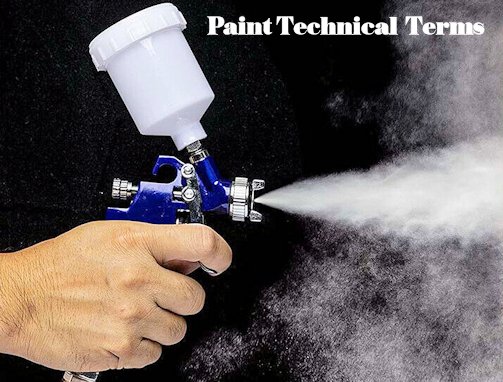
The following are examples of technical terms related to paintwork and recommended for general use.
H
Hardness
Mechanical property of paint coat. Expressed by resistance of paint to mechanical effects (e.g. pressure, friction, scratching).
Hazing
Clouding of a paint surface not caused by external influences which shows up during or after drying.
P
Paint substance
Substance which provides a paint coat with specific characteristics. Collective terms can be used with word combinations, such as primers, stoving enamels, dipping enamels, clear coating, etc.
Paint, paint material
From liquid to pasty, also powdery coating material: applied on a base by means of pertinent methods. Provides a solid paint coat after a physical and/or chemical drying process.
Paint coat, paint film
Paint layer on top of a primer coat. Paint film is another term defining the formation of a cohesive layer.
Paint foundation
Collective term for basic materials such as steel, aluminium, plastics which serve as the base for the respective paint venetration (staining)
(a) Appearance of stain from the undercoat or an existing paint coat into paint layers above. (b) Appearance of paint stain on back of base (e.g. paper).
Pigment separation
Partial separation of binder and pigment or of pigments from each other.
Polishable
Characteristicof a paint for polishing (buffing) with polishing equipment (buffing pad, buffing wheel) and polishing compounds (paste, wax, polish) to obtain a high gloss.
Primer, primer material
Paint material suitable for priming.
Prime coat (primer)
As a paint layer suitable to serve as a connection between the base and paint coats.
R
Rub resistance
Resistance of paint finish to light rubbing.
Runs, sagging
Characteristic/tendency of paint to form runs when painting vertical surfaces. See also anti-sag characteristic.
S
Sanding ability
of paint coats during wet or dry sanding: (a) for smoothing and/or uniform roughing as a preparation for an additional paint coat; (b) as a characteristic, especially for priming, without faults (mechanical resistance,etc.) for preparing with sanding equipment.
Scratch resistance
Resistance of a paint coat to scratching influences, depending on hardness and drying condition.
Sedimentation
Formation of sediment of pigments caused by the joining of particles which are specifically heavier than the binder solution and will therefore settle to the bottom.
Separation
Visible separation of pigments in paint during storage or on paint coat during liquid state.
Swelling
(a) Increase in volume by absorbing liquids, vapours or gases into paint film. (b) 'Wetting interference' at the edges of a sanded area.
W
Weather resistance
Characteristic of a paint coat, defined as its resistance against changes:(a) exposure to the elements through effect of weather at the test site; (b) quick test by the effect of simulated exposure to weathering.
Wetting
Ability of paint to adequately flow, without interference.
Wetting interference
The appearance of flaws, i.e. fish-eye in a paint film. Yellowing Change in colour, especially of bright colours, caused by high thermal stresses or strong light effects.
- Details
- Parent Category: Tech Guide
- Category: Vehicle Body
- Hits: 37
Paint Technical terms A-G
The following are examples of technical terms related to paintwork and recommended for general use.
A
Adhesion
Separation resistance between paint and base.
Anti-sag
characteristic Characteristic of paint not to run/sag while painting vertical surfaces, including thick layers.
B
Bleeding
Penetration of paint materials. Chemical resistance Resistance of paint coat against attack or infiltration of chemicals, i.e. acids, strong solutions, industrial fall-out, natural (organic) fall-out, gases.
C
Clouding
In metallic painting, the uneven distribution of the metallic effect, giving components/particles in the paint.
Coating Collective
term for layers made of coating materials and applied to a base.
Coating material substance
A material which is not prefabricated and provides a coating. See also paint.
Coat thickness
A paint layer has no compactness in a physical sense but only a thickness.
Colour
The sensory perception transmitted by the eye. A colour is characterized by colour tone, brightness and saturation (fullness).
Colour tone
Characteristic which differentiates a chromatic colour (blue, green, red, etc.) from a non-chromatic (hueless) colour (black, white).
Complete drying capacity
complete drying, hard drying Attainment of operational hardness throughout the layer, where 'complete drying' applies more to physically and oxidatively drying (air dry) systems and 'hard drying' more to catalytically and poly-additively drying systems.
Consumption
The quantity of coating material required to provide an area of a given size under given conditions with a layer of given thickness when dry. Indication in kg/m2 or l/m2. See also effective coverage.
Corrosion protection
Sum total of measures for protecting metals, plastics and other materials against destruction by chemical and/or physical attack (aggressive media, weather, mechanical stresses).
Covering ability Ability of a pigmented material to cover the colour or differences in colour of
the base.
D
Drying.drying methods, drying stages
Transition of paint coat from a fluid to a solid state, caused by physical and/or chemical processes.Drying methods are, for example: air drying, heat drying (oven drying, baking or stoving) and radiation drying. Drying stages are: dust dry, tack free and thoroughly dry (fully dried).
Drying time
Period between application of paint and a drying condition determined by specified test conditions.
E
Effect
(paint finish)Visual appearance under similar light conditions of a paint finish with particles which are reflecting differently when looked at from different angles.
Effective coverage
Defined as the area of surface attained with the quantity of a coating material for one layer of certain thickness. Data in m2/l or m2/kg. See also consumption.
F
Flow structure
The general characteristic of paint in its liquid state to spread out smoothly onthe surface being applied to.
Filling capacity
Capacity of a paint to equalizc the unevenness of the base, which provides the optical effect of a particularly well painted surface (fullness).
G
Gloss Visual
appearance of various reflection of light on a paint finish — high gloss, satin gloss, etc.
Gloss retention
Characteristic of a paint finish to resist dulling, that is, of a paint finish dulling by usage, external influences, etc.
- Details
- Parent Category: Tech Guide
- Category: Vehicle Body
- Hits: 33
Paint Skinning problems
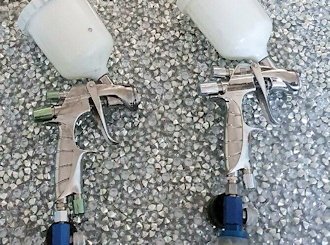
Paint Skinning problems Drying and oxidation of the liquid surface of a paint, particularly in reference to synthetics, forming a soft and slimy or dry and tough
film at the surface. To repair Carefully remove all skin formation before stirring or shaking material. Failure to do this may result in bitty or seedy finish. If skin is excessively thick, material should be discarded and not used.
Cause
- Storing of synthetics in a partly filled container.
- Storing of synthetics in a container which is not closed airtight.
- Opening and reclosing containers of synthetics a number of times.
Prevention
1 Keep containers tightly sealed.
2 Do not save small amounts of synthetics
- Details
- Parent Category: Tech Guide
- Category: Vehicle Body
- Hits: 24
Paint surface Rusting problems
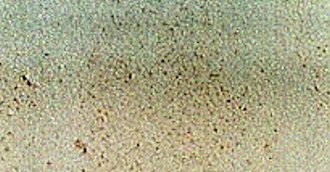
Moisture and chemicals maybe from road salt, sea air or even off road outside parking near where chemicals are used, or damp un ventilated areas undercover, attacking the metal through visible or microscopic breaks in the paint film.
Rusting then often works back under the film, resulting in blistering and peeling. Rusting also forms more rapidly at points where the moisture collects and remains in contact with the film. To Repair remove paint down to metal. Bare metal areas should never be touched by the hands after using metal pretreatment and rust remover and should be primed within 30 minutes to prevent start of new rust formation. Repaint following steps under 'Prevention'.
- Painting over metal which contains rust not completely removed will always result in rapid failure from more rusting.
- Painting over metal touched by bare hands, or metal contaminated by chemical deposits from flatting water.
Prevention
1. Bare metal should be flatted very thoroughly to remove all traces of rust from surface and pits in the metal.
2. Metal should be treated with metal pre treatment and rust remover according to directions.
- Details
- Parent Category: Tech Guide
- Category: Vehicle Body
- Hits: 40
Paint Runs problems

This section includes Paint Runs problems curtains and sags in Automotive paint.
To repair if sag is still wet, and another coat can be applied, lightly brush out the sag with a fine camel hair brush, then recoat. When colour coat is completely dry and
hard, flat out sag with P600 grit wet and dry. Polish out or respray as necessary. Spraying should never be done without plenty Of Properly located light. Many runs are the result of not being able to see the area being sprayed.
Cause
- Spraying over surface contaminated with wax, oil, grease or silicone.
- Use of too much slow-drying thinner.
- Coats applied too heavy and wet.
- Poor spray gun technique or adjustment.
- Distorted spray pattern.
- Material, surface or atmosphere too cold.
- Air pressure excessively low.
Prevention
1. Clean surface thoroughly with wax and grease remover before painting.
2. Avoid use of thinner which is too slow drying. Follow paint manufacturer's instructions as to type and amount of thinner.
3. Do not apply heavy coats. Rely on thin to medium coats.
4. Clean and adjust spray gun to give proper, uniform spray pattern. Develop and practice good spray gun technique.
5. Use good triggering action. Curved surfaces require extra careful gun action.
6. Since different brands of paint and thinner require somewhat different techniques
7. practice on old panel when switching to new materials to obtain the 'feel' of the material.
8. Adjust air pressure and spray gun settings and technique to compensate for temperature and weather conditions.
9. Be sure spray booth allows plenty of room for easy working in uncramped position.
