
Vehicle Body
- Details
- Parent Category: Tech Guide
- Category: Vehicle Body
- Hits: 69
Gravity feed and Suction spray guns
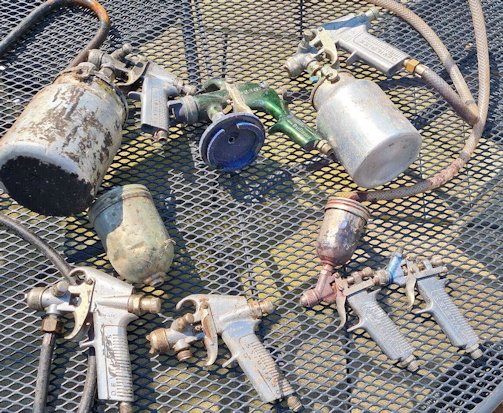
In this section we will show what Gravity feed and Suction spray guns are used for and best use for them.
The selection of spray guns will regard to work volume air pressure, compressor capacity, and the type of work intended.
Spray guns usually have provision for fitting different air cap, fluid needle and fluid cap combinations, to suit the various materials used. Spray guns are of the separate container or attached container types and these two types can be further divided into suction, gravity or pressure feed, bleeder and non-bleeder, external and internal mix guns.
The most common are Gravity and suction,
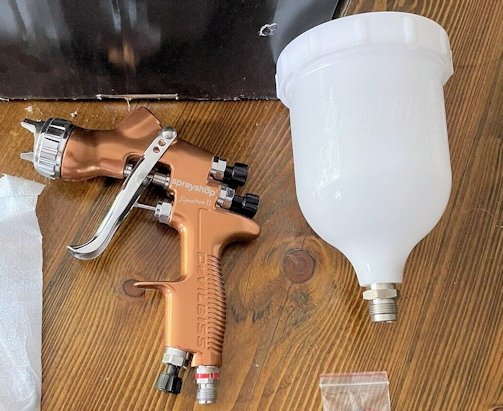
Gravity feed spray gun
Suction feed guns are used where there are many colour changes and they are the most popular in the car refinishing industry. Gravity feed the gravity feed gun is suitable for spraying small quantities of viscous material. It is fed by force of gravity from the paint cup attached to the top of the gun body. The gravity feed gun uses the same air cap and fluid nozzle combination as the suction feed gun.
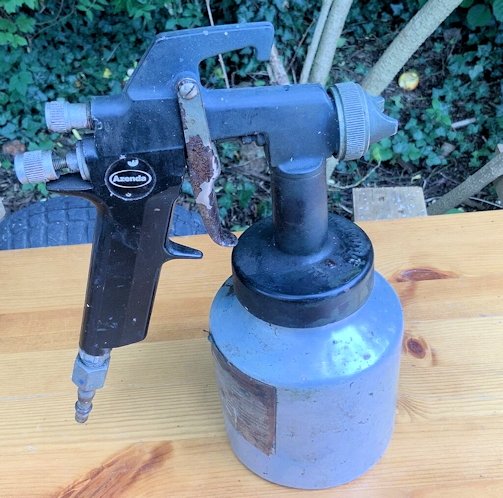
The suction feed spray gun with 1 litre cup and an air consumption of approximately 0.34 m3/min (12 ft3/min) at an operating pressure of 3.85 bar (55 psi) used in conjunction with a fluid cap of 1.8 mm (0.070 in) to deliver approximately 250 cc of paint per minute, depending on the viscosity and settings. This is a type of spray gun in which the stream of compressed air siphons material from the container attached to the Suction feed spray gun.
- Details
- Parent Category: Tech Guide
- Category: Vehicle Body
- Hits: 25
Resistance spot welding How it works
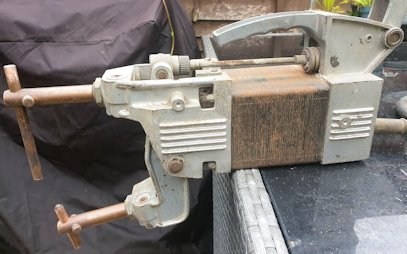
Here we discuss the use of spot welding and how it works.
Spot welding is a variant of electric resistance welding and this method of assembly is used not only because of its technical advantages but also because of the important cost reduction that can be achieved.
The mass production of motor car bodies involves the use of spot welding and motor cars are held together by between 4000 and 9000 spot welds.
The advantages of spot welding are the following;
- Spot welding is the fastest, strongest and most reliable method of joining two pieces of sheet metal.
- Spot welding gives little or no metal distortion owing to too great radiation of heat; the heat required for making a spot weld is limited to a small area around it,
- In some cases it is possible to make spot welds which are almost invisible. This is especially valuable when welding more eye-catching parts.
- No preparatory work is needed for spot welding compared to bolting or riveting there is no need to drill metal, screw bolts drive rivets, and no need for electrode, oxygen or acetylene; hence there is a considerable cost reduction.
- Spot welding does not alter the mechanical characteristics of the parent metal. Good spot welds are equal in strength, hardness and ductility to the original specification of the sheet metal as laid down by the designer for its mechanical performance.
Although repair work is different from production, the repairer should be able to carry out work to standards of quality identical to those obtained in mass production and make use of the advantages offered by spot welding.
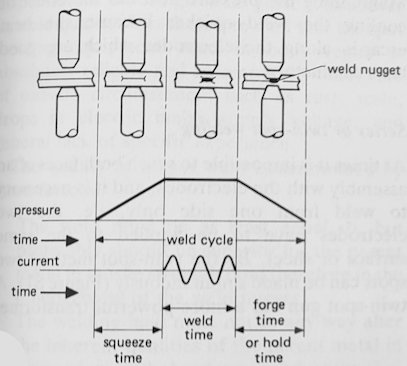
The principles of spot welding
A comparison can be made between an electrical spot weld and a forge weld for in both of these processes a union is formed by an amalgamation of the molecules. In the case of
forge welding, the metal pieces are heated in the forge furnace and then hammered until homogeneous. In the case of spot welding the pieces are heated electrically using the same principle as in an electric radiator (resistance effect); they are subjected to a certain pressure which must be sufficient and continuous to enable the molecules i.e. sub microscopically small particles, to interlock. Spot welding is a self-contained weld method on a limited surface area without added weldmetal.
It involves:
- The use of a preset pressure.
- An electric current of precise intensity and duration
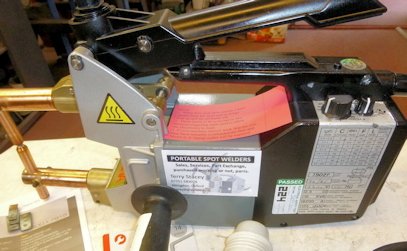
A spot welding gun must have:
- A pressure device worked by the operator for transmitting the pressure to the electrodes.
- A transformer to enable current at high intensity to be fed to the electrodes.
These electrodes are made of a copper chrome alloy, selected for strength and good conductivity. The electrodes must have the ability to conduct mechanical and electrical power.
The following are the three stages in making a spot weld:
- Squeeze time
- Weld time (duration of current flow)
- Hold time
Squeeze time
Bringing the parts together is the stage before welding. It is using the electrodes to put strong
pressure on the parts to be welded which means, from the mechanical point of view, making contact between the parts to be welded, especially an intimate contact at the exact point where the spot weld will be formed. From the electrical point of view there is better current flow, as the pressure lowers the resistance created by the surfaces in contact.
Three contact surfaces are formed two between the electrodes and the sheet metal, and one between the sheets of metal themselves. There is better contact between the electrodes and the workpieces (copper—steel contact) than between the metal sheets (steel—steel) contact. The contact between the steel sheets will offer the greater resistance to the flow of electricity,This is indicated by the 'zigzag'.After bringing the workpieces under pressure an electrical connection is made in which the highest resistance appears at the point of contact between the two pieces. Damage to the work-pieces and gun will result if the weld current is switched on before full pressure has been reached. When full pressureis reached the second stage, weld time, begins.
Weld time
When the current passes through the assembly it meets with resistance at the points of contact. This resistance will cause heating by opposing the passage of the current. The higher the resistance, the greater the amount of heat generated. The highest resistance is at the point where the two metal sheets are in contact, and it is at this point that the greatest heat is produced. Heat is radiated and plasticizes the metal. This produces a round, flattened nugget surround by a sheath of metal in a plastic condition, forming a sort of crucible holding the hottest metal.
During this operation, pressure plays a multiple role:
- It encourages the molecules of metal to interpenetrate.
- It resists expansion, and thus resists likewise the destruction of the crucible of plastic metal enclosing the red-hot metal.
- It ensures a good electrical contact between the electrodes and the pieces to be welded. After complete formation of the nugget, the current is cut and forging by pressure begins.
Hold time
Forging is a metallurgical finishing job, and it is vital for obtaining a good-quality spot weld. When the current is cut, the nugget begins to cool. If, in the course of cooling, pressure
reduced or removed, the nucleus (or nugget) will no longer be maintained; the metal shrink and form fine cracks and create internal stresses, which will reduce the good quality ofthe spot weld. If much pressure is lost, the plasticized metal will squirt out and the resultant weld will be hollow. It is, therefore, vital to keep up the pressure, avoiding these faults and obtaining perfect homogeneity. High pressure makes the grain of the metal finer and greatly increases the mechanical strength of the weld Maintaining the pressure also has the effect of cooling the weld quicker because the heat escapes along the electrodes which are good heat conductors.
- Details
- Parent Category: Tech Guide
- Category: Vehicle Body
- Hits: 42
Oxy-acetylene welding equipment
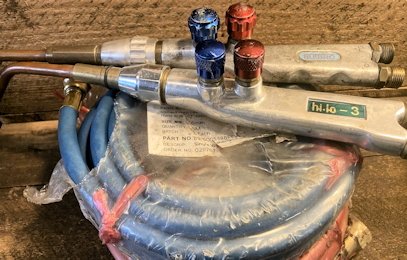
Here we discuss the equipment for Oxy-acetylene Welding.
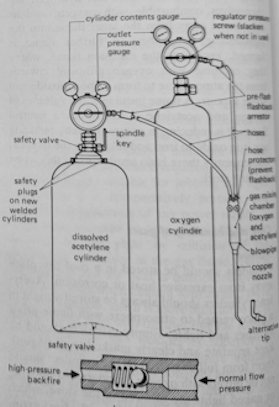
High pressure oxy-acetylene welding systems consist of the following equipment
A supply of dissolved acetylene (DA) stored in steel cylinders which contain a porous substance (charcoal) and a solvent (acetone) for the gas. The cylinders are charged to a pressure of approximately 15.5 bars (221.4 psi), There are various sizes, the usual ones being 3.39 m3 and 5.66 m3.
A supply of oxygen gas in alloy steel cylinders charged to a pressure of 172.5 bars (2464.3 psi). Single cylinders of oxygen and D/A or a bank of cylinders called a manifold may be used, A manifold supplying several blowpipes usually has an acetylene safety valve and two-line pressure gauges. Copper pipe is never used for conveying acetylene because an explosion compound is formed Pressure regulators for each gas to reduce the cylinder pressure to a suitable value for welding. The regulator pressure screw should always be slackened off after welding
Rubber canvas hose with special connections. Hoses for fuel gas are red with left-handed connections, whilst the oxygen hose is blue with right-handed connections. Blowpipe with set of nozzles. The nozzle size may indicate the approximate consumption of the gas in litres/hour using a neutral flame.
Also needed, special tinted welding goggles and a spark lighter
Discharge rates of cylinders
The hourly withdrawal rate of gas an acetylene cylinder must not use greater than 20 per cent (one-fifth) of its contents. otherwise, acetone may be drawn off. The acetone
cylinder should be stood upright. Excessive withdrawal rates of oxygen, especially in cold weather. can cause icing up of regulators. Hot water should be used to thaw out frozen valves and regulators, not naked flames.
Cylinders
Oxygen cylinders are painted black and are fitted a valve outlet which has a right-hand thread. Acetylene cylinders are painted maroon and have a valve outlet a left-hand thread.
They may have a protective cover for the valve.
Regulators
Each cylinder must be fitted with the appropriate regulator which:
1 Shows the cylinder pressure.
2 Shows the pressure at the regulator outlet.
3 Enables accurate control of the output pressure using the handwheel.
4 Prevents gas from flowing back into the cylinder.
5 Prevents the gas in the cylinder from being ignited by a 'flashback'.
The regulator is set for zero output when the regulating screw is turned fully anti-clockwise, i.e., unscrewed.
Gas economizer
This consists of two valves operated by a lever. It is fitted between the regulators and the blowpipe; when the blowpipe is hung on the level, both gas supplies to the blowpipe are cut off. It is normal for a flame to be adjacent for reignition when using an economizer.
This enables:
- Saving of gas, without disturbing the valve adjustments.
- Greater safeties by ensuring that the flame is extinguished when the Pipe is not in use.
Blowpipe
This mixes the oxygen and acetylene before they are burned at the nozzle, it is fitted with control Valve to adjust the rate of flow of the gas;
This varies:
- The intensity of the flame.
- The character, i.e., oxidizing and carburizing of the flame, which is determined by the relative proportions of the two gases. Different sized nozzles may be fitted to the same blowpipe. Cutting blowpipes have a lever which when operated supplies the additional oxygen required for cutting.
Nozzles
The size of nozzle controls the size of the flame.
For heavier work, a larger nozzle is needed. The gas pressures at the regulators must be set at the
correct values for the particular nozzle in use.
Assembly of equipment
Stand both cylinders vertically either in a cylinder trolley or in cylinder stands. Cylinders should never be used lying on the floor. Ensure that jointing surfaces of cylinder valves are free from oil or grease and momentarily open, then close valves to blow out any dirt or obstructions.
Screw the appropriate regulator into each cylinder and tighten. Excessive tightening is not necessary but make certain that joints are gas-tight. The threads on oxygen cylinder valves and regulators are right-handed and on acetylene equipment left-handed.
Blow through the hoses with air to remove any dirt or dust before connecting to the regulator. Oxygen should not be used for this purpose. Connect the hoses (acetylene red, oxygen blue) to the threaded outlet of the regulator by the screwed connectors secured to the hose ends.
Check that the control valves on the blowpipe are closed and screw the appropriate size of nozzle into the blowpipe.
- Details
- Parent Category: Tech Guide
- Category: Vehicle Body
- Hits: 29
Acrylic lacquers Finishes
The use of acrylic lacquers Finishes and what they can do.
Acrylic lacquers are a blend of a resin from the acrylic’s family, such as methyl methacrylate (or 'Perspex') and a synthetic plasticizing resin. The characteristics of acrylic lacquers are very rapid surface drying, excellent gloss and colour retention.Drying is by solvent evaporation only.
This gives the rapid surface drying, but it means that for full through hardness a 16-hour drying period is necessary. Acrylic lacquers respond readily to hand or machine polishing, using rubbing or polishing compounds. Usually, some degree of polishing is necessary, depending on the gloss level required.
Properly applied, an acrylic lacquer system can give excellent results. For durability the undercoats must be those recommended for acrylics. The manufacturer's instructions should always be followed. If products from different manufacturers are mixed, failure of the paint film may occur by cracking or crazing.
- Details
- Parent Category: Tech Guide
- Category: Vehicle Body
- Hits: 29
Paint Sealers
Automotive Paint Sealers what they do .
A sealer is used to improve the uniformity and gloss of the final colour coat, to fill flatting scratches, and to improve colour hold-out. It can also be used as a ground coat to aid the final colour match. Sealers should not be expected to act as 'isolators', to prevent wrinkling of an old paint film under the action of strong lacquer solvents, or to stop bleeding through of a previous colour coat. Special products called 'bleeding inhibitor sealers' are available to stop bleeding.
A point to note about these is that they give a poorer hold-out under colour coats than the standard sealers.
