
Toyota engines
- Details
- Parent Category: Engines Makes
- Category: Toyota engines
- Hits: 65
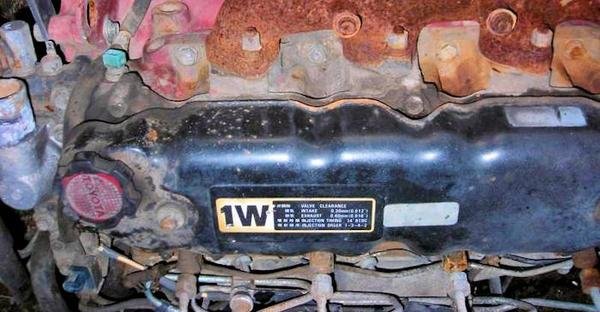
Toyota W engine
| 1983 to 1995 | |
|---|---|
 |
|
| Manufacturer | Hino Motors |
| Also called | Hino W04D |
| Production | 1983-1995 |
| Combustion chamber | |
| Configuration | Inline-4 |
| Displacement | 4,009 cc (244.6 cu in) |
| Cylinder bore | 104 mm (4.1 in) |
| Piston stroke | 118 mm (4.6 in) |
| Cylinder block alloy | cast iron |
| Cylinder head alloy | cast iron |
| Valvetrain | OHV |
| Compression ratio | 17.9:1 |
| Combustion | |
| Fuel system | direct injection |
| Fuel type | diesel |
| Cooling system | water-cooled |
| Output | |
| Power output | 86 kW (115 hp) @ 3200 rpm |
| Torque output | 275 N·m (203 ft·lb) @ 2000 rpm |
| Dimensions | |
| Length | 898 mm (35.4 in) |
| Width | 637 mm (25.1 in) |
| Height | 762 mm (30.0 in) |
| Dry weight | 340 kg (750 lb) |
The Toyota W Engine is a water cooled straight-4 diesel engine.
The Toyota 1W Engine was built by Hino Motors for use in Toyota Dyna and Toyoace light trucks in the Japanese market. It is a 4.0 L direct injection 8 valve OHV diesel engine. The equivalent Hino W04D engine is used for Toyota Dyna trucks and in current model Hino 300 Series trucks

This engine was also used and marinized by the American motorboat manufacturer Bayliner for use in their 32 Motoryacht from 1985-1995.
Applications
- Toyota Dyna (WU26, WU40, WU50, WU90, WU95)
- Toyota Toyoace
- Toyota Type 73 Medium Truck (first generation)
- Details
- Parent Category: Engines Makes
- Category: Toyota engines
- Hits: 234
Toyota B engine Range

The Toyota B engine family was a series of inline-four diesel engines.
Toyota also had a 3.4 L (3389 cc) inline-six gasoline engine from 1937 to 1947 that was also called the B engine. The earlier engine was used in early Toyota cars and trucks and in the first version of the Land Cruiser when it was known as the BJ Jeep. The later engine was used in later versions of the Land Cruiser. The two engines are unrelated and were not made at the same time.
Toyota made 5 generations of the B family engines, each one identified with a number before the B letter. Also, Toyota uses a series of letters to identify technical improvements to their engines:
- The number 1 (one) before the number of the engine model means that the engine uses direct injection, otherwise, indirect injection
- The F letter after the B letter means that the engine is multivalvular. Since the B family are inline-fours, that means that the engine uses 16 valves.
- The T letter, means that the engine is turbocharged
- The E letter, means that the engine is electronically controlled engine control unit (ECU)
For example, the 15B-FTE Engine is the fifth generation of the B engines, comes with 16 valves, is turbocharged, direct-injected and uses an ECU.
B
| Manufacturer | Toyota |
|---|---|
| Combustion chamber | |
| Displacement | 2,977 cc |
| Cylinder bore | 95.0 mm |
| Piston stroke | 105.0 mm |
| Cylinder block alloy | cast-iron |
| Cylinder head alloy | cast-iron |
| Valvetrain | OHV |
| Combustion | |
| Fuel type | diesel |
The B is a 3.0 L inline-four eight-valve OHV diesel engine. Compression ratio is 21:1. Output is 80 hp (60 kW) at 3,600 rpm with 141 lb·ft (191 N·m) of torque at 2,200 rpm, although later versions claim 85 PS (63 kW).
Applications
- Land Cruiser 40
- Dyna 3rd, 4th, 5th generation
- Toyoace 5th generation
- Daihatsu Delta V9/V12-series
- 1978-19?? Hino Ranger 2 (V10)
2B
| Manufacturer | Toyota |
|---|---|
| Combustion chamber | |
| Displacement | 3,168 cc |
| Cylinder bore | 98.0 mm |
| Piston stroke | 101.3 mm |
| Cylinder block alloy | cast-iron |
| Cylinder head alloy | cast-iron |
| Valvetrain | OHV |
| Combustion | |
| Fuel type | diesel |
The 2B is a 3.2 L inline 4 eight valve OHV diesel engine. Compression ratio is 21:1. Output is 93 hp (69 kW) at 2200 rpm with 159 ft·lbf (215 N·m) of torque at 2200 rpm.
Applications
- Land Cruiser (BJ41/44 JDM)
- Coaster (BB10/11/15)
3B
| Manufacturer | Toyota |
|---|---|
| Combustion chamber | |
| Displacement | 3,431 cc |
| Cylinder bore | 102.0 mm |
| Piston stroke | 105.0 mm |
| Cylinder block alloy | cast-iron |
| Cylinder head alloy | cast-iron |
| Valvetrain | OHV |
| Combustion | |
| Fuel type | diesel |
The 3B is a 3.4 L inline 4 eight valve OHV diesel engine. Compression ratio is 20:1. Output is 90 hp (67 kW) at 3500 rpm with 160 ft·lbf (217 N·m) of torque at 2000 rpm.
Applications
- Dyna 4th, 5th, 6th generation
- Toyoace 4th, 5th generation
- Landcruiser 40/60/70
- Coaster 2nd, 3rd generation
4B
| Manufacturer | Toyota |
|---|---|
| Combustion chamber | |
| Displacement | 3,660 cc |
| Cylinder bore | 102.0 mm |
| Piston stroke | 112.0 mm |
| Cylinder block alloy | cast-iron |
| Cylinder head alloy | cast-iron |
| Valvetrain | OHV |
| Combustion | |
| Fuel type | diesel |
The 4B is a 3.7 litre inline-four eight-valve OHV diesel engine of the swirl chamber type. A direct injection version later appeared, called the 14B.
11B
| Manufacturer | Toyota |
|---|---|
| Combustion chamber | |
| Displacement | 2,977 cc |
| Cylinder bore | 95.0 mm |
| Piston stroke | 102.0 mm |
| Cylinder block alloy | cast-iron |
| Cylinder head alloy | cast-iron |
| Valvetrain | OHV |
| Combustion | |
| Fuel type | diesel |
Same as the B but with direct injection. Power is 90 PS (66 kW) and max torque is 21.0 kg·m (206 N·m; 152 lb·ft).
13B
| Manufacturer | Toyota |
|---|---|
| Combustion chamber | |
| Displacement | 3,431 cc |
| Cylinder bore | 102.0 mm |
| Piston stroke | 105.0 mm |
| Cylinder block alloy | cast-iron |
| Cylinder head alloy | cast-iron |
| Valvetrain | OHV |
| Combustion | |
| Fuel type | diesel |
Same as the 3B but with direct injection. Output for 1985 versions is 100 PS (74 kW) and 24.0 kg·m (235 N·m; 174 lb·ft).
13B-T
The 13B-T is a turbocharged version of the 13B engine, with a compression ratio of 17.6:1. Output is 120 hp (89 kW) at 3,400 rpm with 159 ft·lbf (217 N·m) of torque at 2,200 rpm. The later "LASRE" version has 130 PS (96 kW) at 3,400 rpm and 30.0 kg·m (294 N·m; 217 lb·ft) at 2,000 rpm.
Applications
- Land Cruiser (BJ71&74)
14B
| Manufacturer | Toyota |
|---|---|
| Combustion chamber | |
| Displacement | 3,660 cc |
| Cylinder bore | 102.0 mm |
| Piston stroke | 112.0 mm |
| Cylinder block alloy | cast-iron |
| Cylinder head alloy | cast-iron |
| Valvetrain | OHV |
| Combustion | |
| Fuel type | diesel |
Same as the 4B but with direct injection. The 14B is a 3.7 liter inline-four eight-valve OHV direct injection diesel engine. Compression ratio is 18:1. Output is 98 hp (72 kW) at 3,400 rpm with 177 lb·fts (240 N·m) of torque at 1,800 rpm.
Applications
- Toyota Bandeirante
- Daihatsu Delta V11-series
14B-T
The 14B-T is a turbocharged version of the 14B engine.
Applications
- Toyota Dyna/Toyoace
15B
| Manufacturer | Toyota |
|---|---|
| Also called | 1BZ |
| Combustion chamber | |
| Displacement | 4,104 cc |
| Cylinder bore | 108.0 mm |
| Piston stroke | 112.0 mm |
| Cylinder block alloy | cast-iron |
| Cylinder head alloy | cast-iron |
| Valvetrain | OHV |
| Combustion | |
| Fuel type | diesel |
15B-F
The 15B-F is a 4.1 L (4104 cc) inline 4 cylinder, sixteen valve, OHV, direct injection diesel engine (same configuration as the 15B-FTE but no turbo and intercooler). Bore is 108 mm and stroke is 112 mm. Output is 86 kW (115 hp) at 3200 rpm and 290 N·m (214 ft·lbf) of torque at 2000 rpm.
Applications
- 1993-1999 Coaster (4×4 BB58)
15B-FT
The 15B-FT is a 4.1 L (4104 cc) inline 4 cylinder, sixteen valve, OHV, mechanical injection, turbo, intercooled diesel engine. Bore is 108 mm and stroke is 112 mm. Output is 101 kW (136 hp).
Applications
- 1999-2003 Coaster (4×4 BB58)
15B-FTE
The 15B-FTE is a 4.1 L (4104 cc) inline 4 cylinder, sixteen valve, OHV, electronic direct injection, turbo, intercooled diesel engine. Bore is 108 mm and stroke is 112 mm, with a compression ratio of 17.8:1. Output is 114 kW (153 hp) at 3200 rpm with 382 N·m (282 ft·lbf) of torque at 1800 rpm.
Applications
- Mega Cruiser
- 2003-2006 Coaster (BB50)
- Details
- Parent Category: Engines Makes
- Category: Toyota engines
- Hits: 89
Toyota LR V10 engine

The Toyota LR engine is a V10 piston engine built by Toyota.
1LR-GUE
Announced in the Lexus LFA sports car, the 1LR-GUE is a 4,805 cc (293 cu in) DOHC engine. The engine is made from aluminium alloy, magnesium alloy and titanium alloy and is smaller than most V8s.
The oil and water pumps are located at the rear of the engine and the lubrication system uses a dry sump. Titanium is used for the valves and the rocker arms have a diamond-like coating. Each cylinder has an independent, electronically controlled throttle body.
Keeping with traditional practice for high-performance Toyota engines, Yamaha was contracted to co-develop the 1LR-GUE.
Maximum power output is 412 kW (560 PS) at 8,700 rpm. Maximum torque is 480 N·m (354 ft·lb) at 6,800 rpm. The engine will rev to 9500 rpm, with 90% of its peak torque available from 3,700 rpm to 9,000 rpm. The engine revs from idle to its 9500 rpm redline so quickly that the LFA was fitted with a digital LCD tachometer, due to the inability of an analog gauge to keep pace with how quickly the engine revs.
Bore × stroke (mm): 88.0 × 79.0
Compression ratio: 12.0:1
V angle: 72 degrees
Applications:
- Lexus LFA

- Details
- Parent Category: Engines Makes
- Category: Toyota engines
- Hits: 186
Toyota Lexus UZ engine
| From 1989 | |
|---|---|
 |
|
| Overview | |
| Manufacturer | Toyota Motor Corporation |
| Production | 1989– |
| Combustion chamber | |
| Configuration | DOHC 90° V8 |
| Chronology | |
| Predecessor | Toyota V engine |
| Successor | Toyota UR engine |
The Toyota UZ engine family is a 32-valve quad-camshaft V8 piston engine series used in Toyota's luxury offerings and sport utility vehicles. Three basic versions have been produced, the 1UZ-FE, 2UZ-FE, and 3UZ-FE. The UZ series was mostly replaced by the UR series but the 3UZ-FE continues to be produced for the current model Crown Majesta 4WD (Japanese market only).

1UZ-FE
The 4.0 L (3,969 cc or 242.2 cu in) all-alloy 1UZ-FE debuted in 1989 in the first generation Lexus LS 400/Toyota Celsior and the engine was progressively released across a number of other models in the Toyota/Lexus range. The engine is oversquare by design, with a bore size of 87.5 mm (3.44 in) and stroke of 82.5 mm (3.25 in). It has proved to be a strong, reliable and smooth powerplant with features such as 6-bolt main bearings and belt-driven quad-camshafts. The water pump is also driven by the cam belt. The connecting rods and crankshaft are constructed of steel. The pistons are hypereutectic.
Its resemblance to a race engine platform (6 bolt cross mains and over square configuration) was confirmed in 2007 by David Currier (in an interview with v-eight.com), vice president of TRD USA, stating that the 1UZ platform was based on CART/IRL engine design. It was planned to be used on GT500 vehicles, however its subsequent use in the Daytona Prototype use was not planned.
In its standard, original trim with 10:1 compression, power output is 191 kW (256 hp), torque of 353 N·m (260 lb·ft).
The engine was slightly revised in 1995 with lighter connecting rods and pistons and an increased compression ratio to 10.4:1 resulting in peak power of 195 kW (261 hp) and torque of 363 N·m (268 lb·ft).
In 1997, Toyota's VVT-i variable valve timing technology was introduced along with a further compression ratio increase to 10.5:1, bumping power and torque to 216 kW (290 hp) and 407 N·m (300 lb·ft). In the GS400 application, output was rated at 300 hp and 310 lb·ft of torque.
The 1UZ-FE was voted to the Ward's 10 Best Engines list for 1998 through 2000.
Applications:
- 1989–2000 Lexus LS 400/Toyota Celsior
- 1989–2002 Toyota Crown/Toyota Crown Majesta
- 1991–2000 Lexus SC 400/Toyota Soarer
- 1992–2000 Lexus GS 400/Toyota Aristo
- Toyota MR2 Le Mans Car

2UZ-FE
The 2UZ-FE was a 4.7 L (4,664 cc or 284.6 cu in) version built in Tahara, Aichi, Japan and at Toyota Motor Manufacturing Alabama. Unlike its other UZ counterparts, this version uses a cast iron block to increase durability, as it was designed for low-reving, high-torque pickup and SUV applications. Its bore is 94 mm (3.7 in) and stroke is 84 mm (3.3 in).Output varies by implementation, but one VVT-i variant produces 202 kW (271 hp) at 4800 rpm with 427 N·m (315 lbf·ft) of torque at 3400 rpm. JDM versions produce 173 kW (232 hp) at 4800 rpm and 422 N·m (311 lbf·ft) at 3600 rpm, while Australian models produce 170 kW (230 hp) at 4800 rpm and 410 N·m (300 lbf·ft) at 3600 rpm.
Like the 1UZ-FE it has aluminum DOHC cylinder heads, MFI fuel injection, 4 valves per cylinder with bucket tappets, one-piece cast camshafts, and a cast aluminum intake manifold. For 2010, it was replaced by the 1UR-FE or 3UR-FE, depending on the country.
Applications:
- 2003–2004 Lexus GX 470
- 1998–2005 Lexus LX 470
- 1998–2005 Toyota Land Cruiser
- 2003–2004 Toyota 4Runner
- 2000–2004 Toyota Tundra
- 2001–2004 Toyota Sequoia
Toyota Racing Development offered a bolt-on supercharger kit for the 2000–2003 Tundra and the 2003 GX 470.
Another 2UZ-FE variation adds VVT-i and electronic throttle control.
Applications:
- 2005–2009 Lexus GX 470
- 2006–2007 Lexus LX 470
- 2005–2009 Toyota 4Runner
- 2006–2011 Toyota Land Cruiser
- 2005–2009 Toyota Tundra
- 2005–2009 Toyota Sequoia

3UZ-FE
The 3UZ-FE, is a 4.3 L (4,292 cc or 261.9 cu in) version built in Japan. Bore is 91 mm (3.6 in) and stroke is 82.5 mm (3.25 in). Output is 216 to 224 kW (290 to 300 hp) at 5600 rpm with 441 N·m (325 lb·ft) of torque at 3400 rpm. It has an aluminum engine block and aluminum DOHC cylinder heads. It uses SEFI fuel injection, has 4 valves per cylinder with VVT-i. In 2003, the engine was linked to a six-speed automatic in applications with improved fuel efficiency.
A 4.4L version replaced the 3S-GTE as the engine used in Toyota's 500 hp (370 kW) Super GT race cars up to 2009and a 5.0L version was used in the Grand American Road Racing (Grand Am) Series.
Applications:
- Lexus LS 430
- Lexus GS 430
- Lexus SC 430/Toyota Soarer
- Toyota Crown Majesta
- Super GT
- Toyota Supra GT500 Race Car
- 2006-2008 Lexus SC 430 GT500 Race Car
Derivatives
In 1997, the US Federal Aviation Administration granted production certification for the FV2400-2TC, a twin-turbocharged airplane powerplant based on the UZ series Lexus engine. The 360 hp (270 kW) FV2400 was developed in partnership with Hamilton Standard, which provided the digital engine-control system. The goal was to produce a four-seat propeller aircraft.
In 1998, a marine derivative of the UZ powerplant was produced for boating applications. The 4.0 L VT300i engine, producing 300 hp (220 kW) at 6000 rpm and 310 lbf·ft (420 N·m) at 4200 rpm, used the same block as the UZ engine on the Lexus SC 400, GS 400, and LS 400. The marine engine was used on the Toyota Epic waterski boat.
- Details
- Parent Category: Engines Makes
- Category: Toyota engines
- Hits: 73
Toyota V engine
| 1963 to 1998 | |
|---|---|
 |
|
| Manufacturer | Toyota |
| Combustion chamber | |
| Configuration | V8 |
| Displacement | 2.6L 3.0L 3.4L 4.0L |
| Valvetrain | OHV |
| Output | |
| Power output | 115 hp (86 kW) (V) 150 hp (110 kW) (3V) 180 hp (130 kW) (4V) 190 hp (140 kW) (5V) |
| Chronology | |
| Successor | Toyota UZ engine |
Toyota Motor Corporation's V family of engines were a longitudinally mounted V8 engine design. They were used from the 1960s through the 1990s. The V family engine was used in the prestigious Toyota Century. Toyota had worked with Yamaha to produce the first Japanese full aluminum alloy block engine. The V Family is often referred to as the Toyota Hemi as the engine features a similar cylinder head design to those found on the Chrysler's Hemi, even though most of the engine design is completely different.
| Code | Capacity | Bore mm | Stroke mm | Power hp (kW) | Torque Nm (lb·ft) | Compression | Years |
|---|---|---|---|---|---|---|---|
| V | 2599 cc | 78 | 68 | 115 @ 5000 rpm | 196 (145) @ 3000 rpm | 9 | 1963—1967 |
| 3V | 2981 cc | 78 | 78 | 150 @ 5200 rpm | 235 (173) @ 3600 rpm | 9.8 | 1967—1973 |
| 4V | 3376 cc | 83 | 78 | 180 @ 5200 rpm | 275 (203) @ 4400 rpm | 8.8 | 1973—1983 |
| 5V | 3994 cc | 87 | 84 | 190 @ 4800 rpm | 323 (238) @ 3600 rpm | 8.5 | 1983—1998 |
The V 2.6L engine was first used in the Crown Eight from 1964 to 1967 as part of the second generation Crown range. Thereafter the Crown Eight was replaced by the upmarket Toyota Century.
The 3V, 4V and 5V engines were used in the Toyota Century up until 1997 when it got a complete redesign and gained the 5.0 L 1GZ-FE V12.
The V series engines, like several Toyota Motor Corporation engines (e.g. 2T-C, 2M, 4M etc.) at the time had a hemispherical combustion chamber. The position of the spark plugs, like the 2T-C and Chrysler's Hemi, were located on the top of the head.
Toyota V8 3v engine (1967-1973)

