
Toyota
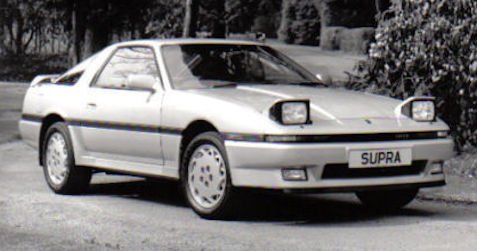
Toyota Supra 3rd generation
 |
|
| Production period: | 1986 to 1992 |
| Class: | Sports Car |
| Body versions : | Coupé |
| Engines: | Gasoline : 2.0-3.0 liters (150-206 kW) |
| Length: | 4620 mm |
| Width: | 1745 mm |
| Height: | 1301-1310 mm |
| Wheelbase : | 2595 mm |
| Curb weight : | 1530-1595 kg |
In early 1986, the third generation of the Supra was introduced. It is also the first that has not been marketed with the suffix Celica, intended to serve as the brand's prestigious flagship. Its luxury, performance, technical specifications, and driving dynamics are meant to symbolize the very best the company has to offer. Moreover, the Supra is not merely a reworked version of the Celica but a completely new model in its own right; the Celica has shifted to front-wheel drive, whereas the Supra remains true to rear-wheel drive.
Toyota's chief designer faced a significant challenge. Mr. Kunihiro Uchida had to work with an inline-six engine that necessitated a very long hood. Furthermore, since the Supra is a 2+2 coupé, he had to design a generally more spacious cabin without compromising comfort for the driver and front passenger. He also had to create the most aerodynamic bodywork possible; in this regard, the Supra boasts a drag coefficient (Cd) of 0.33, comparable to many cars in its class. It must be said that Mr. Uchida handled the initial constraints admirably.
Toyota has always excelled at designing very comfortable cabins that meet most ergonomic standards. The Supra is no exception. While the interior might appear sparse at first glance, this is due more to its presentation than its content, as the car is equipped with everything needed to satisfy even the most demanding drivers. The wraparound dashboard extends into the door panels, placing the driver in an ultra-functional environment and dials are present, with a simple glance,
In the autumn of 1987, the turbo engine with 173 kW (235 hp) appeared The turbo engine had to deal with technical problems because of the often defective cylinder head gasket and was therefore not very stable and reliable. The turbocharger had been mounted on the existing engine without correspondingly reinforcing the remaining components. Many owners of the turbo models therefore had engine problems and blown seals up to engine damage due to overheating. .
A first facelift at the front and at the rear (three-piece rear wing) was carried out in August 1988. At the same time, the naturally aspirated engine was removed from the program. A second revision took place in the spring of 1991. Engine technology, the engine received hardly appreciable 2 kW (3 hp) and 6 Nm more and "strengthened" so that 175 kW (238 hp) and 350th nm.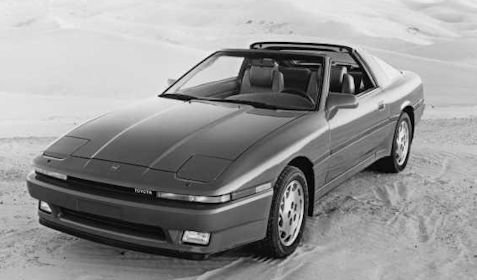
From this generation there was also a variant with Targa , which was offered in certain markets alternatively, but also as the only body version. In Japan and the United States also have a version with a sunroof available.
There was also a limited to 500 pieces homologation model of the MA70 with the designation Turbo-A (7M-GTE Turbo A). This was necessary because the then Group A regulations required this if a modified turbocharger and / or other assemblies were to be used. The Turbo A models produced 204 kW (270 hp) and were only sold in Japan.
Options: ABS, 25% locked differential, oil cooler, headlight washer system, central locking, fog lamps and, seat heating (as an option), cruise control, Targa roof (in turbo series), sunlight-dependent automatic air conditioning, electrically adjustable driver's seat, power windows, power mirrors, adjustable steering wheel ,
End of 1992, the production of the third series ended.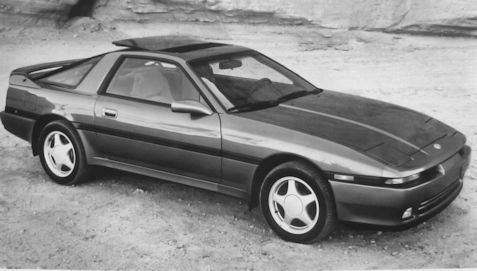
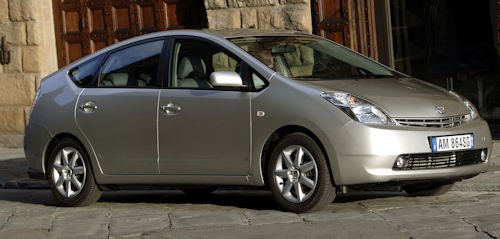
Toyota Prius Prius II (2nd generation)
 |
|
|
Manufacturer |
Toyota |
|
Production |
2003 to 2009 |
|
Class |
Motor Car |
|
Body style |
5-door lift back |
|
Layout |
Front-engine, front-wheel-drive |
|
Platform |
Toyota MC platform |
|
Engine |
|
|
Transmission |
1-speed planetary gear |
|
Hybrid drivetrain |
Power-split hybrid |
|
Wheelbase |
2,700 mm (106.3 in) |
|
Length |
4,450 mm (175.2 in) |
|
Width |
1,725 mm (67.9 in) |
|
Height |
1,490 mm (58.7 in) |
|
Curb weight |
1,317 kg (2,903 lb) |
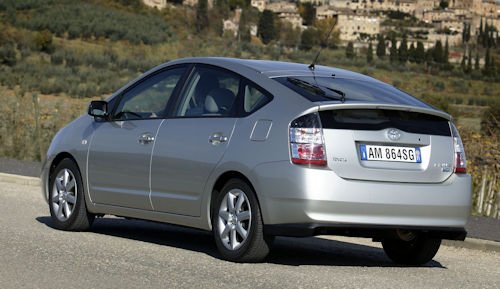
In late 2003, a new Prius appeared, which differed both in appearance and in technology from its predecessors. The headlights are pulled further up; the rear has been transformed into a hatchback. The THS has given way to the Hybrid Synergy Drive (HSD) marketed THS-II. In autumn 2005, a discreet facelift was performed.
While the new car is instantly as an evolution of the original Prius, at 4,450 mm it is 135 mm longer than its predecessor, so the new model asserts itself as a true D-segment car. Key to this is the wheelbase, which has been extended by 150 mm to 2700 mm. Aerodynamics play a significant role in improving fuel economy and performance, and the new Prius captures a leading Cd of 0.26. The underside is as smooth as possible, playing a significant role in reducing overall drag and improving high-speed stability. The suspension, developed from the Avensis model's MacPherson struts at the font and the Corolla's torsion-beam rear set-up, while aluminium components such as brakes and front suspension decrease unsprang weight, benefiting handling and comfort.
The US marketed Prius differs in technical details from the model available in the rest of the world. So, this is equipped with a CHSS (Coolant Heat Storage System abbreviation). Before starting, the gasoline engine is warmed up by the warm cooling water held in the reservoir, which shortens the emission-rich warm-up phase. Due to the gas recirculation and vapor recovery system not used in the USAAs with the NHW11, the fuel tank is equipped with a flexible bladder that minimizes evaporation emissions. At the rear wheels, the US models are equipped with drum brakes that are sufficient for the limited top speed. The European Prius can - subject to conditions - additionally triggered by the user at the touch of a button in the EV mode in which the car is moved only with the help of electrical energy from the NiMH battery. The car does this automatically whenever the controller thinks it makes sense.
The gasoline engine operates with valve timing, in which the intake valves close very late and thereby a portion of the mixture is returned to the intake tract . Therefore, despite a mechanical compression ratio of 13: 1 , the engine can be run on standard premium grade gasoline. The process called Atkinson cycle increases the efficiency.
The new Prius is the first in the world to rely on an entirely electric active safety package, including power steering and the world's first by-wire braking system with an entirely electric set-up (excluding the backup circuit). ABS, EBD and a new version of the Vehicle Stability Control system, called
VSC+ ,The VSC+ works together with the electric power steering, acting in unison when an unexpected situation occurs. As a result, it is possible to achieve a much quicker vehicle reaction time, which will prove crucial in avoiding potential accidents.
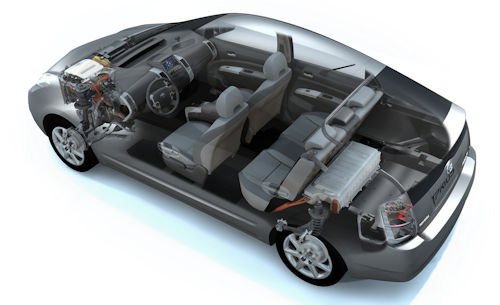
The Prius has a power-split transmission in which the moments of the gasoline engine and the electric motors are distributed to the front wheels via a planetary gear . The gear ratio and thus the speed of the gasoline engine is controlled by means of the generator and the electric motors purely electrically and completely continuously. The acceleration behaviour therefore corresponds to a car with continuously variable transmission ( CVT ).
In addition to visual changes, a modified chassis tuning and a stiffer frame construction, the facelift of the 2006 model year introduced the option of the reversing camera with parking assistant. A horizontally split rear window had before the Prius the Lamborghini Espada and the Honda CRX in the second generation. The world's first electric inverter air-conditioning improves fuel efficiency and maintains cabin temperature, even with engine off, as it runs from an independent power source, engine efficiency is not compromised.
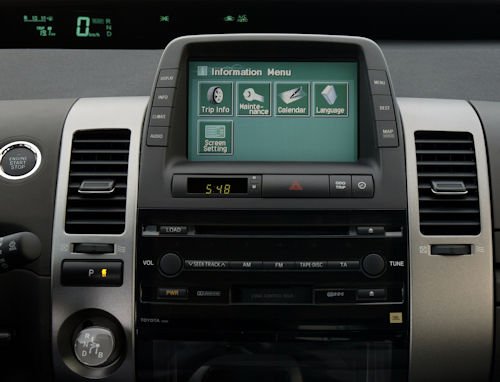
The full-map DVD-based navigation touch-screen and is equipped with powerful search capabilities that can incorporate points of interest, telephone numbers, postal code or even coordinates. The touch screen also features Bluetooth technology. Drivers with a Bluetooth-enabled mobile, simply select it from the central display and use touch-screen to dial. Steering wheel controls start and end calls with simple hands-free communication.
Consumption test
A more powerful 1.5-litre petrol engine works together with the more efficient electric motor to deliver a performance the electric motor is now more
powerful than most 1.0- to 1.2-litre combustion engines and at 400Nm from 0-1 ,200 rpm, the Prius model's torque figure surpasses that of V6
diesels. Because fie hybrid's advanced control Stern uses electric motor as the main power source, it displays exceptional smoothness. Acceleration is power, especially from 50-80 km/h, while noise and vibration are minimal. For the first time ever in a hybrid car, the driver can use the EV (Electric
Vehicle) driving mode simply by pressing a button installed in the fascia. This allows the exclusive use of the electric motor to power the vehicle,
producing zero emissions and very low noise.
The standard consumption for the Prius II is noisy factory specifications 4.3 litres of unleaded premium gasoline per 100 km distance, this has a CO 2 emissions of 104 g / km result. In the so-called "CO 2 marathon", the ADAC determined a practical consumption of 5.8 l / 100 km, which means a CO 2 emission of about 136 g / km, which makes it the best in terms of CO 2 efficiency.
The CO 2 emission measured in the "Ecotest" on the ADAC test bench was 119 g / km and the fuel consumption was 5.02 l / 100 km. The combustion of one litre of gasoline produces about 2,360 g of CO 2 .
Toyota Sequoia 2nd generation
 |
|
|
Model code |
XK60 |
|
Production |
2007 to 2022 |
|
Assembly |
United State |
|
Engine |
|
|
Power output |
|
|
Transmission |
|
|
Wheelbase |
122.0 in (3,099 mm) |
|
Length |
205.1 in (5,210 mm) |
|
Width |
79.0–79.9 in (2,007–2,029 mm) |
|
Height |
77.0 in (1,956 mm) |
|
Curb weight |
5,730 lb (2,599 kg) |
Toyota unveiled the Sequoia, 2008 model, at the 2007 Los Angeles Auto Show ; The sale started the following December. Also, the new model is based on the tundra again. Major differences, however, consist in a completely built into the body frame, a rear independent suspension on double wishbones and coil springs (for better ride comfort and space saving) and a limited slip differential in the four-wheel drive models. The new chassis ensures a smaller turning radius of 11.6 m and allows the flat rear seat. Toyota said the new frame is 70% stiffer to straight bend and 30% stiffer to torsional forces than the old one . The drag coefficient was reduced to 0.35.
The drive has also been improved: a 3UR-FE type ULEV-II -compatible 5.7-liter V8 engine in conjunction with a 6-speed automatic transmission.
The 2008 model is available in three trim levels: as before, the SR5 and the Limited; new is the Platinum . Prices range between US $ 34,000 and US $ 55,000, depending on the model and features. Base engine is the ULEV -compatible 4.7-liter V8, type Toyota 2UZ-FE, with 276 hp (206 kW) from the previous model. The 4.7-liter V8 comes standard in the SR5 model, while the Limited and Platinum have the 5.7-liter V8. Four-wheel drive is available for all models.
In the interior of the Sequoia, model 2008, there is the same dashboard as in the new tundra. Also supplied as standard: a height and tilt adjustable steering column, power windows, remote control electric door locks and two sun visors. On request, there is a DVD-based navigation system, a rear-view camera with 7 "screen, a DVD video system for the rear seat passengers, a JBL audio system with 14 speakers and heated seats with fans (standard for the equipment line Platinum). The Limited has remote controls for air conditioning, audio system and Bluetooth phone, an improved JBL audio system, electroluminescent Optitron controls, electro-chromatic dimming interior mirrors and exterior mirrors HomeLink receiver. The Platinum model comes as standard with a DVD-based navigation system, a reversing camera, rear air suspension (for easier loading) and an adaptive cruise control .
There are eight seats in the SR5 and Limited equipment lines and seven for the Platinum. The Platinum is also equipped with a 60: 40 electrically convertible rear seat. The permissible trailer load is higher than any other SUV.
The outward differences include the colour of the door handles (in the body colour of the SR5 and chrome plated in the Limited and Platinum), 20 "Platinum alloy wheels and heated exterior mirrors with remote control.
Delivered as standard: stability control (VSC), anti-lock braking system (ABS), brake assist (BAS), electronic brake force distribution (EBD), side airbags front and curtain side airbags for all three rows of seats. In the 2010 model, knee airbags for the driver and front passenger were added.
|
NHTSA Crash Test Classifications 2008 : |
|
|
Front impact driver: |
5 Stars |
|
Front impact passenger: |
4 stars |
|
Side impact driver: |
Not checked |
|
Side impact passenger: |
Not checked |
|
Rollover: |
4 stars |
Changes from model year to model year
- In the 2009 model, there was a 5.7-liter V8 engine that was suitable for ethanol (E85).
- In the 2010 model, the 4.7-liter V8 engine was replaced by the all-new 4.6-liter V8, which features a 6-speed automatic transmission. The Limited is equipped with navigation system, DVD video system for the rear seat passengers and only seven seats. Knee airbags for the driver and the front passenger were added. The Platinum received wood applications on the steering wheel and shift knob; The SR5 comes standard with Bluetooth and remote control for the audio system. The exterior colour "Timberland Mica" gives way to the exterior colour "Spruce Mica" (fir green) of the Camry . All audio systems are equipped with USB ports and can be connected to an iPod . The interior mirror in the Limited has a screen for the rear-view camera integrated.
Toyota Paseo 2nd generation
 |
|
|
Production |
1995 to 1999 |
|
Body style |
|
|
Engine |
|
|
Power output |
|
|
Transmission |
|
|
Wheelbase |
2,380 mm (93.7 in) |
|
Length |
4,155 mm (163.6 in) |
|
Width |
1,660 mm (65.4 in) |
|
Height |
1,295 mm (51.0 in) |
|
Curb weight |
910–1,000 kg (2,006–2,205 lb) |
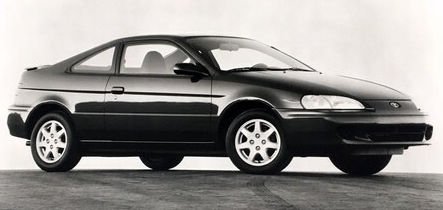
In autumn 1995, the second generation of the Paseo (type EL54) first appeared as a coupe, followed by a Cabrio in the spring of 1996. As standard, the removable sunroof, power steering, power windows, electrically adjustable mirrors, central locking, immobilizer, driver and passenger airbags and ABS were.
Optional extras included Mica Metallic paint, air conditioning, leather seats, heated seats and a Toyota audio system.
Body
From the Paseo EL54 there were two variants: a coupe and a convertible. A peculiarity of the Paseo Cabriolet is that each one was initially also manufactured as a coupe, transported to the USA to the American Sunroof Corporation and only then converted to a convertible. Finally, the convertible so produced was shipped back to Japan to be delivered from there to the customer.
A special edition of the EL54, the Paseo S was a sportier version of the standard Paseo. The features of this version were the 215 40R16 tires, a front spoiler from TTE , a TTE rear spoiler, 7.5JJx16 "alloy wheels and a lowering of about 30 mm In Austria, a sportier version of the Paseo was offered, were optical details of the Paseo in collaboration with the company Alpina Tuning.
For the Japanese market, the EL54 also existed again as Toyota Cynos . It was offered in addition to the EL54 with the engine code 5E-FHE (Cynos Beta) as EL52 (Cynos Alpha), in which the engine of the identifier 4E-FE (1331 cc, 63 kW / 85 hp) was installed. This engine was installed among other things also in the Toyota Starlet and Toyota Corolla . The EL52 Cynos was offered in contrast to the EL54 Cynos with three-speed automatic transmission.
In summer 1999 the production ended. The Toyota Paseo, introduced in May 1991 as the company's lowest priced "sporty car," was discontinued for the 1998 model year. According to Toyota Motor Sales, U.S.A., Inc., sales of remaining 1997 Paseo coupes and convertibles will continue while supplies last. The company said it is dropping the Japan-built Paseo in order to make way for new and future projects in the sport specialty-segment, including the new North American-built Solara mid-sized sport coupe which will debut this August. Based on the Tercel, Paseo was designed to reach buyers looking for a stylish sub-compact vehicle that offered strong performance with excellent fuel economy, quality and value. Tercel will continue as Toyota's entry in the sub- compact segment.
Toyota Sienna 2nd Generation
 |
|
|
Model code |
XL20 |
|
Model years |
2004–2010 |
|
Assembly |
United States |
|
Layout |
|
|
Platform |
Toyota K platform |
|
Related |
|
|
Engine |
3.3 L 3MZ-FE V6 (MY2004–2006) 3.5 L 2GR-FE V6 (MY2007–2010) |
|
Power output |
|
|
Transmission |
|
|
Wheelbase |
3,030 mm (119.3 in) |
|
Length |
|
|
Width |
1,970 mm (77.4 in) |
|
Height |
1,750 mm (68.9 in) |
|
Curb weight |
|
In January 2004, the second generation of Sienna was unveiled at the Detroit Auto Show . The manufacturing facility was relocated to Princeton, Indiana , and the Georgetown facility was converted to produce the second-generation Camry Solara . To give the revision even more chance of success, Toyota commissioned chief engineer Yuji Yokoya with the project. Yokoya and his family drove the predecessor model over 85,000 km throughout North America to find vulnerabilities.
The new model will continue to be offered in the equipment lines CE, LE and XLE, but in addition came the new top model XLE Limited. All Sienna now have a 3.3 -liter V6 engine, type Toyota 3MZ-FE, which is connected to a five-speed automatic transmission and ensures the classification of the car as ULEV . The automatic selector lever moved from the steering column to the center console and works in a zig-zag pattern, similar to that of the Lexus RX . The new design gives the car a drag coefficient of 0.30. Gas mileage improved to 14.1 l / 100 km urban and 9.6 l / 100 km out of town (with four-wheel drive : 14.9 l / 100 km urban and 10.9 l / 100 km out-of-town).
The Sienna, which has grown significantly over its predecessor, offers a wealth of new equipment details, many of which were taken over by the competition. A good example of this is the third seat, which folds flat into the floor of the car (only for front wheel drive models). She first appeared in the Dodge Caravan and Chrysler Town & Country and then on almost every van. With the Honda Odyssey this bank is only one-piece repositionable, while it is conveniently divided at the Sienna in the ratio 60: 40. Also new are the electrically operated side windows in the rear sliding doors, which disappear completely in the door (for the first time on the Mazda MPV), 8 seats (CE and LE only), electrically operated sliding doors and an electrically lockable tailgate (standard on XLE and XLE Limited, optional on the LE).

Standard remote control for door locks, height and tilt adjustable steering column, heat protection glass on the windshield and front side windows, actuators for heating and air conditioning for the rear seat passengers and tires with runflat (only for all-wheel drive) supplied. All Sienna of the model years 2004-2007 also had a trailer hitch with a trailer load of max. 1,600 kg. On request, XLE Limited xenon high voltage discharge lamps, cruise control , front and rear parking sensors , wide-angle mirrors, voice-activated navigation system, reversing camera, JBL 10-speaker audio system and a DVD video system with folding screen for rear seat passengers were available.
Security
The Sienna comes standard with ABS , Brake Assist (BAS), Electronic Brake Force Distribution (EBD), Traction Control (TRAC) and Tire Pressure Monitoring. Side airbags and side curtain airbags were standard on certain 2004 and 2005 models; since 2006, they are standard on all models. The stability control (VSC), which was initially only available on request with some simpler models, was part of the series from 2008 onwards.
The Insurance Institute for Highway Safety (IIHS) awarded second-generation Sienna a "good" rating in all six categories of head-on collision. Side airbag models also got a "good" side-impact, while the other models achieved only "satisfactory" .
|
Crash Test Ratings of NHTSA (2004) : |
|
|
Front impact driver: |
5 Stars |
|
Front impact passenger: |
5 Stars |
|
Side impact driver: |
5 Stars |
|
Side impact rear seat passengers: |
5 Stars |
|
Rollover (front wheel drive model): |
4 stars |
In 2006, the Sienna was again slightly revised and received a new front, a new side contouring and new taillights. Blue fluorescent electroluminescent OptitronControl elements have been installed in the equipment lines LE, XLE and Limited. The "XLE Limited" was renamed XLE to cause less confusion, and this line of equipment received on request a memory function for driver's seat and side mirrors (also available in the XLE optional) and electrically automatically folding exterior mirrors with built-in LED indicators. Furthermore, a Bluetooth connection and an electrically folding third seat are available on request. Front side airbags and curtain airbags for all three rows of seats are standard, but the audio system for rear seat passengers is no longer available. The power specifications according to SAE regulations are now 215 hp (158 kW) (instead of 230 bhp (169 kW)) and the torque specifications are 301 Nm (instead of 328 Nm). Toyota now allows gasoline with 87 octane for the Sienna.
In 2007, a new 3.5L V6 Toyota 2GR-FE engine with ULEV-II certification was introduced, delivering 266 hp (196 kW) and 14.1 l / 100 km urban and 10, 0 l / 100 km out of town (front wheel drive model), or 14.9 l / 100 km urban and 11.4 l / 100 km out of town (all-wheel drive model) consumed. Limited and four-wheel drive models have new alloy wheels with seven spokes.
In 2009, the Sienna remained largely unchanged, but its prices were lowered despite an additional "Extra Value Package", to make it more competitive. In the Canadian market, the base price fell by a total of CDN $ 1,500 .
Models
The Toyota Sienna, vintage 2010 is available in the following equipment :
- CE (US $ 24,540, -)
- CE 8 seats (US $ 24,690, -)
- LE (US $ 26,065, -)
- LE 8 seats (US $ 26,215, -)
- LE AWD (US $ 29,235, -)
- XLE (US $ 29,725, -)
- XLE AWD (US $ 32,485)
- Limited (US $ 35,665, -)
- Limited AWD (US $ 37,865, -)


