
Peugeot
Peugeot J7
| Manufacturer | Peugeot |
|---|---|
| Years of production | 1965 to 1980 |
| Production | 336 220 copy |
| Class | Commercial vehicle |
| Motor (s) | 4-cylinder in-line petrol and diesel |
| Displacement | Petrol: 1 468, 1 618 and 1 796 cc Diesel: 1 948, 2 112 and 2 304 cc |
| Maximum power | Petrol: 52 to 65 hp - Diesel: 48 to 66,5 hp |
| Maximum torque | Essence: 104 to 131 Nm |
| Transmission | Front-wheel Drive |
| Unloaded weight | 1800 kg |
| Maximum speed | 100 km / h |
| Bodywork | Van (from 8.7 m ), minibuses, pick-ups, livestock and chassis cab |
| Length | 4,740 mm |
| Width | 2000 mm |
| Height | 2,350 mm |
| wheelbase | 2500 mm |
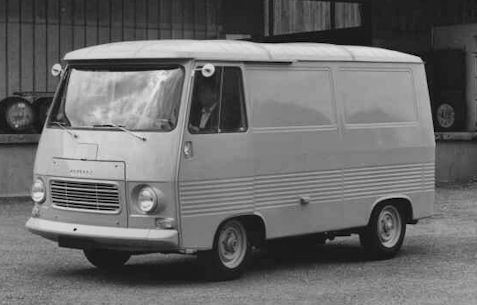
The J7 is a van sold by Peugeot as from June 1965 . It is manufactured at Chausson as the previous van D4B and, in small series, at Heuliez . The J 7 and J 9 were front-mounted pickup truck from Peugeot with front engine and front-wheel drive . This construction made possible, in addition to the usual panel van , station wagon and pick-up variants from the factory various other structures such. B. ambulance including chassis extensions of various bodywork companies .
The Peugeot J7 is a fairly compact pickup truck of advanced cabin type, with the engine under hood. It exists with petrol or diesel engines.The front-wheel drive of the J7 requires a more limited turning radius , but it allows a very low loading threshold further improved by the four-wheel independent suspension (no rigid rear axle like the current vans). The large volume for a van of these dimensions and the excellent reliability made the J7 the choice of many professionals at the time. The J7 has the particularity to have sliding cabin doors that allow rolling open doors.The principle Of "all forward" to the engine and transmission floor to 050 m from ground level,
Thus reducing effort to a minimum. The Open design Of the body provides interior: 4.6 m2 of flat floor. giving a capacity of 8.7 m: (10.1 m3 for the raised roof version). The height of the roof from floor is 1.83 m 2.13 m for raised roof version) The J7 will be available in Tahitian blue or pearl gray for 1400 kg and 1800 kg vans as well as emerald green or beige for the coach. The chassis and body have been designed using the performance techniques of aircraft construction. A rigid but light framework eminently suitable for all types Of conversion (lengthening. heightening, etc.). The side and cross members are of dimensions to withstand the points Of fatigue. The box sections are designed to withstand loading .
The J7 is first offered in a van of 1,400 kg payload. The first models can be recognized by their wheels in the same color as the body, with prominent conical front hubs and six round lights at the rear. The small front lights come from the 204 .During his career, the J7 is equipped with two basic engines, a gasoline engine with the Peugeot 404 and a Diesel ( Indenor ) whose displacement will evolve over time or according to the versions (J7 1,800 kg with a larger engine than the J7 1400 kg ).
The range is completed quickly by a 1,800 kg van (September 1965), a glazed van and a minibus (October 1965).Ambulances, livestock and the pickup arrive early 1966 .In September 1967 , the hatch access to the radiator cap disappears, we can now reach it by tilting the grille. A new dashboard with two round dials is emerging and a servo brake is now available as an option or as standard depending on the model.
With the J 9, the engines ranged from 1.6 to 2.4 liters, the power from 66 to 75 hp. The load compartment was the same size as the J 7, the total weight at the standard 1400 was 2.8 t, 1800 1800 t, at a curb weight depending on the type of a maximum of 1.7 t.
In September 1970 , the petrol versions went from 1.5 and 1.6 liter to 1.6 1.8 .For 1974 , the J7 adopts disc brakes at the front while the Comfort versions (minibuses, ambulances) see their special grille replaced by the same as the other models with an additional Lion.In September 1975 , a new straight dashboard with a four-spoke steering wheel from the 504 take place.For 1978 , the diesel versions of 1.9 and 2.1 liters go to 2.1 and 2.3 liters.At the end of 1980 , the Peugeot J7 was removed from the range. It is replaced by the J9 .
The J7 all versions (van, minibus, ambulance) will be produced from 1965 to 1980 to a total of 336 220 copies.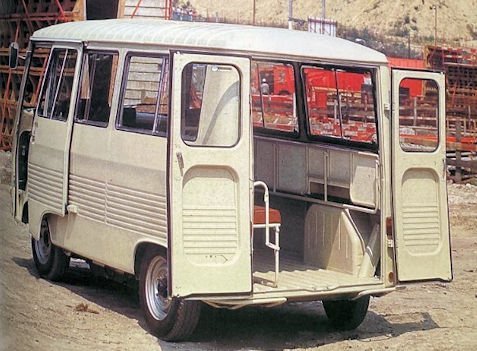
Peugeot Partner 1st generation
 |
|
|---|---|
| Production period: | 1996 to 2009 |
| Body versions : | Box van , minibus |
| Engines: | Gasoline : 1.1-1.8 liters(44-80 kW) Diesel :1.6-2.0 liters(50-66 kW) |
| Length: | 4137 mm |
| Width: | 1724 mm |
| Height: | 1810 mm |
| Wheelbase : | 2693 mm |
| Curb weight : | 1263-1344 kg |
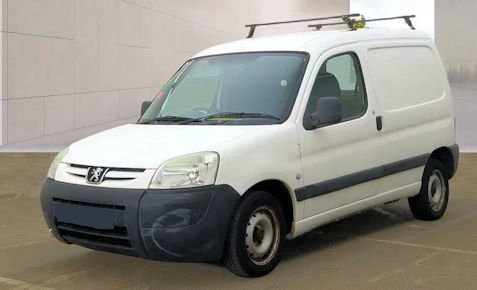
The partner was manufactured as a high roof or panel van and is identical to the Citroën Berlingo . Differences between the two vehicles exist with regard to the design of the upholstery and the selection and combination options for the optional extras. The new concept won in 1997 together with the Citroën Berlingo the title Van of the Year .
The engines are available in four-cylinder engines with 44 to 80 kW (petrol) and 50 to 66 kW (diesel). The trunk is extremely generous with 624 liters.
In early 2003, the partner received a facelift , which gave him a modified front with other headlights. 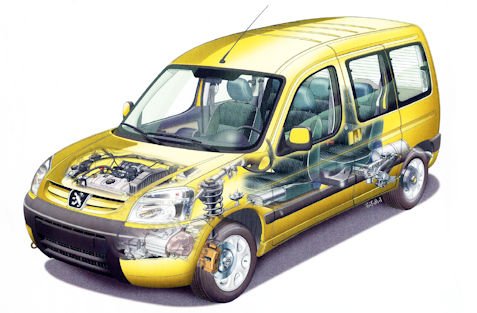
At the same time Peugeot introduced the moderate off-road variants Escapade , which was higher compared to the standard version and received an underrun protection for engine and drive shafts and protective grille in front of the headlights. The Grande Escapade version also featured an automatic locking differential (75%).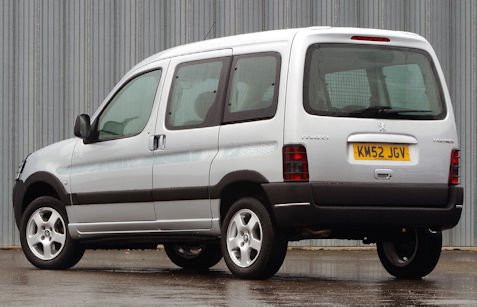
By the year 2008, 570,000 units were distributed throughout Europe, making the partner the most popular vehicle in its class. After the appearance of the successor partner Tepee this was sold under the name Partner Origin .The production of the Partner Origin expired at the end of 2009, while the Escapade ended in spring 2008 Partner Electric, Peugeot equipped in the 1990s, many vehicles with electric drive. They were powered by DC motors , as a traction battery wet nickel-cadmium batteries Saft company were used.
Peugeot 404 pickup truck
 |
|
| Manufacturer | Peugeot |
|---|---|
| Years of production | 1967 to 1988 |
| Production | 802.023 copy (s) |
| Class | Commercial vehicle |
| Engines | 4 cylinders in line, 1 468 cm 3 , 1 618 cm 3 carburetor or injection 1 948 cm 3 diesel |
| Unloaded weight | 1.160 - payload: 950/900 kg |
| Maximum speed | 120 - 135/108 km / h |
| Bodywork (s) | Pick-up - Cab chassis |
| Length | 4.580 mm |
| Width | 1.720 mm |
| Height | 1,600 (cover 2.120) mm |
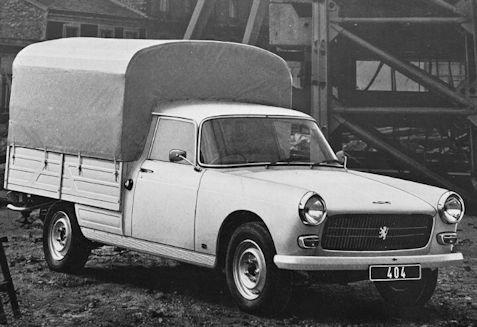
The Peugeot 404 Pickup is a utility vehicle from the French car manufacturer Peugeot , produced from the beginning of 1967 . It is directly derived from the 404 sedan and comes to replace the Pickup 403 from 1956. Peugeot has marketed two variants of this utility: the 404 pickup truck and the 404 bare chassis to bodyshell.
In 1955, Peugeot presents the 403 . Shortly after Citroën launches the DS . French customers do not succumb to the hydraulic suspension, especially since the first technical problems appear very quickly. But faced with this keen competitor, the Sochaux leadership, for the first time, reacts very quickly and by the end of 1955, the decision to launch urgently the study of the replacement of the 403 .
The first project included a V8 petrol engine and a hydraulic suspension ... given the serious setbacks of Citroën with its DS, this engine is quickly abandoned. The world is in addition to the full Suez war, Peugeot is betting on a traditional family sedan, but with a modern appearance. Very satisfied with his first collaboration with the Italian bodybuilder Pininfarina , designer of the 403, Peugeot entrusts him with the study of the 404 but with a drastic constraint, the extreme reduction of the duration of the study. It was, however, admitted that the designer had the opportunity to draw inspiration from a project already ready or underway. Pininfarina then proposed the study carried out on behalf of Fiat which will give birth to the Fiat 1800/2100 and, for the British Austin . After some retouches to make other manufacturers accept that Peugeot sells a similar body, the 404 is designed in just 3 months. The production of the Peugeot 404 sedan was launched on May 10, 1960 Pininfarina will manufacture in its workshops the coupe and cabriolet models for Peugeot from 1961 to 1968.
The propulsion part was partly that of the 403: cast iron engine block, 4 cylinders in line, three bearings, cylinder head made of light alloy Alpax ) but with a displacement of 1.6 liters and tilting the block at 45 ° (" lying "on the right). The power obtained was 65 ch DIN. In 1963, on the occasion of the launch of the coupé / cabriolet, this engine will be equipped with the indirect injection carrying the power to 80 ch DIN.
The success of the car is immediate, the sedan is not lacking assets with its sober and elegant line, the proven mechanics of the 403, which allows Peugeot to attract a customer frightened by the innovative solutions but without reliability of the Citroën DS / ID. Renault did not offer any vehicles in this segment. The 404 range included the sedan, convertible, coupe, station wagon, and pickup truck also called in France tarpaulin.
The Peugeot 403 pickup truck continued its commercial career until 1967 and quite naturally gave way, in July 1967, to the 404 van with tarpaulin. It is also called 404 U8 . This first series, available with a petrol or diesel engine, offers a fairly low payload of 850 kg. The model is quickly supported by the version 404 U10 also available in gasoline or diesel, with a payload of 950 kg. Without real competition on the French market, the 404 covered van will quickly win. These versions of the Peugeot 404 will quickly acquire a solid reputation of robustness and will make the beautiful days of artisans and farmers. The 404 pickup became iconic before disappearing quickly. It must be said that it has been very popular in the former French colonies of Africa where many copies have been exported.
The 404 utility has been equipped with different engines: carburetor , fuel injection or diesel .Like its predecessors, 203 pickup truck and 403 pickup truck , this is a rigid rear axle propulsion and shift lever. The front suspension adopts, for the first time, helical springs in place of the traditional transverse leaf spring present since the 201 .The 404 pickup incorporates the front half of the sedan, designed by Pininfarina with its protruding wings and the panoramic windshield with return to the sides. The side windows are flat without baffles.
Like the sedan, the 404 pickup has been criticized for its braking consists of four economic assisted drums called "thermostable". These brakes are effective but of a picky maintenance, they will eventually be replaced (with a lower assistance) in 1968 only, by front disc brakes already used by most competing foreign manufacturers. On the other hand, the Indenor diesel version will never be entitled to braking improvements.
The Peugeot 404 was assembled locally in CKD on the chains of the Berazategui factory from 1962. That year, 2 071 copies were produced as well as 6 734 Peugeot 403 .A year later, the family version made its appearance but the production is interrupted in September 1964 as a result of malpractices in the importation of French components that lead to the dissolution of the company IAFA.In 1965, SAFRAR took over the factory and obtained a license for local production and no longer the assembly of Peugeot models. In 1973, the Pick Up T4B is replaced by a version built on the basis of the 404. In 1972, the diesel engine is proposed with the model 404 D. In Argentina, the gasoline engine delivers the power of 73 hp SAE to 5,600 rpm with a compression ratio of 8.3: 1.
As a result of legal regulation problems, the pickup version was stopped in 1978, its manufacture will resume in 1980 with a larger loading platform for some units only because, with the absorption of SAFRAR by Sevel Argentina that same year , the production of the whole range 404 is definitively stopped in Argentina. it appears that 26,372 copies of the TB4, 404 van and pick-up would have been assembled or manufactured locally between 1962 and 1980.
Peugeot 807
 |
|
| Also called | Citroen C8 Fiat Ulysses II Lancia Phedra |
|---|---|
| Make | PSA-Fiat |
| Years of production | 2002 - 2014 |
| Production | Peugeot 807: 197 919 copies |
| Classroom | People Carrier |
| Assembly plant (s) | SEVEL Nord |
| Engines | Gasoline 2.0 136/140 hp 2,2 158 hp 3,0 V6 204 hp Diesel 2,0 HDi / JTD 110/120/136/163 2,2 HDi / JTD 128/170 hp |
| Engine position | Before, transversal |
| Displacement | From 1,997 to 2,946 cm 3 |
| Maximum torque | From 190 to 400 Nm |
| Gearbox | Manual 6 speed Automatic Sequential 4/6 Reports |
| Unloaded weight | From 1,645 to 1,825 kg |
| Mixed consumption | From 6.9 to 9 L / 100 km |
| Emission of CO 2 | From 182 to 213 g / km |
| Bodywork | 5 doors, 2 (5) to 8 seats |
| Frame | Citroen C8, Peugeot 807, Fiat Ulysses II, Lancia Phedra |
| suspensions | front: MacPherson , lower arms triangulated stabilizer bar, hydraulic telescopic shock absorbers rear: torsion bar , Panhard bar , hydraulic telescopic shock absorbers |
| Length | 4,727 mm |
| Width | 1,854 mm |
| Height | 1 752 mm |
| wheelbase | 2,820 mm |
| Trunk volume | 324 dm 3 |
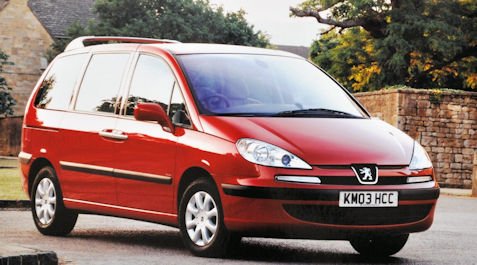
The Peugeot 807 are MPVs with seven or eight seats produced on the same basis, in the SEVEL Nord plant constituted by Sevel , a joint venture PSA Peugeot Citroën - Fiat Professional .
Predecessors released in 1994 were perceived as lacking personality and resembling utilities. Both groups decided to fix it. The line of four minivans is now less cubic. In addition, each asserts a different identity , each brand having been able to draw the front and rear faces of its model .Only upholstery and equipment differ. The four minivans are large and flexible, as evidenced by the seats that can be disassembled and put in several positions. The dashboard is almost identical on all four versions. The center console above the floor always accommodates the shifter and climate controls . The trunk volume is 324 liters in 7 or 8 seater configuration.
The design of the Peugeot 807 is very similar to that of the C8 and the profile is identical. At the front, the lion's brand's prominent acronym struts the grille and headlights half-way up. The upper optics are tapered as on the Peugeot 207 , Peugeot 307 and Peugeot 607 . At the rear, the vertical lights are shorter and wider than those of the C8. The location for the license plate is lower on the tailgate than on the Citroën .
Phase I: 2002 - 2008
Phase II: 2008 - 2013
Phase III: 2013 - 2014
Peugeot / Citroën: 2002 - 06/ 2014
Phase II (2008 - 2012)
- New HDI 163 FAP BV6 and BVA engine (later availability).
- Diesel engines:
- 2.0 l 16v HDi FAP (120 hp), 300 Nm, 6-speed mechanical gearbox;
- 2.0 l 16v HDi FAP (136 hp), 330 Nm, 6 speed manual gearbox;
- 2.2 l 16v HDi (170 hp), 370 Nm, 6-speed manual gearbox / 400 Nm, 6-speed automatic transmission;
- The gasoline range:
- 2.0 l 16v (141 hp), 200 Nm, 5-speed manual / 4-speed automatic transmission.
The Fiat group has already announced that it stopped the manufacture of its models at the end of 2010. The Citroën C8 and Peugeot 807 will first be restyled in 2012, but will not be renewed because of public disinterest for this type of vehicle (minivans are gradually abandoned in favor of crossovers and SUV).The 807 also evolves by integrating on this occasion the latest stylistic codes of the lion brand: new bi-tone emblem on the grille, new flap hubcap and the new Peugeot brand block on the rear flap, new interior ambiances typified above. range: "Mistral" interior with black harmony on the Allure finish, appearance of alcantara on the door panels and the dashboard. The engine offer is identical to that of the C8.The production of the two French models was stopped in June 2014 without direct descent in the respective ranges although the Peugeot 5008 and Citroën Grand C4 Picasso II also have 7 seats, in a more compact size.
Peugeot 406 Coupé
 |
|
|
Years of production |
1997 to 2004 |
|
Production |
107,631 copies |
|
Motor |
Gasoline |
|
Engine position |
Front transversal |
|
Displacement |
1997 to 2946 cm 3 |
|
Transmission |
Front-wheel Drive |
|
Gearbox |
Manual 5 speed |
|
Maximum speed |
203 to 240 km / h |
|
Acceleration |
0 to 100 km / h in 7.8 to 12.3 s |
|
suspensions |
MacPherson |
|
Length |
4,615 mm |
|
Width |
1,780 mm |
|
Height |
1,354 mm |
|
wheelbase |
2,700 mm |
|
Ways Front / Rear |
1512 mm / 1524 mm |
|
Trunk volume |
390 dm 3 |
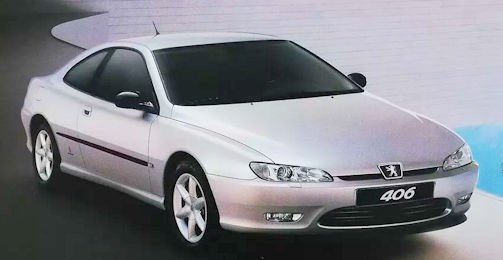
The Peugeot 406 coupe is a car of the Peugeot brand (PSA group) manufactured in Italy near Turin in the Pininfarina factory of San Giorgio Canavese.
Derived from the 406 sedan, it nevertheless retains no bodywork element, which was entirely designed, developed and manufactured by the famous Italian bodybuilder Pininfarina. Presented for the first time to the public in October 1996 at the Mondial de Paris, its commercialization began in May 1997.Peugeot produced 107,631 cut 406 for an initial contract of 70,000 vehicles with Pininfarina
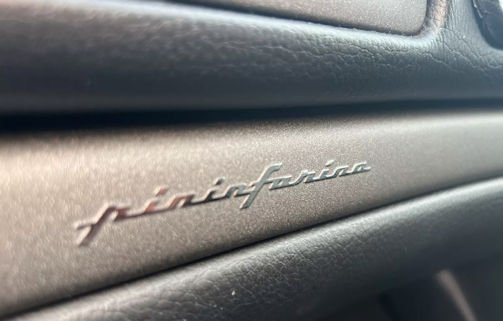
History
The coupe is a long-standing tradition at Peugeot (type 21 is the first of the brand, made in 1898 4), but at the end of production of the 504 coupes in 1983 5 no model ensures the next generation. Indeed, Peugeot is experiencing some financial difficulties as a result of its failure in the United States 6 and the acquisition of Chrysler-Simca, projects (405 and 505 coupe) are removed
It is only 14 years later that the 406 Coupé will come, scratched like its predecessor, Pininfarina. Indeed, the cooperation between the firm of Sochaux and the Italian coachbuilder is not at its first test: the Peugeot 403 benefited from 1951. Many pirate clichés will circulate until the official presentation of the model in October 1996 at the Paris Motor Show.
Comfort is a strong point of the 406 Coupé, its leather endowment is well made and the interior space is quite generous. It only has 4 seats; it also allows it to provide passengers with a rare ease in the segment. The seats are electrically operated and have a memory position. They were designed by Pininfarina but are made by Recaro, a company famous for its sports car seats.For reasons of cost, several elements of the cabin are borrowed from the sedan, so the interior presentation is considered too classic and lacks exclusivity. The dashboard stands out for example only by a metal strapping counter.
The 406 Coupé is a well-supplied model in terms of equipment compared to the rest of the manufacturer's range. From the restyling in April 99 there is therefore a modern standard equipment (on-board computer, air conditioning, cruise control ...), but the metallic paint or the GPS are optional for the two finishes "Base" and "Pack". The electric sunroof is available as an option on all finishes except the "Griffe" which has them as standard.
- Finish "S" (base): (50 701 examples)
- Regulated air conditioning, radio RD3 steering wheel, lining mid leather, board computer, through loading, cruise control, heated electric door mirrors, variable power steering, emergency brake assist, ABS / ESP (except 2.0 e BVA), light alloy wheels
- Finishing "Pack”: (50,046 copies)
- Finish "S" + upholstery leather, headlight washers, rear view mirror inside electrochromic, floor mats, driver seat memory, heated and electric front seats, audio system JBL "Prestige"
- Finish "Claw”: (885 copies)
- Metallic paint, Hurricane leather upholstery (black), memory driver's seat, electric and heated front seats, JBL "Prestige" audio system, CD charger, cruise control, climate-controlled air conditioning, aluminium door sill, electric heated exterior mirrors and electrically folding rear view mirror, 16 "alloy wheels, automatic headlamps, headlamp washers, rain sensor, alarm, variable assist steering, on-board computer, ABS / ESP (Except 2.0e BVA), sunroof electric
- Finishing "Ultima Editioned" (Limited): (2,177 copies)
- Controlled air conditioning, RD3 radio, JBL "Prestige" audio system, variable assist steering, on-board computer, cruise control, electric heated and fold-down exterior mirrors, ABS / ESP (except 2.0 BVA), 16 "alloy wheels lightweight, leather upholstery, headlamp washers, electrochromic rear-view mirror, memory driver seats, electric and heated front seats
Upholstery
- Three leather upholstery and two fabrics make up the finish of the coupe right out. The leathers are ventilated, recognizable by perforations on the seat and the backrest. The available colours are " Apricot”, " Amaranth " and "Hurricane" for black leather. The interior fabrics offered are "Blue Nile" and "Gray Nile”. Steering wheel, shift knob and gearshift bellows are lined with Hurricane leather for all finishes.
- In May 2000 the leather Apricot gives way to the leather " Chestnut " and the fabric Blue Nile to "Salzburg Astrakhan" in a tone Grayer, the Gray Nile is no longer available. The leather is now pleated rather than ventilated and the steering wheel adopts a two-tone leather matched to the chosen leather finish.
- For its new Phase2 trim, the coupe leaves its Amarante dress replaced by the blue " Cobalt " and its two-tone steering wheel. The fabric "Salzburg Astrakhan" meanwhile has smooth leather hurricane on its flanks.
- Another interior made its appearance with the special series "Sport”, the "Chess”. Translated from chess into English, it is characterized by its black checkered fabric and smooth Hurricane leather on the sides of the seats.
- A white leather interior is reserved for the limited series "Settimana”, in conjunction with a chestnut leather, also exclusive because the two finishes offer a matching padding and gearshift bellows, the brake lever parking and a two-tone steering wheel.
Mechanical
Taking the chassis of the sedan with independent wheels, a front-type pseudo- McPherson and a multi-link rear axle, the 406 Coupé inherits a good compromise between handling and comfort. The wheelbase remains the same, but the ground clearance is reduced compared to the sedan, the centre of gravity is thus lowered and an anti-approach bar adds a little more stability when cornering (only models 2.0l are not equipped). Pilotless suspensions are available as an option for the V6 pack.
Braking is provided by Brembo 4-piston callipers mounted on 305 mm diameter ventilated discs for V6 and HDi models or floating callipers mounted on 283 mm ventilated disks for 2.0l and 2.2l versions. At the rear a floating calliper mounted on a 290 mm disc fits all versions. If the ABS is standard when the coupe is launched, the ESP only appears in 99 and the AFU in 2001.
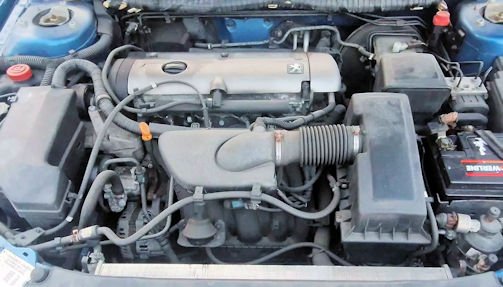
Only available in two gasoline versions four and six cylinders at launch, the coupe will have its diesel in January 2001. Like the Coupe 504, which inaugurated the V6 PRV in its day, the 406 Coupé inaugurated the PSA / Renault “V6 ESL engine " o. Its engines undergo some modifications during his career, the aging 135- hp four-cylinder in-line from the 605 is replaced in 1999by the new 2-liter 137 hp, borrowed from the 206 S16. At the same time the V6 evolves after a visit to Porsche, its power is increased to 210 hp for consumption down. In March 2002 the 2.0l in manual transmission gives way to 2.2l 160 hp which already equips the sedan 607.
Completely in the style of its designer, the coupe does not include any element of bodywork of the original sedan. She was awarded several times and was not restyled except for her shield before, at the end of her career. Unlike the usual, the hull mirrors do not take the colour of the body but a dark colour marking a break with the line of the car. According to the designer it would, in profile, making them invisible mirrors. Peugeot offers an accessory fin for those customers who want to stand out from the crowd with a touch of sportiness.For phase 1, the drag coefficient (Ch) is 0.32 and the Sc (Ch multiplied by the frontal area) is 0.656. These figures determine the aerodynamics that directly affect fuel consumption and top speed.
The exterior mirrors receive a " twilight " Gray paint (Colour Code: ETK) until 2003 when it is changed to a cosmos gray paint (Colour Code: EYF) formerly present in the catalo of body colours. The Granit black coupes are exceptions and receive mirrors of the same colour.Fifteen shades were part of the catalo, but only the colours Scarlet Red and Gray Thallium were proposed from the beginning to the end of the production. The colour Heather Gray in shades beige and gray light has the shortest career, he appeared in May 2004 to replace the Beige Solstice.The coupe was originally introduced with a 15 "mounts for the 2.0l or 16" for the V6 BBS rims, manufactured in Italy and bearing the name of their manufacturer. These 7-inch-wide rims with central hub cover will only be replaced in July 2001 by the "Hoggard" model. More differences between engines, all are entitled to 16 inches.In 2002, the model "Nautilus" introduced with the series " Settimana " in two-tone colours equips the entire range in a new plain Gray metallic version. Finally in April 2003 the restyling Phase 2 brings the 5 branches of the rims " Tacoma ".
The coupe has undergone several changes more or less important in his career. We talk about coupe phase 1, phase 1 "restyled" and phase 2. In April 1999 Peugeot changes the engine XU10J4R 2.0 l 135 hp for the EW10J4 2.0 l 137 hp, the V6 ES9J4 is remodelled at Porsche 210 hp and takes the name of ES9J4S. The throttle cable disappears in Favor of a potentiometer. The electrical circuit is partially multiplexed so-called "semi-mux" and the control plate changes appearance. In 2001 appears the diesel engine, in 2002 version 2.2 petrol. In order to meet the new European directives on pedestrian impact, Pininfarina provides in 2003 a new front shield more in line with the stylistic evolution of the Lion brand, reminiscent of the Ferrari 612 Scaglietti, and announcing the future 407.
April 1999 (at the same time as the sedan):
- Phase 1 "restyled"
- Partial multiplexing, on-board computer and new display, new automatic climate control on all versions, new car radio, transparent side turn signals ... New central console, new form of steering wheel, removal of the visible cut-out of the passenger airbag. Smooth leather storm doors replaced by the same perforated leather to go with the upholstery.
2000:
- May: Change of some colours, black marking of the amounts of the front windows, perforated leather replaced by a folded leather.
- October: Limited and numbered series stuntman
2001:
- January: Appearance of a diesel engine 2.2 HDi
- July: Multiplexing (full mux), emergency brake assist, automatic ignition of the lights, a thermic windscreen, 16 " Hoggard rims, change of some colours ...
2002:
- Removal of Brembo callipers on HDi, 16 " Nautilus rims, replacement of 2.0 l 16s by 2.2 l 16s
- Special series "sport" or "Black & Silver" abroad
during April 2003:
- Phase 2
- New shield in the spirit of the future 407, 16 " Tacoma wheels, removal of Brembo callipers on the V6, change of some colours and skins ...

