

Opel Kaptain A
 |
|
|
Production period: |
1964 to 1968 |
|
Class: |
Luxury Car |
|
Body versions: |
Sedan, coupe |
|
Engines: |
Gasoline: 2.6-5.4 Liters |
|
Length: |
4948 mm |
|
Width: |
1902 mm |
|
Height: |
1494-1510 mm |
|
Wheelbase: |
2845 mm |
|
Curb weight: |
1350-1610 kg |
|
previous model |
Opel Captain P 2,6 |
|
successor |
Opel KAD Series B |
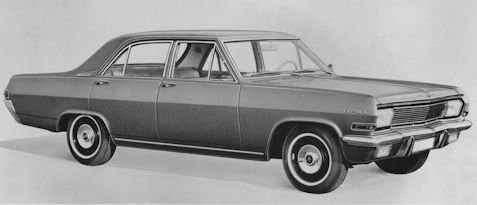
The Opel Kaptain was built from spring 1964 to autumn 1968 at the Adam Opel AG in Rüsselsheim the mid luxury class model Kaptain Part of the Kaptain, Admiral and Diplomat, line up short for: Opel KAD A, successor to the previous Captain P 2.6, all had the same newly developed body with a straight shape and offer more interior space than the earlier Admiral with 316 cm, and at 484.5 cm in length. This was the Cheapest model in the line. The Kaptain A had a horizontally accented grille and chrome trim less, than the other two models.
Opel again now offered engine with eight cylinders in the program first since the 1920's. The V8 engine was derived from the Chevrolet - Division of parent company General Motors.Initially, it was offered with a 2.6-liter inline six-cylinder engine and a power output of 74 kW (100 hp). In September 1965, this was replaced by the newly designed inline engine Opel CIH with six cylinders, 2.8 Liters displacement and 92 kW (125 hp). The new litre six-cylinder engine which develops 140 HP at 5200 r.p.m. The engine features an extremely short stroke (69,8 mm (2.75 in.) and a 92 mm (3.62 in.) bore), overhead camshaft, wedge-type combustion chambers, valves in slanted position, crankshaft with 7 main bearings, twin barrel carburetor with automatic choke. Acceleration from 0-100 km/h (0-62 MPH) in 13,9 seconds, top speed about 170 km/h (106 MPH).
In addition, there was from September 1965 the " Kaptain A V8 " with a 4.6-liter Chevrolet V8 engine with 140 kW (190 hp). From this version only 113 vehicles were built.
For tax purposes, the Austrian market also had a 2.5-liter version with 82 kW (112 hp). It was also possible to choose between 92 kW variant (S engine) or the more expensive 103 kW HL engine (HL for high performance) with two Zenith carburettors from 1967 onwards. In the 2.8-liter six-cylinder engines Opel first used hydraulic tappets, which made a control and adjustment of the valve clearance unnecessary. All models were equipped with a standard four-speed manual transmission.
Inside, in addition to three levers (fresh air/air blower, temperature, air distribution), there are six further controls for heating and ventilation: two fresh air flaps for the footwell, two air vents for the side windows, and two knobs for separate regulation of the footwell heating. This results in a large number of possibilities, but it is almost too much of a good thing to have to regulate the heating and ventilation in nine different places but the system's performance as a heater is excellent; for ventilation. The other switches and instruments are clearly arranged; a clock, trip odometer, and reading light are included. A center armrest is available for the rear passengers, and a rear-window defroster fan can be installed upon request. The precise, quiet closing action of the doors and trunk lid deserves praise; the owner's manual quite rightly points out that there is no need to slam the doors shut. As is typical for Opel, the front doors can be locked from the outside without a key by pressing the button while closing them. Only a single key is provided; the doors cannot be opened from the inside when the locking buttons are depressed. The size of the trunk is beyond reproach.
Kaptain was equipped as standard with 4-speed transmission for a surcharge was a middle shift or the two-speed Powerglide automatic with shift lever on the steering wheel. This automatic from General Motors was standard in the Diplomat A, with centre selector lever Power steering is available option.
A total of 24,249 copies were built from February 1964 to November 1968, of which alone 15,030 models with the 2.6-liter engine until August 1965. The trio was replaced in the spring of 1969 by the KAD B series, whose bodies were a little smaller and smooth-surfaced.

