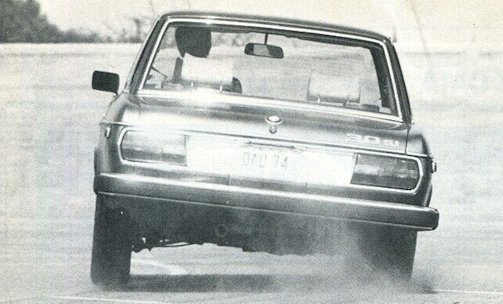
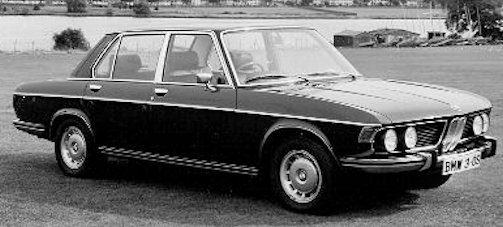
BMW E3 3.0 3.3 New Six
 |
|
|
Manufacturer |
BMW |
|
Production |
1971 to 1977 |
|
Assembly |
Germany |
|
Designer |
Wilhelm Hofmeister |
|
Class |
Luxury Car |
|
Body style |
4-door sedan/saloon |
|
Layout |
Front-engine, rear-wheel drive |
|
Platform |
E3 |
|
Engine |
|
|
Transmission |
|
|
Wheelbase |
|
|
Length |
|
|
Width |
|
|
Height |
|
|
Curb weight |
|
The BMW E3 3.0l and 3.3l were 4-door sedan/saloon cars produced from 1971 to 1977
Model History
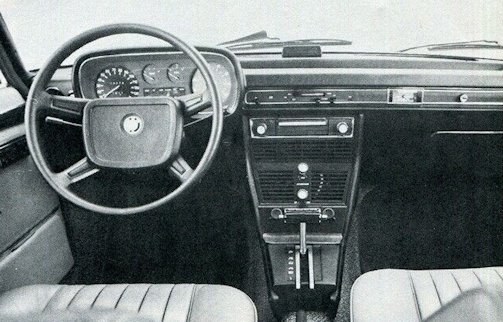
In 1971, came the BMW 3.0 S As of the first E3 2500 and 2800 models the chassis is based on that of the New Class models. With more luxury fittings and options such as Automatic/Manual Gearbox options power assisted steering.Insulated glass. Light alloy wheels, Electric steel sun roof. Eloctric windows.
Leather covered steering wheel, Leather upholstery, Individually shaped seats at the rear. Automatic seat belts front and back Automatic aerial, 2 rear
reading lamps, Cigar lighters front and back, Head light, Wiper/washer system. Halogen fog light. Exterior overtaking mirror electrically adjustable from inside.
The good driving characteristics of previous BMW models were surpassed by corrections with an inclination of the axis of the MacPherson struts to the pivot axis, and despite the higher front axle load, easier steering than the BMW 2000 was achieved. The four-wheel Independent suspension system Boge "Nivomat" spring struts with automatic levelling were sometimes used on the semi- trailing arm rear axle. Another difference is the use of disc brakes on the rear wheels as well. A rather sporty chassis tuning distinguishes the BMW E3 from other luxury cars of the time.
The electrical equipment includes a 500 W three-phase alternator, a heated rear window, rear fog lights and four halogen headlights Becker Grand Prix three-speaker AM/FM stereo radio.
With a higher engine output thanks to more displacement. The range of mixture preparations in the BMW 3.0 Si was increased by intake manifold injection added. The second E3 series, available from the summer of 1971, was characterized by small external changes. In addition to other rims, the forced ventilation of the interior was relocated to the slots next to the rear window with the elimination of the side grilles in the C-pillar. The radiator grille was matte black instead of chrome-plated, the rear lights got a different layout of the light chambers, and additional mouldings were introduced, which landed on the fold at the level of the waistline and continued over the trunk lid on the models with larger displacement.
In addition to the well-known six-cylinder engines, larger machines were also being developed. Some have even been running on test benches. These included eight-cylinder engines with a displacement of between four and five litres and a twelve-cylinder V engine with a capacity of around five litres and which produced around 227 kW (310 hp). In 1973, an eight-cylinder was installed as a test in an E9 series coupe.
In August 1974, a new body variant with a 100 mm longer wheelbase was presented in the BMW 2.8 L and the BMW 3.0 L; at the same time, the interior of the vehicle has been upgraded to a higher standard. At the same time - only for the long version a new engine variant with more displacement was introduced with the BMW 3.3 L, which later with intake manifold injection and slightly reduced displacement, but significantly reduced consumption as the BMW 3.3 Li compared to the BMW 3.0 Si, although no additional power, but offered a better torque curve The BMW 3.0 Si was one of the fastest 4 door production cars in the world at the time with a Top speed of 133 mph.
PERFORMANCE
- max speeds: (1st) 33 mph, 53 km/h; (2nd) 59 mph, 95 km/h; (3rd) 91 mph, 146 km/h; (4th) 127 mph,205 km/h
- max power (DIN): 180 hp at 6,000 rpm
- max torque (DIN): 188 1b ft, 26 kg m at 4,300 rpm
- power-weight ratio: 17 lb/hp, 7.7 kg/hp
- acceleration: standing 1/4 mile 16.2 sec
- fuel consumption: 24.8 m/ imp gal, 20.6 m/US gal, 11.4 1 x 100 km.
3.0 Si
- max power (DIN): 200 hp at 5,500 rpm
- max torque (DIN): 201 1b ft, 27.7 kg m at 4,300 rpm 67 hp/l
- max speed: 131 mph, 211 km/h
- power-weight ratio: 15.7 lb/hp, 7.1 kg/hp
- acceleration: standing 1/4 mile 15.8 sec, 0-50 mph (0-80 km/h) 7.8 sec
- fuel consumption: 25.2 m/ imp gal, 21 m/ US gal, 11.2 1 x 100 km.
3.3 L
- power-weight ratio: 15.4 lb/hp, 7 kg/hp
- acceleration: standing 1/4 mile 16.1 sec
- fuel consumption: 25.7 m/ imp gal, 21.4 m/US gal, 11 1 x 100 km.
- max power (DIN): 190 hp at 5,500 rpm
- max torque (DIN): 214 1b ft, 29.5 kg m at 3.500 rpm
- 57 hp/l.
The sedan went a step further and in the same year put the V12 in a BMW 3.0 L. This had to be lengthened by 80 mm at the front so that the machine could fit. The vehicle reached almost 240 km/h. About five of the large twelve-cylinder were made by hand; However, after the first oil crisis in 1973/74, BMW stopped using it in the large sedans and coupés.
Model designation
There is no separate, coherent model designation for the vehicles in this model series, only the cubic capacity is given as the model designation. However, since the BMW vehicles in the smaller vehicle classes in the engine range do not overlap with the displacement sizes of the BMW E3, a clear distinction can be made between them.
- BMW 3.0 (displacement in litres)
- BMW 3.3
The type designations were sometimes combined, supplemented by letters suffixed to indicate a higher engine output ("S" - Sport), intake manifold injection (“i" - injection) or the longer wheelbase in connection with higher-quality equipment ("L" - long/ luxury).
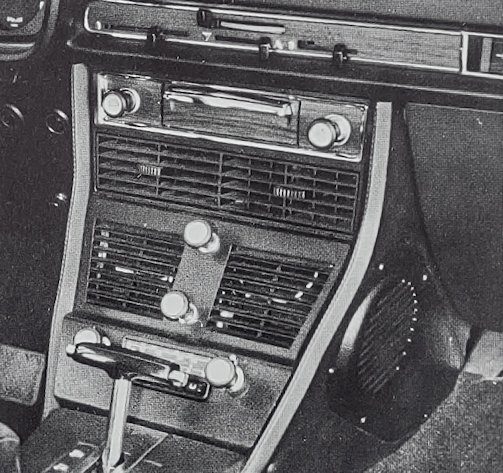
* The 3.3 L and 3.3 Li vehicles were equipped with an automatic transmission as standard; a manual transmission was only available as an option on the 3.0 L a Optional Borg-Warner 35 automatic transmission, with hydraulic torque converter and planetary gears with3 ratios + reverse (1st 2.400, 2nd 1.460, 3rd 1, rev 2.400), with possible manual selection the indicator reads "P-R-O-A-2-1"; "0" means Neutral and "'A" means Drive. .
The BMW E3 was produced in a total of around 190,000 vehicles of all engine sizes.