

Marcos GT 1800
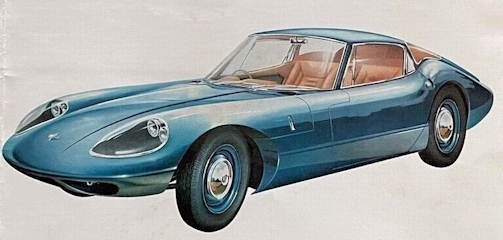 |
|
|
Manufacturer |
Marcos Engineering Ltd. |
|
Production |
1964 to 1966 |
|
Designer |
Dennis and Peter Adams |
|
Class |
Sports car |
|
Body style |
2-door coupé |
|
Engine |
1.8 L Volvo B18 I4 |
|
Transmission |
4-speed manual |
|
Wheelbase |
89 in, 2,261 mm |
|
Length |
159 in, 4,039 mm |
|
Width |
62.50 in, 1,587 mm |
|
Height |
41.50 in, 1,054 mm |
|
Dry weight |
1,217 1b, 552 kg |
The Marcos GT 1800 was a light British sports car built in the 1960s.
History
The first Marcos, the Marcos Xylon of 1959, was a car with gull-wing doors, free-standing front wheels and a four-piece windscreen. In 1962 Marcos first appeared at the 24 Hours of Le Mans. The Luton Gullwing Coupe with the drivers John Hine / Dick Prior, powered by a 1.5-liter Ford Martin 12-valve engine, but had to be turned off in the 9th hour with engine damage (oil pressure).
From 1963 there was an orientation towards more roadworthy vehicles, which should be achieved with the model Fastback GT. With 18 produced units of the Fastback, however, this attempt was unsuccessful, the more successful, however, acted in international motorsport by Marcos’s factory-owned racing cars now often used on the mainland (including two works cars in the 500-km race Nürburgring 1963). In January 1964, the Marcos 1800 had its premiere at the London Motor Show the glass fibre-bodied Marcos 1800 GT was now introduced. A completely new design, the proven plywood chassis, which however had to be completely redesigned, and a robust engine from Volvo were the basic building blocks for the now more successful entry into series production of a sports car whose development continued until the 1990s.
- Leg Room passenger 28" 71cm
- Leg Room Driver 15" 38cm
- Boot Height 16" 41 cm
- Boot Length 21" 53 cm
- Boot Width 32" 81 cm
It was not until 1969 that the production of the plywood chassis was abandoned because the immensely time-consuming production. The plywood chassis was glued together from 386 separate pieces was no longer profitable and drove the small business into ruin. As a replacement, the brothers Adams developed a robust, but very conventional tubular frame on which the proven fiberglass body was now screwed.
using the cast-iron block and head the four-cylinder Volvo with engine capacity of 108.62 cu in, 1,780 cu cm B18 unit with a compression ratio of 10 and powered with 2 Stromberg 175 CD horizontal carburettors fitted with an overdrive gearbox and options for IRS suspension and De Dion rear axle with various ratios. Successful in competition with distribution of weight at 50% front axle, and 50% to rear axle, but the rather expensive car sold very slowly, and after the first 33 cars the de Dion rear suspension was replaced by a live Ford axle.

PERFORMANCE
- Engine capacity: 108.62 cu in, 1,780 cu cm
- Fuel consumption: 30 m/imp gal, 25 m/US gal, 9.4 1 x 100 km
- Max speed: 116 mph, 186.8 km/h
- Max power (SAE): 114 hp at 5,800 rpm
- Max torque (SAE): 112 1b ft, 15.5 kg m at 4,000 rpm
- Max number of engine rpm: 6,000
- Specific power: 64 hp/l
- Max speeds: in 4th gear; 116 mph, 186.8 km/h in overdrive/top
- Power-weight ratio: 10.6 lb/hp, 4.8 kg/hp
- Acceleration: standing 1/4 mile 15.7 sec, 0—50 mph (0—80km/h) 7 sec
- Speed in top at 1,000 rpm: 17.5 mph, 28.2 km/h.
The car was out of production from 1972 until 1981, many different models, including Marcos GT (1960/61), Marcos 1000GT Gullwing (1961/62), Marcos Fastback GT (1963/64), Marcos 1800GT (from 1964), 1500GT, 3Liter, Marcos Mantaray, Marcos Mantis, Marcos Mantis GT, Marcos LM500, Marcos LM 600, Marcos Mantara Spyder 400, Marcos Mantula, Mini Marcos, Marcos TSO GT2, Marcos TS0 GT Coupe, Marcos TSO. when small scale kit production recommenced. The original GT continued to be built until 1989 or 1990, being developed into its altered Mantula form. This was further developed into more powerful and aggressively-styled designs, culminating in the 1994 LM600 (which competed in the 1995 Le Mans 24-hour race).


