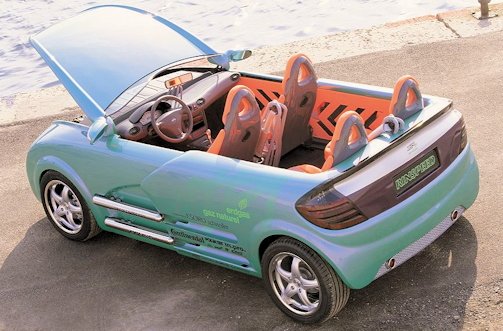
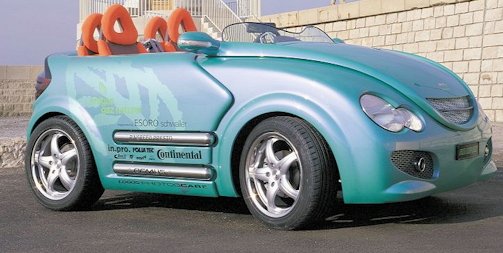
Rinspeed Presto Concept
 |
|
|
Presentation Year: |
2002 |
|
Class: |
Concept car |
|
Type: |
sports car |
|
Body design: |
Roadster |
|
Engine: |
Diesel :1.7 litres |
|
Length: |
2700-3600 mm |
The Rinspeed Presto is a concept vehicle of the Swiss creative firm Rinspeed.
History
The Rinspeed Presto is a Pick-up the front roof part folds down behind the loading surface with 420 hp Double turbo engine runs on natural gas,reducing exhaust emissions and fuel consumption.
The unique thing about the Presto is that it can be transformed from a 2.7-meter open two-seater to a 3.6-meter four-seater in just a few seconds at the touch of a button The rear additional space can also be used as a pick-up bed. This is done by an electric motor, which can push the carriage by 746 mm in length over 2 spindle gearboxes made possible by a centrally located electric motor, which stretches the vehicle with two mechanical screw-and-nut gears to its full extended length of 3.74 meters. The precision rollers disappear like a drawer in the rear of the floor pan the adjustable floor operation safety mechanism also features self-locking safety latches. A color camera integrated into the taillights reveals any potential obstacles to the driver in the rearview mirror. Instead of conventional light signals the Rinspeed Presto has innovative lighting technology with LED lights. During braking the word ‘Stop’ appears on the brake lights, and during turns ‘Turn’ appears. With lights turned on, the taillights the vehicle’s name, ‘Presto’.

The engine is also innovative: the Presto is equipped with a four-cylinder common-rail turbo diesel engine. The engine runs on a mixture of natural gas and Diesel fuel at a 40 to 60 ratioin dual-fuel configuratio as a priming jet engine with combined natural gas diesel operation Natural gas is injected into the intake air of the engine. It is based on a Mercedes-Benz 1.7-liter engine and has been modified accordingly with the installation of a tank for the natural gas and a gas-injection system.
Fuel consumption and pollutant emissions are well below the production engine. Despite the very environmentally friendly principle of the engines four-valves develops a power output of 120 hp / at 4’200 rpm, and produces maximum torque of 224 Nm at only 1600 rpm it brings a power of 88 kW, which accelerates the car in 10.5 seconds to 100 km / h and gives it a top speed of 180 km / h.