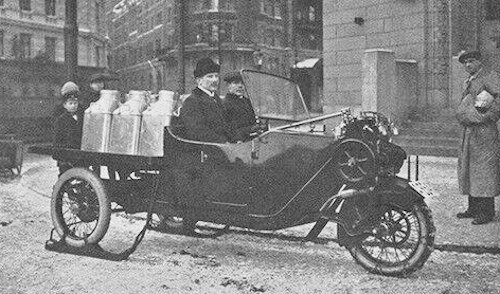
Phänomobil (Phänomen-Werke)
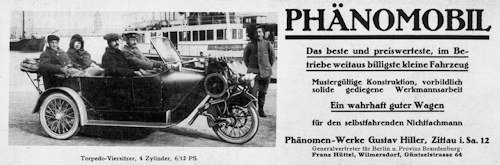
Phänomen-Werke was an early small Vehicle manufacturer from Germany from 1907 to 1927
History
Phänomobil was manufactured by the Phänomen-Werke in the German town of Zittau in the state of Saxony.
Various models were available as passenger cars as well as delivery vans. The Netherlands company Baakman in Assen , which also distributed the cars. Later In 1927 the firm switched to producing lorries called the Granit. The cars were extremely successful with a number of thousand being produced between 1907 and 1927
The Phänomobil 4/6 hp was a 3-wheel car, the Phenomenon brought as the first car model in 1907 on the market by the Zittau motorcycle manufacturer.This had a 2-cylinder SV -V engine with 0.9 litres of displacement, the 6-7 hp (1910: 9 hp) made and his power via a 2-speed planetary gear to the single front wheel on which he was built, passed through a chain. The car had a steel tube frame and a rear rigid axle, which was hung on C-springs, later on semi-elliptic leaf springs. The front fork had encapsulated coil springs. The foot brake acted on the rear wheels as an outer band brake. Open two-seaters and wheelbarrows were produced.
In 1912, a four-seater replaced this first vehicle this was equipped with a similar concept with a 4-cylinder SV- series engine, which developed from 1.55 litres displacement 12 hp. The outside band brake had been replaced by a normal drum brake. The tubular frame had given way to a sheet steel frame that was pulled up and tapered to accommodate the front fork.
The light van. had an air-cooled, four-cylinder, 1.5-litre engine used for delivery’s, later almost without modifications, this car was replaced in 1920 by the type V phenom, which was manufactured until 1927, also as a taxi.
After the end of production, the phenomenon plants turned to the production of commercial vehicles as Granit.