

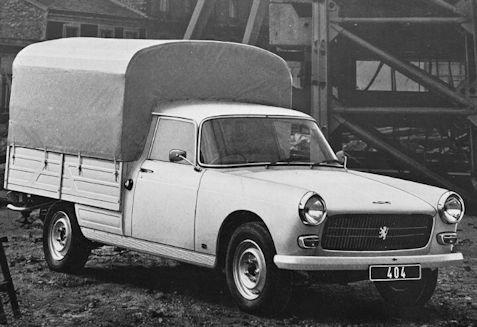
Peugeot 404 pickup truck
 |
|
| Manufacturer | Peugeot |
|---|---|
| Years of production | 1967 to 1988 |
| Production | 802.023 copy (s) |
| Class | Commercial vehicle |
| Engines | 4 cylinders in line, 1 468 cm 3 , 1 618 cm 3 carburetor or injection 1 948 cm 3 diesel |
| Unloaded weight | 1.160 - payload: 950/900 kg |
| Maximum speed | 120 - 135/108 km / h |
| Bodywork (s) | Pick-up - Cab chassis |
| Length | 4.580 mm |
| Width | 1.720 mm |
| Height | 1,600 (cover 2.120) mm |
The Peugeot 404 Pickup is a utility vehicle from the French car manufacturer Peugeot , produced from the beginning of 1967 . It is directly derived from the 404 sedan and comes to replace the Pickup 403 from 1956. Peugeot has marketed two variants of this utility: the 404 pickup truck and the 404 bare chassis to bodyshell.
In 1955, Peugeot presents the 403 . Shortly after Citroën launches the DS . French customers do not succumb to the hydraulic suspension, especially since the first technical problems appear very quickly. But faced with this keen competitor, the Sochaux leadership, for the first time, reacts very quickly and by the end of 1955, the decision to launch urgently the study of the replacement of the 403 .
The first project included a V8 petrol engine and a hydraulic suspension ... given the serious setbacks of Citroën with its DS, this engine is quickly abandoned. The world is in addition to the full Suez war, Peugeot is betting on a traditional family sedan, but with a modern appearance. Very satisfied with his first collaboration with the Italian bodybuilder Pininfarina , designer of the 403, Peugeot entrusts him with the study of the 404 but with a drastic constraint, the extreme reduction of the duration of the study. It was, however, admitted that the designer had the opportunity to draw inspiration from a project already ready or underway. Pininfarina then proposed the study carried out on behalf of Fiat which will give birth to the Fiat 1800/2100 and, for the British Austin . After some retouches to make other manufacturers accept that Peugeot sells a similar body, the 404 is designed in just 3 months. The production of the Peugeot 404 sedan was launched on May 10, 1960 Pininfarina will manufacture in its workshops the coupe and cabriolet models for Peugeot from 1961 to 1968.
The propulsion part was partly that of the 403: cast iron engine block, 4 cylinders in line, three bearings, cylinder head made of light alloy Alpax ) but with a displacement of 1.6 liters and tilting the block at 45 ° (" lying "on the right). The power obtained was 65 ch DIN. In 1963, on the occasion of the launch of the coupé / cabriolet, this engine will be equipped with the indirect injection carrying the power to 80 ch DIN.
The success of the car is immediate, the sedan is not lacking assets with its sober and elegant line, the proven mechanics of the 403, which allows Peugeot to attract a customer frightened by the innovative solutions but without reliability of the Citroën DS / ID. Renault did not offer any vehicles in this segment. The 404 range included the sedan, convertible, coupe, station wagon, and pickup truck also called in France tarpaulin.
The Peugeot 403 pickup truck continued its commercial career until 1967 and quite naturally gave way, in July 1967, to the 404 van with tarpaulin. It is also called 404 U8 . This first series, available with a petrol or diesel engine, offers a fairly low payload of 850 kg. The model is quickly supported by the version 404 U10 also available in gasoline or diesel, with a payload of 950 kg. Without real competition on the French market, the 404 covered van will quickly win. These versions of the Peugeot 404 will quickly acquire a solid reputation of robustness and will make the beautiful days of artisans and farmers. The 404 pickup became iconic before disappearing quickly. It must be said that it has been very popular in the former French colonies of Africa where many copies have been exported.
The 404 utility has been equipped with different engines: carburetor , fuel injection or diesel .Like its predecessors, 203 pickup truck and 403 pickup truck , this is a rigid rear axle propulsion and shift lever. The front suspension adopts, for the first time, helical springs in place of the traditional transverse leaf spring present since the 201 .The 404 pickup incorporates the front half of the sedan, designed by Pininfarina with its protruding wings and the panoramic windshield with return to the sides. The side windows are flat without baffles.
Like the sedan, the 404 pickup has been criticized for its braking consists of four economic assisted drums called "thermostable". These brakes are effective but of a picky maintenance, they will eventually be replaced (with a lower assistance) in 1968 only, by front disc brakes already used by most competing foreign manufacturers. On the other hand, the Indenor diesel version will never be entitled to braking improvements.
The Peugeot 404 was assembled locally in CKD on the chains of the Berazategui factory from 1962. That year, 2 071 copies were produced as well as 6 734 Peugeot 403 .A year later, the family version made its appearance but the production is interrupted in September 1964 as a result of malpractices in the importation of French components that lead to the dissolution of the company IAFA.In 1965, SAFRAR took over the factory and obtained a license for local production and no longer the assembly of Peugeot models. In 1973, the Pick Up T4B is replaced by a version built on the basis of the 404. In 1972, the diesel engine is proposed with the model 404 D. In Argentina, the gasoline engine delivers the power of 73 hp SAE to 5,600 rpm with a compression ratio of 8.3: 1.
As a result of legal regulation problems, the pickup version was stopped in 1978, its manufacture will resume in 1980 with a larger loading platform for some units only because, with the absorption of SAFRAR by Sevel Argentina that same year , the production of the whole range 404 is definitively stopped in Argentina. it appears that 26,372 copies of the TB4, 404 van and pick-up would have been assembled or manufactured locally between 1962 and 1980.

