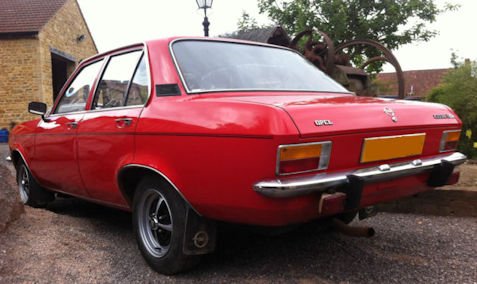
Opel Ascona A
|
|
|
|
Production period: |
1970 to 1975 |
|
Class: |
Motor Car |
|
Body versions: |
Saloon, station wagon |
|
Engines: |
|
|
Length: |
4124-4180 mm |
|
Width: |
1630 mm |
|
Height: |
1385-1400 mm |
|
Wheelbase: |
2430 mm |
|
Curb weight: |
870-1025 kg |
|
successor |
Opel Ascona B |
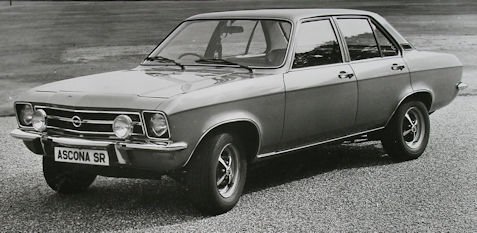
The Opel Ascona A is a car built from November 1970 to July 1975 from Opel. It was in the manufacturer's range between the cadet and record, replacing the Opel Olympia A. The car has an independent body and is equipped with normal cadet or record type engines.
In five years, a total of around 690,000 Ascona A cars were built. The Ascona A was built in the Opel factory Bochum Under the working title "Project 1450" was developed in the late 1960s at Opel a rival model for the end of 1968 introduced Ford Capri. The Successor was the very successful Ascona B. The 1970 Opel Manta A is the coupe version also built on the same Ascona platform.
Originally, the Ascona A become a Cadet C but they them decided by GM and Opel as a completely new model series.
The Ascona was from the beginning as a two and four-door sedan, a standard or luxury version and a three-door station wagon. Its luxurious variant "Voyage" had on the vehicle flank a glued wood decor. The standard model of the station wagon called Opel CarAVan, traditional name for the station wagons, which was used to differentiate from other manufacturers in other Opel models such as the record.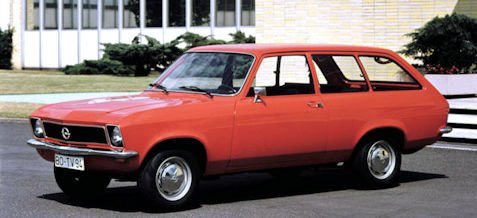
The Ascona was available in three different body versions:
- two-door notchback sedan
- four-door notchback sedan
- three-door station wagon
From March 1971, there was the Ascona A in a sporty SR version with firmer tuned suspension and 1.6-liter S-engine with 80 hp (59 kW) or 1.9-liter S-engine with 90 hp (66 kW). They were equipped with sports steering wheel, tachometer, wood veneer on the instrument panel, a console for additional instruments with clock, ammeter and oil pressure gauge, double side strips on the body edges, chromed exhaust tailpipe and steel racing wheels without hubcaps. In March 1972 was introduced as the new cheapest variant of the 1.2-liter engine. The power was 60 hp (44 kW).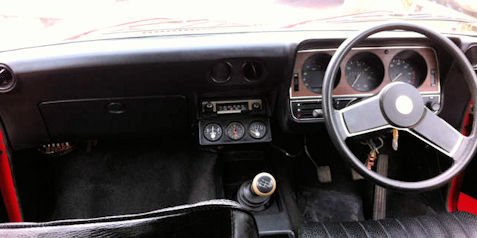
The first models had an aluminium grille, the square headlight trims were made of bright polished aluminium, in the hood was only a washer integrated and the dashboard had two air jets. From August 1971, the headlight trim panels were black. The grille was also painted black, but retained an aluminium-coloured frame and an aluminium centre bar.
In August 1973, the Ascona A was slightly revised with a black plastic grill with a large Opel emblem. Instead of the previously round mirrors now became square. All vehicles were equipped with windscreen wiper switches on the turn signal lever, a new centre console and two additional fresh air nozzles, two windscreen washer nozzles on the bonnet and an instrument panel with wood trim. For additional charge, a headlight wiper-washing system was available on request in some markets. From October 1970 to July 1975, the Ascona was sold under the name Opel 1900 in the United States. Offered were two- and four-door sedan (the latter only until autumn 1973) and the three-door station wagon, each powered by the 1.9-liter four-cylinder, here at a compression of 7.6: 1 76 DIN horsepower (56 kW) made. In total, around 170,000 units of the 1900 series (including Manta A) were sold in the USA.
At the beginning of 1975 new Gasoline Lead Law came into force. Opel adapted its engines to the new directive. The performance was reduced in the 1.6-liter N from 68 hp (50 kW) to 60 hp, in the 1.6-liter S from 80 to 75 hp (55 kW), and the 1.9-liter engine from 90 hp to 88 hp (65 kW). The 1.2-liter engine retained its previous performance. From June 1975, however, the performance of the 1.9-liter engine was increased again with a downdraft Zenith INAT 35/40 to 90 hp. The older, higher horsepower engines needed to avoid damaging knocking at high-speed Lead substitute additive to be added with each tank filling.
The Engines used all in-line four-cylinder:
The 1.2-liter engine based on the Kadett B with side camshaft and the larger on the CIH -Motor of the record C.
Performance 1.2L
max speed: 88 mph, 142 km/h
power-weight ratio: 33.6 lb/hp, 15.2 kg
acceleration: standing 1/4 mile 21 sec, 0-50 mph (0-80 km/h) 12 sec
consumption: 35.8 m/ imp gal, 29.8 m/US gal, 7.9 1x100 km.
max power (DIN): 60 hp at 5,400 rpm
max torque (DIN): 65 1b ft, 9 kg m at 2,600-3,400 rpm
max engine rpm: 5,800; 50.2 hp/l
The following types were available since introduction:
- 1.2-liter S with 44 kW (60 hp)
- 1.6-liter N with 50 kW (68 hp)
- 1.6-liter S with 59 kW (80 hp)
- 1.9-liter S with 66 kW (90 hp)