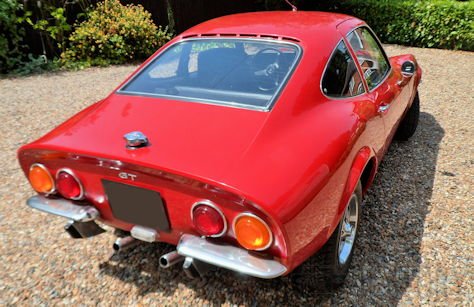
Opel GT
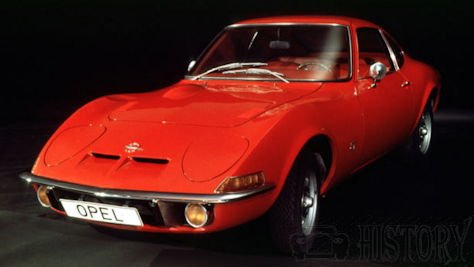 |
|
|
Production period: |
1968 to 1973 |
|
Make |
Opel GM |
|
Class : |
sports car |
|
Body versions : |
Coupe |
|
Engines: |
Petrol: 1.1-1.9 liters cylinders: 4, in line |
| wheel base: | 95.71 in, 2,431 mm |
| overall length: | 161.93 in, 4,113 mm |
| overall height: | 48.23 in, 1,225 mm |
| ground clearance: | 5.08 in, 129 mm |
| dry weight: | 1.1L 1,863 1b, 845 kg 1.9L 2,073 1b, 940 kg |
The Opel GT is a two-seat coupe model, from Opel AG as of August 1968 untill July 1973 .The body was designed by Erhard Schnell , who worked from 1952 to 1992 as a designer at Opel.
History
The coupé. although derived from the Rekord. represents the debut of Opel in Gt Market The Opel designers have decided strongly to underline the fact that this is sports car. The lines are smooth. with a pointed shark's snout has an aggressive and penetrating look. The fast-back is in the style in fashion for racing cars at the time. There is a wrap-round windscreen and 2 large rear window which ensure excellent visibility and plenty of light inside the car. The surfaces are smooth. with a complete absence of moulding. A simple. marked line connects the roof to the tail which incorporates the rear window. There are two air-vents on the bonnet and the headlamps are retractable. disaprearina inside the bonnet during the day. all accentuating the sporting Opel 1900 GT Coupé.
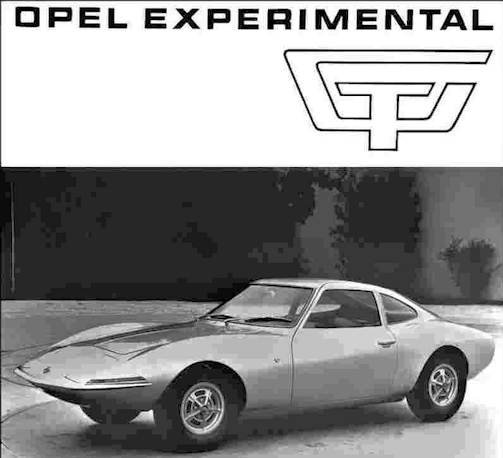
The development of the Opel GT began in the winter of 1963 with the production of design studies in plasticine, and at the IAA 1965, a prototype was shown under the name Opel GT Experimental . The car should serve primarily as an image carrier of the General Motors (GM) Group. The possible introduction of a GT sports car from Opel at the time sparked as much astonishment as enthusiasm, because a sports car did not meet the previously staid brand image of the Rüsselsheim automaker. However, Opel did not say anything about the actual realization for a long time.
On the occasion of the opening of the test and development center in Dudenhofen , an Opel GT was released for a test drive before the eyes of the car press. After that, the technique of the vehicle was set. underbody, suspension and the 1.1-liter engine were the Kadett B taken; the 1.9-liter CIH engine came from the Opel record C . The latter fit only with a bulge of the hood in the car. Because of the small space had to be bevelled in this engine, the cylinder head cover in the front area.
However, the management of Opel was faced with the problem that no capacity was available for the new vehicle. A small series of 30,000 pieces per year, which corresponded to about a tenth of the cadet production, could not easily be inserted into one of the existing works. That's why Chausson's bodywork was made in Gennevilliers (France), while Brissonneau & Lotz in Creil (France) did the painting and interior work. The finished bodies were delivered to the Opel plant in Bochum, where they received engine, transmission and axles.Characteristic for the model were the door openings, which were pulled far into the roof, the so-called Coke-Bottle-Shape or the fender swivels reminiscent of a Coca-Cola bottle and the folding headlamps. The shape of the doors allowed a relatively comfortable entry and exit despite the low height of the car of 1.23 meters.
The same spotting type of layout is to be noted in the interior of the anatomically designed seats which wrap round and support the body very well, ensuring comfort and safety at high speeds.The very high backrests are characteristic and also serve as headrests. There a three-spoke steering wheel. just as might be expected on a GT of this type. The rich selection of instruments are rationally laid out on the facia and include an ammeter and a rev counter. a tachometer and a speedometer. an electric clock and oil and temperature
gauges.
A great deal of attention has been given. too. to questions of safety which are of great interest to all drivers these days. The body is constructed according to tho most modern criteria from the time with ribbing reinforcing the passenger occommodation and collapsible front and rear ends. There is a telescopic shock. absorbing steering column. a collapsible rear driving mirror. padded facia and safety belts. all fitted as standard.
The folding headlights were extended and retracted with a lever placed on the center tunnel. In addition, the GT had under the front bumper two small headlights for high beam and flasher. The extended folding headlamps affected the Windschlüpfigkeit the body and slightly reduced the possible maximum speed of the car. The Opel GT was a two-seater without a trunk with a flat luggage rack behind the two seats, which can only be accessed from the inside of the car. The folding seat backs were extended upwards to catch any slipping luggage.
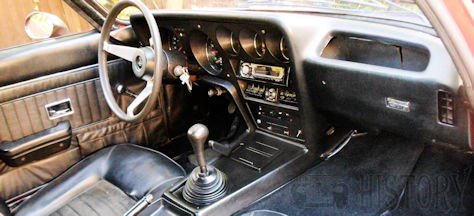
Interior:Instruments odometer. Tach. Brake warnng light. Parking brake control light.gas gauge and speedometer Oil pressure warning light and gauge. Amp indicator light and gauge. Twospeed blower. Dome light, Cigar lighter. Electric clock. AM radio, Carpeting front and rear. All vinyl. Full seats with adjustable seat backs. Head restraints. shoulder belts and seat belts. Safety door locks. lnside day-night rear View mirror.
Colors Exterior/lnterior Trim:
- Strato Blue/Buckskin
- Brilliant White/Red
- Flame Red/Black
- GT Chartreuse/Black
- Sunburst Yellow/Black
- Rallye Orange/Black
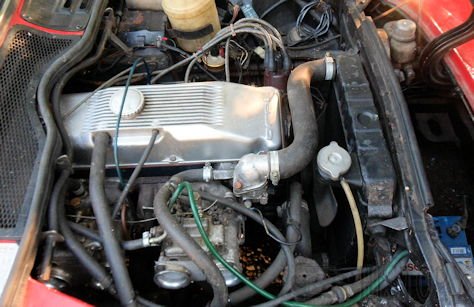
The Opel GT was initially built in the Opel GT 1100 and Opel GT 1900 variants. The 1100 cc engine of the GT 1100 develops nearly 60 hp (44 kW), while the GT 1900 mobilizes 90 hp (66 kW) and reaches a top speed of 185 km / h. The GT 1100 was only 155 km / h. The relatively unpopular GT 1100 was set in 1970. Instead followed the Opel GT / J (J stands for junior), the without cord seats, opening windows, additional instruments and chrome Parts came out and could be offered so much cheaper. He also had fewer ads in the cockpit. The correct name for the 1900 cc version was Opel GT AL, with the A - according to the usual Opel nomenclature - for the first series stands and the L for luxury.
- PERFORMANCE: 1100 GT
Max power (DIN): 60 hp at 5,000 rpm
Max torque (DIN): 62 1b ft. 8.5 kg m at 3,800-5,000 rpm
Max engine rpm: 6,000
Specific power: 55.7 hp/l
Power-weight ratio: 31.1 lb/hp, 14.1 kg/hp
Acceleration: 0-50 mph (0-80 km/h) 11 sec;
Fuel consumption: 37.7 m/ imp gal, 31.4 m/ US gal
Max speeds: 25 mph, 40 km/h in 1st gear; 43 mph, 70 km/h in 2nd gear; 68 mph, 110 km/h in 3rd gear; 96 mph, 155 km/h in 4th gear - PERFORMANCE: 1900 GT
Engine capacity:115.75 cu in, 1,897 Cu
Fuel consumption: 33.2 m/imp gal, 27.7 m/US gal, 8.5 1 x 100 km
Max speed: 115 mph, 185 km/h
Max power (SAO: 103 hp at 5,400 rpm
Max torque (SAE): 115 1b ft, 15.9 kg m at 2,800-3.000 rpm
Max engine rpm: 5.750
Acceleration: O— 50 mph (O —80 km/h) 7.5 sec.
Specific power: 54.3 hp/l
Power-weight ratio: 20.1 lb/hp, 9.2 kg/hp
Max speeds: 33.6 mph, 54 km/h in 1st gear; 53.4 mph, 86 km/h in 2nd gear; 84.5 mph, 136 km/h in 3rd gear; 115 mph, 185 km/h in 4th gear
More than half of the total production was shipped to the United States , where the GM subsidiary Buick took over the marketing under the maintenance of the brand name Opel. After Opel had previously been hapless with the sale of the very successful sedans in Europe in the US, the GT was there very soon accepted as a real sports car and had a fast-growing fan community. There was the Opel GT as a small Corvette ("Baby Corvette"), which had been designed by the same design team. 1973, the production of the Opel GT was discontinued. The reasons for this are manifold: Firstly, after the acquisition of the automobile division of Brissonneau & Lotz by the Société des Usines Chausson, which worked closely with Renault , the supply contracts for the OPEL GT bodies were terminated due to competition with the Renault Alpine A110 , on the other hand, new safety regulations came into force in the US, prescribed special bumpers that would be difficult to reconcile with the shape of the GT. It is always the subject of discussions among GT enthusiasts, whether GM continued the production despite the great success, because the Opel GT contested the also originating from GM Corvette market share in the US. It is clear that the GT was very popular in the GM home market; actual cannibalization effects but can be doubted because the Corvette was much more powerful and expensive.
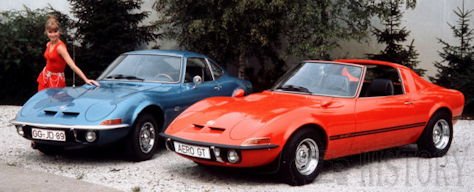
A repeatedly discussed convertible - or a Targa model of the Opel GT did not go into series. Likewise, there was no production of a direct successor model, the "Opel GT 2" or "Opel GT 2 + 2". The fact that the Opel GT has a large construction close to other Opel models facilitates conversions, for the 2.2 -l or 2.4 -l engines of Opel Rekord or Omega, injection engines from Manta or Ascona and 5-speed gearboxes of various Opel types are suitable. Before its launch, the Opel GT completed a crash test , which was not self-evident at the time . At an impact speed of 50 km / h , the passenger compartment remained largely undeformed.
30 years after the end of production of the first GT, Opel announced to revive the name. Total produced in 103,463 copies.