LaSalle History
LaSalle was the name of a under Cadillac from 1927 to 1940 led brand of the US automotive group General Motors.
History
LaSalle named after Robert Cavelier de La Salle was made by General Motors boss Alfred P. Sloan in the mid-1920s in the group's extensive range of cars a gap between the top brand Cadillac and Buick, which should be filled by a new brand.
Under the leadership of Cadillac then the LaSalle was developed, which appeared in March 1927 and was built at Cadillac. The body design of the LaSalle came from the hand of Harley Earl, and is considered as an example of a deliberately designed effect rather than pure functionality designed car body. Earl was hired by GM after the success of his LaSalle and in 1928 appointed head of the Art and Colour Section, the first design department of an automotive company. From the economic crisis as a result of the New York stock market crash in the fall of 1929, all car manufacturers were badly affected, including LaSalle. While in many cases, sales recovered noticeably from the middle of the 1930s, LaSalle did not see the sales figures that would have justified the continuation of the brand, according to GM bosses. In the summer of 1940, the mark was abandoned; in their place came with the Cadillac Series 61.
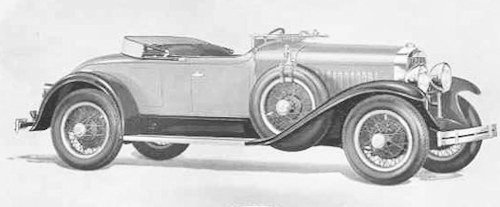
In March 1927 Cadillac launched the self-developed LaSalle (Series 303) as an independent brand below its own models. Offered on two wheelbases (125 and 134 inches) 11 different open and closed variants with Fisher bodies and (only on the short wheelbase) 4 versions with bodies of the body manufacturer Fleetwood. Both companies had recently been in GM ownership. The LaSalle models cost between $ 2495 and $ 4700, a few hundred dollars less than the slightly larger and more powerful Cadillac models. The technique was very similar to that of Cadillac's own models. The LaSalle was powered by a new five-litre V8 (bore × stroke: 79.4 × 125.4 mm, fork angle 90 °), which was constructively different from the previous Cadillac V8, but whose features were soon adopted for the larger Cadillac V8, compressed 4.8: 1, this machine came to an output of 75 hp. The manual transmission had three gears. The suspension was oriented with leaf-sprung rigid axles front and rear and mechanically operated four-wheel brakes on the then standard standard.
1928 accounted for some model variants; Fisher, however, delivered new base models (coupe and sedan), each costing $ 2,350. Fleetwood provided only three different Town Cabriolets on the short or long wheelbase available. The front drum brakes were increased in diameter to 16 inches.1929 appeared the Series 328 with 5.4 litres (328 cubic inches) enlarged V8. All models, except the Roadster and the open Phaeton four-seater, were now based on the longer wheelbase. Fleetwood also added a five-door Imperial Sedan with cutting disc to production. All versions received two electrically operated windscreen wipers and panes of safety glass.
In 1930 (Series 340), the short wheelbase models were eliminated and the bodywork stylistically approached the Cadillac models. The drive took over now almost unchanged from the Cadillac Series 341 of the years 1928/29 acquired 5.6-liter V8.1931 to 1933 (Series 345-A, -B and -C) did the unmodified V8 from the Cadillac Series 353 and Series 355 in LaSalle service. The model range was reduced in 1932 to 4 models with Fisher body (wheelbase 330.2 cm: Coupé, Cabriolet, Town Coupe and sedan) and 3 Fleetwood versions on longer wheelbase (345.4 cm: Sedan, Town Sedan and Imperial Sedan), 1933, the bodies were modernized with laterally pulled down front fenders and other details.
From model year 1934, General Motors pursued a new concept with the LaSalle. This was decoupled from the technology of the Cadillac models and provided with components of other GM brands. The LaSalle should be cheaper than a Cadillac to stimulate sales by the lower prices and thus help Cadillac on the sales crisis of recession time.
This new Series 50 (or Model 350) appeared in January 1934, rested on a new X-shaped tubular steel frame and had independently hung front wheels, three-speed gearboxes and a new 3.9-liter inline-cylinder engine that was fitted to Cadillac, but actually by Oldsmobile came from. On a wheelbase of 302.3 cm five different Fleetwood bodies were offered: sedan, Club Sedan, Cabriolet, Coupé and four-door convertible. The prices started now at 1595 dollars.
In 1935, all the bodies came from Fisher and got the new "Turret Top" all-steel roof. The offer included only coupe, convertible and two- and four-door sedan. The row eight-cylinder was enlarged with a slightly longer stroke to 4.1 litres, extended the wheelbase by 2.5 cm and the price further lowered (now from 1225 dollars).
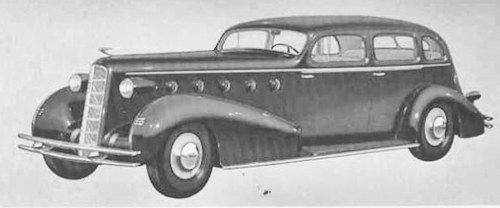
In 1936, there were virtually no changes, in 1937, the LaSalle again received a Cadillac V8, namely the previous year in the Cadillac Series 60 published 5.3-liter. At the same time, the wheelbase was extended by 10 cm and the bodies were reworked, such as with higher front fenders. In 1939, the LaSalle received a new front end with a very narrow grille and side grills on the "catwalks", the transitions between fenders and body shell. A sunroof was available under the name "Sunshine Turret Top"; the surcharge was $ 40.
The last LaSalle (Series 50 or 52) with a slightly shorter wheelbase was introduced in October 1939. New was the Series 52 with a modified body, more inclined rear windshield, curved rear window and rounder rear. A model in 1941 was still planned, but not put into production.