
Protos Automobile GmbH
Automotive manufacturer of Berlin ,Germany from 1905 to 1927
Protos was a German automobile and commercial vehicle manufacturer in Berlin .
History
The company was founded in 1898 by engineer Alfred Sternberg and Oskar Heymann as engine factory Protos in the then independent city of Schöneberg near Berlin . In 1906, the company headquarters moved from Schöneberger Großgörschenstraße 39 to Reinickendorf . The Siemens Schuckertwerke completely took over Protos in 1908 and moved the company to Spandau on the Nonnendamm in Siemensstadt , where the name Protos Automobilwerk Nonnendamm GmbH was born. In 1911 the company was Protos Automobile GmbH . Protos also developed electric vehicles, some of which were manufactured at the Wilhelmsruh plant of Bergmann Elektrizitätswerke . In 1926 the company was sold to the AEG and Protos was merged with the AEG subsidiary NAG ( National Automobile Company ). The new NAG Protos AG had only one year inventory. On January 1, 1928 NAG-Protos took over the Chemnitz Presto works . With the change of name to National Automobile Company Ltd Department Presto works, Chemnitz name Protos went out.
Around 1908 Protos built an electric truck for municipal purposes on the Nonnendamm in Berlin. Designers of commercial vehicles were u. a. Ernst Valentin and Franz Starkloph. The vehicle was powered by the rear wheels of two wheel hub motors. In addition to the normal steering wheel, there were additional left and right steering wheels on the outside of the truck, which could be operated by the driver next to the vehicle. This device was u. a. also with Faun . This municipal e-truck was also built by Protos as a normal four- ton payload e-truck and as an e-bus. The chassis were made by Siemens-Schuckert and the engines by Siemens & Halskemanufactured. 1911, the commercial vehicle construction for electric vehicles was discontinued. In addition to the passenger and van from 1913 also truck and bus types were produced as cab with 2.5 t and up to 30 hp . During the First World War , many trucks with 40 hp and 3 t payload emerged as so-called regular riders . In addition, a truck type with 50 hp and 4.5 t payload was built. The motor vehicle AG (KAG) took over the sales and distribution of the truck. After the war, the trucks that were no longer needed, which were on heap, were still offered until the 1920s. The production was limited to passenger cars and delivery vans.
The car models, which were very similar to the van at that time, enjoyed a good reputation at the time, and Protos was a car manufacturer with a very high regard for reliability. This was mainly due to the - later denied - victory of the endurance race from New York to Paris in 1908 promoted. The vehicle used, however, was a converted light truck.
The Protos 1918 reissued as the only model after the First World War .The car had a four-cylinder - SV -Reihenmotor with 2.6 liters of displacement, the 30 hp at 1800 / min. developed. Through a four-speed gearbox, the shift lever was mounted outside or inside right, the engine power was forwarded to the rear wheels. The vehicle had a U-profile press steel frame on which two rigid axles were suspended from Halbelliptik leaf springs. The rear feathers were designed as an underslung half- feathers. The foot brake only worked on the cardan shaft.
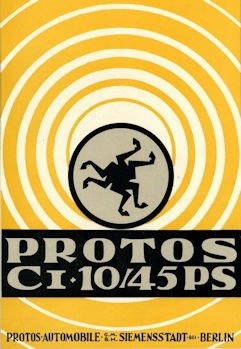
In 1924, the prototype type C1 replaced this model. Its equally sized engine was equipped with overhead valves ( OHV ). As a result, he now made 45 hp at 2500 / min. In 1925, the shift lever of the gearbox moved into the center of the car and next to the cardan shaft , the front wheels were also braked with the foot brake.
When Protos was taken over by the NAG in 1927 , about 10,000 of the types C and C1 were created after the war.
Legendary of the Protos was a participant in the then longest car race in the world, which went in 1908 from New York to Paris . The route passed through Canada , Alaska , China , Mongolia , Siberia and Russia . Of six participating starters, the Protos reached with Lieutenant Hans Koeppenon the steering wheel on July 26, 1908, the first destination in Paris. They were later reset to # 2 because they were never in Alaska. The first car trip around the world had thus won Thomas (USA). On 12 February 1908, only six of actually 13 registered vehicles started, with the exception of the Protos still the car manufacturers De Dion -Bouton , Motobloc , Sizaire-Naudin , Züst and Thomas (USA) joined.
The Protos car for the World Rally made 40 hp and was a Berlin coachbuilder , the Wagenfabrik Jos. Neuss , built only for this purpose. The chassis alone already weighed 1.1 t; fully equipped and refueled with 800 liters of petrol it came to 2.7 t.

