
BMW M4 DTM First generation
|
|
|
|
Class |
Race Car |
|
Constructor |
BMW |
|
Chassis |
Carbon-fibre monocoque |
|
Suspension |
Double wishbones with H&R spring and ZF Sachs damper units to front and rear axles, actuated via pushrods |
|
Length |
4,775–5,010 mm (188–197 in) |
|
Width |
1,950 mm (77 in) |
|
Height |
1,200 mm (47 in) |
|
Axle track |
1,950 mm (77 in) |
|
Wheelbase |
2,750 mm (108 in) |
|
Engine |
BMW P66 (2014-2016) later P66/1 (2017-2018) 4.0 L (244 cu in) V8 90° naturally-aspirated, front engined, longitudinally mounted |
|
Transmission |
Hewland 6-speed sequential semi-automatic paddle shift |
|
Fuel |
Aral Ultimate unleaded 102 RON racing gasoline |
|
Lubricants |
Castrol Edge (2014) later Shell Helix Ultra (2015-present) |
|
Brakes |
AP Racing carbon brake discs with 6-piston callipers and pads |
|
Clutch |
ZF 4-plate carbon fibre reinforced plastic clutch |
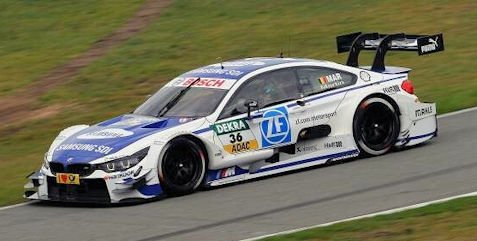
The BMW M4 DTM first generation is a prototype racing car of the German automobile manufacturer BMW , which was designed for exclusive use in the DTM and has been racing there since 2014 . The M4 DTM replaced the since 2012 and used M3 DTM through to 2018.
Like all DTM racing cars since 2012, the BMW M4 DTM is based on a standardized monocoque made of carbon fibre reinforced plastic (CFRP) with an integrated 120-liter fuel tank and steel roll cage. But the appearance, however is based on a production vehicle of the BMW F82.
The racing car was powered by a BMW P66 naturally aspirated V8 engine with four litres, whose power around 353 kW (480 hp) is and delivers a maximum torque of 500 Nm. The acceleration from 0 to 100 km / h is in about three seconds. The sequential manual gearbox with six forward gears, which is the same for all DTM vehicles, is fitted with the rear differential ( transaxle design) on the driven rear axle. All wheels are individually hung on double wishbones. The brake system with brake discs made of carbon fibre reinforced plastic is the same for all DTM vehicles , the car is equipped with a Drag Reduction System (DRS).
The DTM vehicles were not allowed to be further developed from the 2014 season for reasons of cost savings. During the 2015 season, however, it became clear that the BMW M4 DTM lagged behind the competition. Therefore, BMW could start the season in 2016 with a wider rear wing and less weight. The model for the 2017 season has many changes, especially in the field of aerodynamics. Thus, the bumper on the vehicle front forms a completely new shape. In addition, the rear and the rear wing have been redesigned. So far, the rear wing consisted of only one profile and folded when triggering the DRS completely down. The wing of the new BMW M4 DTM now consists of two profiles, the upper one of which works upwards when the DRS is activated. The setting range for the system is up to 40 degrees in 2017. In addition, venting channels were used at the rear wheel arches for the first time.
Starting in the 2019 season, the racing car is now the second generation powered by a four-cylinder engine with two litres of displacement and turbocharger . By charging the BMW P48 achieved , despite halving the number of cylinders and displacement compared to the previous engine, an output of about 456 kW (620 hp).

