
AC Montlhery
|
Manufacturer |
AC Cars |
|
Production |
1926 |
|
Class |
sports car |
|
Engine |
straight six |
|
Transmission |
4-speed manual |
|
Wheelbase |
111 in (282 cm); |
Designed by John Weller. it featured a three-speed gearbox in unit with the back axle and a disc clutch. During the war Weller had designed an advanced, light, 2-litre, 6-cylinder engine, which had alloy pistons and block, with wet steel liners, and a chain- driven overhead camshaft, and an experimental unit had been constructed in 1919 thus providing the later A.C. slogan 'The First Light Six'.
One was used by Selwyn Francis Edge, after he left Napier. He effectively took control Of AC in 1922, whereupon Weller left. His legacies included the transaxle and a six-cylinder engine that was to serve AC until 1963. Both were used in the Montlhery Sports Six.Straight six
Previewed at the 1919 London Motor Show, but not in production until 1922, Edge now got this engine into production by 1922, and it was to continue to be made by A.G., with modifications of course the same engine was usec up until 1963. It was marketed in the same chassis as the 4-cylinder cars, and it sold gently until 1926 when serious production of the 2-litre 'sixes' got under way, the 'fours' being phased out in 1928.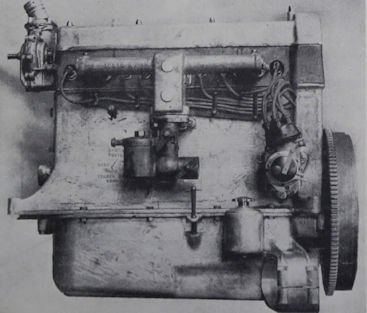
The engine war advanced. An light aluminium block and sump to bring the weight down and a chain driven Overhead camshaft; initially it developed 40 bhp, and by the end of the 1920s Output had been raised to 66 bhp, while for the mid-decade records a 65 bhp version was used. The bore and stroke are 65 mm. and 100 mm. (approximately 2.56in. x 3-937in.), giving a swept volume of 1,991 c.c. and an R. A.C. rating of 15-72. As fitted to the standard chassis, the engine develops 40 h.p. at 3,000 r.p.m., while that fitted to the sports chassis develops 66 at 4,000 r.p.m. The engine presents a clean, accessible and attractive exterior, and the accessories are all conveniently placed. It embodies many interesting features, certain of which novel in a vehicle of this size and class. Cylinder liners, for instance, are used, the cylinder block being a single aluminium casting formed in one with the top half of the crankcase. This casting is in fact the engine body proper, and carries the crank- shaft and main bearings. For the entire length of their working stroke the six liners are surrounded by the cooling water, which is contained in the single rectangular water jacket. There is therefore no contact between the liners and the jacket, except at their lower ends, the upper ends being spigoted into the combustion chambers which are formed in the detachable monobloc cylinder head.
The clutch is of the single plate, or, more correctly, the three-plate type, and drives by intermediary shaft to the enclosed propeller-shaft, the torque tube being anchored at a central tubular frame cross member. The gear box, aspreviously mentioned, is integral with the rear axle. Four-wheel brakes were fitted.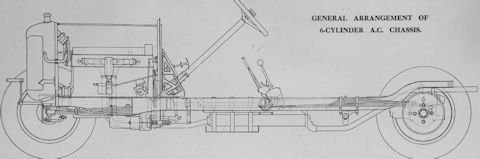
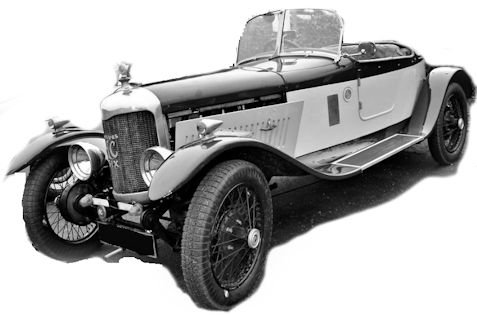
Meanwhile, the Company had entered for the J.C.C. 200 Miles Race every year from 1921 to 1924 with both 4- and 6-cylinder cars, their best result being a third place in 1923. In 1925 they built a special ohc, 6-cylinder racing-car for an attempt on Edge's own 1907 World 24-hour record. The car was taken to the Montlhéry track outside Paris where it scored a handsome success at 82 mph, being driven solo by Thomas Gillett for the whole period. the exploit providing the addition to the A.C. range next year of the splendid triple carburettor. 6-cylinder Montlhéry' sports model. which was guaranteed for 85 mph. Breaking Edge's 24-Hour record S.F. Edge had set the 24-Hour record in 1907, and his associate Thomas Gillett broke it in 1925, averaging 85.28 mph/137 kmh at Montlhéry. model named for it was a neat sports car, guaranteed to reach 85 mph/136 km.
Hon. Victor Bruce and W.J. Brunell 2-litre's victory in the Monte Carlo Rally. Nevertheless, the Company was in financial trouble in 1929; Edge left. and it went into voluntary liquidation.
to be later reformed in 1930 by the brothers.Hurlock.
Related
Technical
-
Engine
straight six
65 x 100 mm
1991 cc
sohc;
max power, approx 60 bhp at rpm.
Max speed approx 85 mph/130 kmh.
Transmission
three-speed manual gearbox.
Suspension:
non-independent; quarter-elliptic springs all round.
Brakes:
drum.
Dimensions
wheelbase, 111 in (282 cm);
track, front and rear, 45 in (114 cm).

