
Triumph GT6 MKIII
|
|
|
|
Manufacturer |
Triumph |
|
Production |
1970 to 1973 |
|
Class |
Sports car |
|
Body style |
2-door fastback |
|
Layout |
FR layout |
|
Engine |
1,998 cc (2.0 L) OHV I6 |
|
Transmission |
4-speed synchromeshed manual with optional overdrive |
|
Wheelbase |
2,128 mm (83.8 in) |
|
Length |
3,785 mm (149.0 in) |
|
Width |
1,486 mm (58.5 in) |
|
Height |
1,193 mm (47.0 in) |
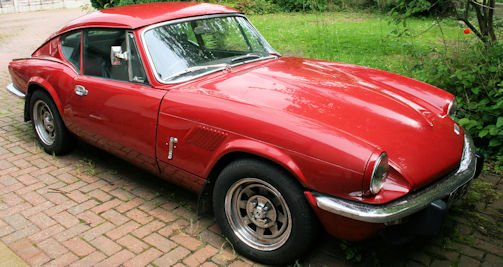
The GT6 Mk3 is a improved 6-cylinder sports car which was built by Triumph. Production ran from 1966 to 1973.The GT6 was based on the popular Triumph Spitfire .
In November 1970, the Mk 3 version took over, With all the same re-style features as the Spitfire Mk IV, namely the squared-off tail, re-skinned nose and integrated front bumper, There were no major chassis changes, but through-flow ventilation in the cabin, and an alloy-spoked steering wheel, all helped, along with different road wheels (no longer Rostyle type). When fitted option, the overdrive was controlled by a slide switch in the top of the gear-lever knob, which was a British motor industry "first". The top speed with improved aerodynamic shape was now up to 112mph and as was the handling in 1973 when the Spitfire-type swing-spring rear suspension took over.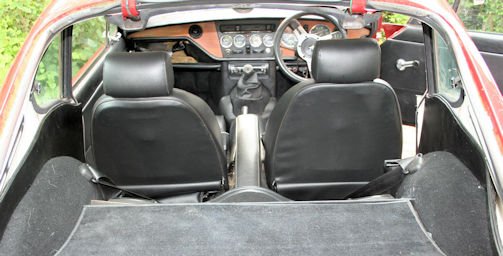
The final major facelift for the GT6 came in 1970, to make the MK3. This time the whole bodyshell was revised to match the changes made to the Spitfire Mk IV; these included a cut-off rear end, recessed door handles and a smoother front end. Only detail changes were made to the mechanics, but in 1973 close to the end of the car's production life the rear suspension was changed again, this time for the cheaper (but still effective) "swing-spring" layout also fitted to the Spitfire Mk IV. This was a modification of the swing axle rear suspension used on the lesser Herald-derived models, with the transverse leaf spring mounted on a pivot, eliminating roll stiffness at the rear, and thus greatly reducing the jacking effect under cornering loads. To compensate for this loss of roll stiffness, a larger front anti-roll bar was fitted. A brake servo was also added in 1973, and seats were changed from vinyl to cloth. There was still a fairly comprehensive options list, but the "knock-on" wire wheels were no longer available. The unladen weight increased slightly to 2,030 lb (920 kg).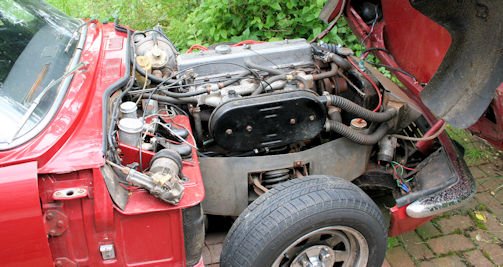
Engine power and torque for the Mk III was similar to the Mk II, but better aerodynamics led to a new top speed of 112 mph (180 km/h) and a 0–60 mph time of 10.1 seconds; this was now comfortably ahead of the MGB GT, which topped out at about 105 mph (169 km/h) and reached 60 mph in approximately 13 seconds. Fuel economy was also improved to 28 mpg-imp (10 L/100 km; 23 mpg-US). The last USA models performed comparatively poorly however, as compression ratios were lowered to accommodate lower octane unleaded gasoline.
The Mk III never sold in the numbers hoped for by Triumph, and was comprehensively beaten in the marketplace by the MGB. Triumph refused to release an official convertible version of the GT6 and, after poor sales, it was dropped from the Triumph range at the end of 1973, although a few cars were sold the following year.
PERFORMANCE
max power (DIN): 95 hp at 5,250 rpm
max torque (DIN): 106 1b ft, 14.6 kg m at 3,000 rpm
max engine rpm: 6,000; 47.5 hp/l
max speeds: (I) 46 mph. 74 km/h: (II) 68 mph, 110 km/h; (III) 96 mph, 155 km/h; (IV) 110 mph, 177 km/h
power-weight ratio: 20.3 lb/hp, 9.2 kg,/hp
acceleration: standing 1/4 mile 18.2 sec, 0-50 mph (0-80 km/h) 8 sec
fuel consumption: 25.7 m/ imp gal, 21.4 m/ US gal, 11 1 x 100 km.
Production ran out at the end of 1973 when it now rationalised its sales to the USA due to changes in emission and safety regulations. Predictably enough, the Mk 3 were the thought to be best of all the GT6s not only because they were fastest; but because they handled best and had the best. ventilation and packaging in the cabin, Well thought of in later years.
OPTIONAL
Laycock-de Normanville overdrive on III and IV (0.787 ratio), with 3.890 axle ratio
wire wheels
servo brake. 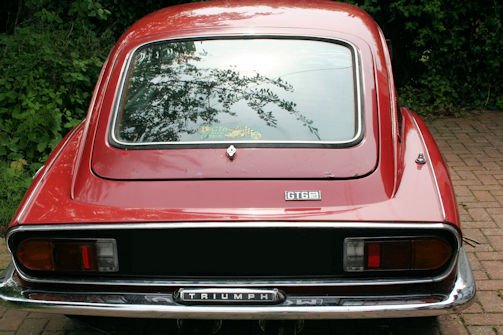
Related
Technical
-
Triumph GT6 MKIII Specifications (1970-1973)
DIMENSIONS AND WEIGHT
wheel base: 83.07 In
tracks: 49.02 in. 1.245 mm front. 50 in, 1.270 mm rear
length: 149 In, 3.785 mm
width: 58.66 in. 1.490 mm
height: 47,05 ln. t.t95 mm
ground clearance: 4.02 in, 102 mm
dry weight: 1.936 lb. 878 kgENGINE 1 ,998 cc
front, 4 stroke; 6 cylinders, in line
121.9 cu in, 1 ,998 cc (2.94 x 2.99 in, 74.7 x 76 mm)
compression ratio: 9: 1
cast iron cylinder block and head
4 crank-shaft bearings
valves: overhead, push-rods and rockers
camshafts: 1, side
lubrication: eccentric pump, full flow filter
2 Stromberg CDS (E) side-draught carburettors
fuel feed: mechanical pump
water-cooledTRANSMISSION
driving wheels: rear
clutch: single dry plate (diaphragm), hydraulically controlled
gearbox: mechanical; gears: 4, fully synchronized
ratios: I 2.650. II 1 .780, III 1.250, IV 1, rev 3.100
lever: central
final drive: hypoid bevel
axle ratio: 3.270CHASSIS
double backbone, channel section with outriggers;
front suspension: independent, wishbones. coil springs. anti-roll bar, telescopic dampers
rear suspension: independent, transverse leafspring upper arms, swinging semi-axle longitudinal trailing radius arms, telescopic dampers.STEERING
rack-and-pinion
turns lock to lock: 4.25.
turning circle (between walls): 26 ft. 8 mBRAKES
front disc (diameter 9.69 in. 246 mm)
rear drum
swept area: front 197 sq in, t,27t sq cm, rear 75.5 sq in, 487 sq cm. total 272.5 sq in, 1,758 sq cm.ELECTRICAL EQUIPMENT
12 V
56 Ah battery
alternator
Delco distributor
© Motor car History
Service
-
fuel: 100 oct petrol
engine oil Total 9 imp pt, 10.8 US pt. 5.1 1
engine oil change: 8 Imp pt. 9.5 US pt. 4.5 1, SAE 20W-50, change every 6.000 miles. 9,700 km
Coolant 6.2 imp pt. 7.4 LIS pt. 3.5 1.
gearbox oil: 1.6 imp pt, 1.9 US pt.no change recommended
final drive oil: Imp pt. 1.3 US pt. 0.6 1, no change recommended
greasing: every 6.000 miles, 9.700 km, 2 points, every 12.000 miles, 19,300 km, 2 points
tappet clearances: inlet 0.010 ln. 0.25 mm, exhaust 0.010 in, 0.25 mm
valve timing: 18° 58° 50° 18°
tyre pressure: front 24 psi, 1.7 atm, rear 28 psi. 2 atm.
fuel tank: 9.7 Imp gal. 11.6 US gal, 44 1.
carrying capacity: 353 1b, 160 kg
width of rims: 4.5"
tyres: 155 x 13.© Motor car History
