
About
Technical
-
Note: Full Specifications and Service Repair Manuals available for registered users
© Motor-car.net
Manuals
Suzuki Cappuccino
 |
|
|
Manufacturer |
Suzuki |
|
Production |
1991 to 1998 |
|
Assembly |
Kosai, Shizuoka, Japan |
|
Class |
Sports car |
|
Body style |
2-door roadster |
|
Layout |
Front mid-engine, rear-wheel-drive |
|
Engine |
657 cc F6A DOHC turbo I3 657 cc K6A DOHC turbo I3 |
|
Transmission |
5-speed manual |
|
Wheelbase |
2,060 mm (81.1 in) |
|
Length |
3,295 mm (129.7 in) |
|
Width |
1,395 mm (54.9 in) |
|
Height |
1,185 mm (46.7 in) |
|
Curb weight |
725 kg (1,598 lb) |
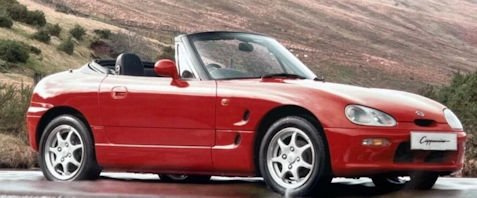
The Suzuki Cappuccino is a roadster of the Kei Car class produced by Suzuki in Japan from 1991 to 1998 and was built at the Kosai plant in Japan.
In the Japanese small car boom of the early 1990s, the cappuccino was a rival to the successful and built at about the same time Honda beat with mid-engine. The Cappuccino is a 3.30 m long and 690 kg heavy convertible with 4-way roof (closed, convertible, Targa, T-bar roof) and a 660 cc three-cylinder engine with aluminium housing, turbocharger and intercooler . The small roadster accelerates with this engine in less than eight seconds from a standstill to 100 km / h.
The retro design won many lovers and was a success especially with female customers. The car was sold from 1992 to 1997 about 27,000 times. From 1995 there was the cappuccino then also with anti-lock braking system and limited slip differential . Officially 120 vehicles found their way to the Federal Republic in 1994 . A limited small series of 200 vehicles was sold in Japan with a luggage set on the trunk lid and with wood applications in the interior.
The first official presentation of the cappuccino as a design study was in October 1989 at the 28th Tokyo Motor Show . He was a star of the show with the design and concept of flexible roof construction. The silver metallic Cabriolet coupe was presented with a water-cooled 660 cc turbo engine named F6A, with 12 valves and a charge air cooler over the radiator. The dimensions differed slightly from the later sold model.
The total length of the design study was 3195 mm, the width 1395 mm and height 1185 mm. The dry weight was 480 kg and the maximum engine torque of 125 Nm at 4000 rpm. The tires had the size 165/65 R 14 74 H.
The water-cooled 657 cc engine with cast aluminium housing is placed in the front of the engine compartment. With turbocharger , two overhead camshafts ( DOHC ) and 12 valves, a compression ratio of 8.3: 1 and a multipoint injection system (EPI), the engine produced 47 kW (64 hp) at 6500 rpm. This results in a Liter output of 71.5 kW / l.
The power is transmitted from the blocked 5-speed gearbox on the engine via a two-part cardan shaft to a differential on the rear axle and from there via drive shafts to the rear wheels. The weight distribution is 51% at the front and 49% at the back. The wheels are individually guided on two wishbones and damped and spring-loaded by spring damper units . The delay is provided by four ventilated disc brakes .
The instruments consist of the tachometer to 12,000 / min (red area 8,500 / min), tachometer h to 140 km /, cooling water thermometer and fuel gauge.
|
Featured
|
|
