
Nissan Primera First Generation P10
 |
|
|
Production period: |
1990 to 1997 |
|
Class: |
Motor Car |
|
Body versions: |
Sedan, hatchback, station wagon |
|
Engines: |
|
|
Length: |
4400-4510 mm |
|
Width: |
1695-1700 mm |
|
Height: |
1390-1500 mm |
|
Wheelbase: |
2550 mm |
|
Curb weight: |
1110-1358 kg |
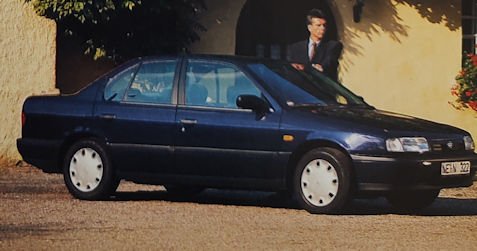
The Nissan Primera in the first series P10 came in the fall of 1990 as a direct successor to the Nissan Bluebird on the market to replace it in Europe. Available was a sedan or hatchback and a station wagon. This model was also sold in the US as the Infiniti G20.
The Primera was developed and produced as the first model by Nissan specifically for the European market. This first appeared in October 1990 at the Paris Motor Show.
The Primera achieved has been redeveloped, whereby a very good handling could be achieved. The front suspension of the Primera sedan is a hybrid construction. The sedan and the combination variants are built on different platforms and have little in common except for the name. In fact, the Traveler (W10 series) is based on the Japanese Nissan Avenir and therefore does not have the same chassis design as the saloon. Already in June 1993, the Primera received a small revision, in which the safety equipment was expanded and the engines were revised.
In January 1995, all variants of the Primera received a comprehensive facelift. The safety equipment was further improved; driver airbags were now standard on board. Additional passenger airbags as well as belt tensioners were also available and in higher quality equipment (SE, eGT) part of the series.
Visible were the face-lifted sedan models on a modified grille with chrome inserts and modified, lower-drawn front and rear bumpers. Also, the taillights a more modern look. In the front apron now two fog lights were integrated. The last Primera models of the P10 series met the emission standard Euro 2, but it was partly retrospectively a conversion of the Euro-1 engines with a cold run control (KLR) possible.
The estate version received a modified front bumper, another grille and standard ABS. In June 1996, the Traveler was again slightly revised to produce it as a gap filler until the fall of 1997. A detachment model has only appeared after the facelift of the next generation of Primera as WP11-120. This second facelift is recognizable by a modified radiator grille and additionally has passenger airbags and belt tensioners.
- LX: basic version, manual windows, no electric mirrors
- SLX: comfort version with 4 × eFH, electric and heated mirrors, central locking, power steering, optional air conditioning available as a dealer upgrade.
- Sri (sports package in optics of the Primera GT): Front spoiler, side skirts and rear wing (in body colour), characteristically the writing "Sri" at the tail, at the sides and at the speedometer. Hand brake lever, gear knob and steering wheel in leather edged, sports seats with better lateral support. Delivered in the colours Gemini Blue, Cherry Red, Tundra Green or Black. Mineral effect paint for an additional charge. Motorization in Germany: only 1.6 l with 90 hp.
- eGT: the sports version of the Nissan Primera: SR20DE 2-liter engine with 150 hp, 0-100 in 8.4 s and a top speed of 220 km / h. Optically emphasized sportiness through rear spoiler, side skirts, sports seats, alloy wheels u. v. m., Such as an oil pressure gauge in the tachometer instrument
- SE: the luxury version of the Nissan Primera, only available with 2.0-liter engine. Externally recognizable by the alloy wheels with 195er tires, chrome door handles and the lettering "SE" at the rear. Optionally available for the SE were leather seats with integrated seat heating. Gear knob, steering wheel and hand brake lever leather-coated as with the Sri and eGT, centre console with burl wood application, integrated cassette box included.
For the market launch in October 1990, three different gasoline engines with an output between 66 kW and 110 kW and a diesel engine without turbocharger with 55 kW were available. The gasoline engines were equipped depending on the version with carburettor or port injection, but were all provided in a revamp of the engine range in June 1993 with a multipoint injection. The two-Liter 16V with 85 kW was offered from April 1991 with four-wheel drive, but only in the two sedans. As an engine only Nissan engines were offered, which were designed as a four-cylinder. The gasoline engines have 16 valves, which are driven by a timing chain via two overhead camshafts, these engines were extremely sturdy and mileages of well over 300,000 km were not uncommon. The diesel engine, however, has only eight valves, which are operated by an overhead camshaft. The valve is controlled by a toothed belt.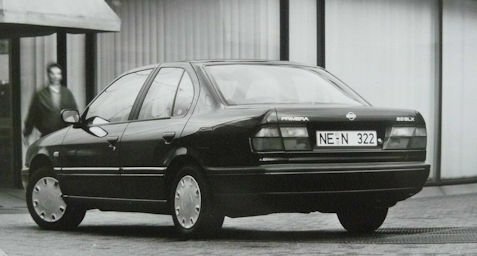
Related
Technical
-
model
capacity
valves
Max. Power
at rpmMax. Torque
at rpmcode
construction
variant
Fuel feed
gasoline engines
1.6
1597 cm³
16
66 kW (90 hp) / 6000
133 Nm / 4000
GA16DS
06 / 1990-05 / 1993
Hatchback, notchback, wagon
carburettor
1.6
1597 cm³
16
66 kW (90 hp) / 6000
136 Nm / 4000
GA16DE
06 / 1993-10 / 1997
Hatchback, notchback, wagon
Multipoint injection
2.0
1998 cm³
16
85 kW (115 hp) / 6000
166 Nm / 4000
SR20Di
06 / 1990-05 / 1993
Hatchback, notchback, wagon
central injection
2.0
1998 cm³
16
92 kW (125 hp) / 5600
170 Nm / 4800
SR20De
06 / 1993-10 / 1997
Hatchback, notchback, wagon
Multipoint injection
2.0 eGT
1998 cm³
16
110 kW (150 hp) / 6400
181 Nm / 4800
SR20DE
06 / 1990-05 / 1993
only notchback
Multipoint injection
2.0 eGT
1998 cm³
16
110 kW (150 hp) / 6100
181 Nm / 4800
SR20DE
06 / 1993-06 / 1996
only notchback
Multipoint injection
diesel
2.0 d
1974 cm³
8th
55 kW (75 hp) / 4800
132 Nm / 2800
CD20
06 / 1990-10 / 1997
Hatchback, notchback, wagon
indirect injection

