
About
Technical
-
Colors
Solid
Vanilla WhiteMetallic
Platinum SilverMetallic
Satin BeigeMetallic
Natural KhakiMetallic
Blue TitaniumMineral Effect
Blue OnyxMetallic
Superior RedSolid
Ebony BlackEngines
model
cylinder
capacity
power
torque
transmission
emission standard
drive
comment
construction
gasoline
2.4
four cylinders
2359 cc
128 kW (174 hp) / 6000 min -1
226 Nm / 3750 min -1
6-speed manual,
6-speed automatic5 euro
2WD or4WD
2009-2012
2.7 V6
six-cylinder
2656 cc
139 kW (189 hp) / 6000 min -1
248 Nm / 4000 min -1
4-speed automatic transmission,
5-speed manual transmissionEuro 4
2WD or 4WD
2006-11 / 2009
3.3 V6
six-cylinder
3342 cc
180 kW (245 hp) / 6000 min -1
306 Nm / 4500min -1
5-speed automatic
Euro 4
2WD or 4WD
for USA; Not available in Germany
2007-2009
3.5 V6
six-cylinder
3470 cc
206 kW (280 horsepower) / 6300 min-1
336 Nm / 5000min -1
6-speed automatic
Euro 4
2WD or 4WD
for USA; Not available in Germany
2009-2012
4.4 V8
eight cylinders
4378 cc
235 kW (319 hp)
390 Nm / 3000 min -1
5-speed automatic
Euro 4
Not available in Germany
2009-2012
diesel
2.2 CRDi
four cylinders
2188 cc
110 kW (150 hp) / 4000 min -1
335 Nm / 1800-2500min -1
5-speed automatic transmission,
5-speed manual transmissionEuro 3
2WD or4WD
2006-2008
2.2 CRDi
four cylinders
2188 cc
114 kW (155 hp) / 4000 min -1
343 Nm / 1800-2500min -1
5-speed automatic transmission,
5-speed manual transmissionEuro 4
2WD or 4WD
2007-11 / 2009
2.2 CRDi
four cylinders
2199 cc
145 kW (197 hp) / 3800 min -1
421 Nm / 1800-2500min -1
[436 Nm / 1800-2500min -1 ]6-speed manual transmission,
[6-speed automatic]5 euro
2WD or 4WD
11 / 2009-2012
2WD = Two-Wheel-Drive (front wheel drive)
4WD = Four-Wheel-Drive
ENGINE
2.2 VGT
2.7 V6
Type
In-line 4 cylinder SOHC
V6 cylinder CVVT
Capacity (cc)
2,188
2,656
Valves
16
24
Bore x stroke (mm)
87.0 x 92.0
86.7 x 75.0
Compression ratio
17.3:1
10.4:1
Max. power (kW/bhp @ rpm)
110/148 @ 4,000
139/186 @ 6,000
Max. torque (Nm/lb ft @ rpm)
335/247 @ 1,800 – 2,500
248/183 @ 4,000
SUSPENSION
Front
MacPherson struts with coil springs
Rear
Multi-link type with anti-roll bar
STEERING
Type
Power assisted rack and pinion steering. Energy absorbing collapsible steering column.
Turns lock to lock
3.24
BRAKES
System
Dual diagonal split circuit, power assisted with ABS and Electronic Brakeforce Distribution
Front
16 in ventilated discs, floating calliper with pad warning device
Rear
Disc
TYRES AND WHEELS
2.2 VGT GSI
2.2 VGT & 2.7 V6 CDX & CDX+
Tyre type/size
Radial 235/65 R17
235/60 R18
Wheel type/size
Alloy 7.0J x 17
Alloy 7.0J x 18
DIMENSIONS
Overall length (mm/in)
4,650 (4675 for CDX / CDX+) /183.0
Overall width (mm/in)
1,890/74.4
Overall height
1,725 (1,795 inc roof rack) /70.6
Wheelbase (mm/in)
2,700/106.3
Track - front (mm/in)
1,615/63.6
Track - rear (mm/in)
1,620/63.8
Turning circle (m/ft)
5.45/17.88
WEIGHTS & CAPACITIES
2.2 VGT
2.7 V6
Luggage capacity, 5 seat models – seats up (SAE l/cu ft)
969/34.2
969/34.2
Luggage capacity, 5 seat models – seats down (SAE l/cu ft)
2,213/78.2
2,213/78.2
Luggage capacity, 7 seat models – seats down (SAE l/cu ft)
2,213/78.2
2,213/78.2
WEIGHTS & CAPACITIES contd…
2.2 VGT manual
2.2 VGT automatic
2.7 V6 automatic
Kerb weight – 5 seats (kg/lb)
1,823 (4,019)
1,853 (4,085)
1,780 (3,924)
Kerb weight – 7 seats (kg/lb)
1,863 (4,107)
1,893 (4,173)
1,820 (4,012)
Gross vehicle weight – 5 seats (kg/lb)
2,520 (5,555)
2,520 (5,555)
2,325 (5,126)
Gross vehicle weight – 7 seats (kg/lb)
2,550 (5,622)
2,550 (5,622)
2,495 (5,500)
Max. towing weight – braked (kg/lb)
2,200 (4,850)
2,000 (4,409)
2,000 (4,409)
Max. towing weight – unbraked (kg/lb)
750 (1,653)
750 (1,653)
750 (1,653)
Max. roof weight (kg/lb)
100 (220)
100 (220)
100 (220)
Fuel tank capacity (l/gallons)
75 (16.5)
75 (16.5)
75 (16.5)
PERFORMANCE
2.2 VGT manual
2.2 VGT automatic
2.7 V6 automatic
0-62 mph acceleration (sec)
11.6
12.9
11.7
Max. speed (km/h - mph)
179/111
179/111
179/111
FUEL CONSUMPTION & EMISSIONS
Urban mpg (l/100 km)
(9.6) 29.4
(11.0) 25.7
(14.4) 19.6
Extra urban mpg (l/100 km)
(6.0) 47.1
(6.4) 44.1
(8.4) 33.6
Combined mpg (l/100 km)
(7.3) 38.7
(8.1) 34.9
(10.6) 26.6
193
214
252
Note: Full Specifications and Service Repair Manuals available for registered users
© Motor-car.net
Manuals
Hyundai Santa Fe 2nd generation
|
|
|
|
Production period: |
2006 to 2012 |
|
Body versions : |
station wagon |
|
Engines: |
Gasoline: 2.4-3.5 litres (128-210 kW) |
|
Length: |
4675 mm |
|
Width: |
1890 mm |
|
Height: |
1795 mm |
|
Wheelbase : |
2700 mm |
|
Curb weight : |
1745-2069 kg |
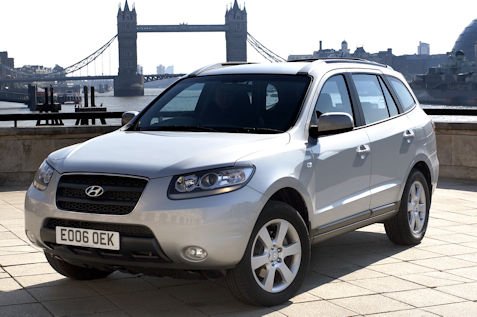
The Hyundai Santa Fe is a sport utility vehicle of the South Korean manufacturer Hyundai , which is manufactured since the fall of 2000. It has front or four-wheel drive and was placed in the Hyundai Group between the Hyundai Tucson and the larger SUV Terracan.
In April 2006, a fundamentally revised Santa Fe appeared. In terms of design, the successor model has almost no similarities with its predecessor. In terms of dimensions, the new model grew in all areas and now offered more space in the interior, so now for the first time a third row of seats is available at an additional cost, which extends the five- to seven-seater.
The design and above all the quality and the materials used have been improved to appeal to a younger clientele with a modern design. A significantly improved handling and sportier engines were crucial for Hyundai to confidently call the Santa Fe "Sportsroader”. The vehicles for the North American markets, however, came since March 2006 from production of Hyundai Motor Manufacturing Alabama in Montgomery ( Alabama ). Due to the limited capacity of the plant, production had to be relocated to the Kia Motors Manufacturing Georgia plant at West Point in September 2010 .
At 1,725mm tall, (1,795mm including the roof racks) new Santa Fe is 50mm taller than the previous model, it has grown in girth by 45mm to 1,890mm and, crucially for the clever stowable seven seat layout, it is 150mm longer at 4,650mm (CDX and CDX+ models featuring the two-tone bumper are 175mm longer overall at 4,675mm).The greater overall length and wheelbase (increased by 175 and 80mm respectively) have enabled Hyundai to engineer a third row of seats that can easily be folded down for extra luggage space when not required.
At the front, the new grille emphasises the lines that flow down the bonnet from the A pillars. It also unifies the upper and lower body sections and brings together the dynamic angled sweep of the clear-lens light clusters, which themselves flow back neatly into the curve of the pronounced front wheelarches.The extra length has allowed a more sweeping profile than before, with the wrap-around rear light clusters extending into the flared waistline. On higher grade models, the LED high-mounted stop light is neatly integrated into the rear spoiler, deep-opening rear tailgate neatly rounds off the flowing style.
In the late autumn of 2009, the Santa Fe received a facelift on the front and rear. In the US and Latin America there was a modified 3.5l V6 with all-wheel drive and 210kW (285hp)At the end of 2011, a renewed overhaul was carried out on the Santa Fe, which can be seen from then on silver-coloured underbody guards front and rear and on a chrome trim on the rear. Other features include the black bezel of the fog lights and a black roof rail. On the roof rails accounted for the two permanently installed cross member, now the Santa Fe has an open railing like most cars. The diesel engine 2.2 CRDI now provides 197 hp and offers a higher torque. The new engine meets the Euro 5 standard.
Engines
Two power units are available: a new high-performance 148 bhp (150 PS) 2.2 litre VGT common rail diesel and a revised version of Hyundai’s renowned 2.7 litre V6 petrol engine, with power increased to a mighty 186 bhp (189 PS).
The 2.2 litre VGT common rail diesel engine Variable Geometry Turbocharger (VGT) technologyThe high pressure common rail injection system improves response and control and also reduces engine noise and vibration levels including a new low friction balancer shaft.
The four-cylinder 2.2 litre VGT diesel delivers a maximum 148 bhp (150 PS) at 4,000 rpm, with a maximum 335 Nm (225 lb ft) available all the way from 1,800 to 2,500 rpm, . In terms of performance with 0-62 mph despatched in just 11.6 seconds (12.9 automatic) and a maximum speed of 111 mph.
The 2.7 litre V6 has Constantly Variable Valve Technology (CVVT), a power hike from 170 to 186 bhp (189 PS), with maximum torque of 248 Nm
(183 lb ft). This translates into 0-62 mph in 11.7 seconds and a top speed of 111 mph, with combined cycle fuel consumption of 26.6 mpg and CO2 emissions cut to 252 g/km.
As the only equipment in the CM, the GLS version is used. It comes as standard with a central locking with remote control, power windows front and rear, an alarm system and an on-board computer, chrome door handles, a roof rail and electric mirrors. Compared to its predecessor, the safety equipment has been extensively expanded. ESP and ABS as well as head, side and front airbags, electronic brake force distribution, active front head restraints and side impact protection in the doors are standard. Later, a premium version was added, which included additional leather trim, GPS, reversing camera, cruise control, xenon headlights, a light sensor and a tire air pressure control system.
Crumple zones and reinforcements to be built into the vehicle, which can absorb impact forces and direct them away from the passenger cabin should an accident occur. with the on-road active safety systems, including; ESP (electronic stability programme) and ABS with EBD (electronic brakeforce distribution). Brake dimensions have also been increased, with ventilated 16 inch front discs and larger brake stopping power.ESP, fitted as standard to CDX and CDX+ versions, uses a network of sensors to monitor different aspects of vehicle behaviour, such as deceleration, power input, yaw rates and wheel slippage. All versions are fitted with six airbags, (eight in the seven seat models) with driver and front passenger airbags (the passenger airbag is now fitted with a cut-off switch), front side airbags and roof curtain airbags. On seven seat models the roof airbags extend through to the third row seats. Three point seatbelts are provided on all seats and, on higher-grade models, active head restraints are provided for enhanced protection against whiplash injuries.
GSI
The GSI, which comes equipped with side and roof curtain airbags and ABS with Electronic Brakeforce Distribution (EBD). on 17 inch alloy wheels. front fog lights, roof rails with a crossbar, body colour matched door handles and (electrically adjustable) mirrors and twin exhaust pipes. The remote central locking, alarm and immobiliser provide excellent security, while anyone suffering a puncture will be pleased to know a full size spare is provided rather than a space-saver.
interior include air-conditioning, a factory-fit sound system with CD player, electric windows and height adjustable telescopic steering wheel. A wood grain finish on the dashboarde.
CDX
The CDX zone climate control (with independent controls for third row passengers in the seven seat versions), 2-stage heated front seats and a full leather interior. The driver’s seat is electrically adjustable and on those frosty mornings, a front screen wiper de-icer further aids rapid clearing. seven-speaker sound system is standard, featuring a six-disc CD autochanger and additional audio controls on the steering wheel. Cruise control and an auto-dimming rear view mirror with compass are also provided.
the CDX models include the Electronic Stability Programme (ESP) and active head restraints. Larger, 18 inch alloys and a rear spoiler add to the Santa Fe’s bold but stylish road presence.
CDX+
Top-of-the-range CDX+ versions The on-board entertainment package provides both a premium hi-fi and a multimedia DVD package The 10 speaker Infinity sound system features Logic 7 surround sound and an in-dash six-disc autochanger. DVD via a roof-mounted screen. The system is also compatible with PlayStation and X box consoles.
Smartnav satellite navigation, rain-sensing windscreen wipers, a handy cool box in the centre console and electric adjustment for the passenger seat.
Additional equipment:
for example, the Comfort package with electrically adjustable leather seats and seat heating, a speed control system and tinted windows, as well as metal entrance panels and leather steering wheel / shift knob; for vehicles without four-wheel drive additionally with a double climate control with air quality sensor
an electric panoramic lift / sunroof
Metallic or mineral effect painting
The new Santa Fe delivers new high levels of practicality, and the choice of a five or seven seat configuration. The cabin benefits from a modern, integrated design. The new seating is designed for additional head, shoulder and legroom for all on board.The increased exterior dimensions translate into additional space, with, for example, 25mm extra legroom for the driver and an extra 84 litres of load space at the rear. Access is easier, too, with wider doors, a higher roofline and more space between the front and rear seats. Dual zone climate control or air-conditioning, according to model grade. Furthermore, on models fitted with seven seats and climate control, those in the rear-most seats benefit from their own independent ventilation controls.A high quality feel has been designed and engineered into every detail, from the location of the electric window controls, to the pleasing action of the Modern blue instrument lighting, a first for Hyundai, is easy on the eye arake adjust and telescopic steering wheel..
For greater ease of use and additional storage spaces. On higher-grade models, the full leather interior, while all versions feature a fine wood grain finish on the dashboard.A foot operated parking brake,keeps the centre console area tidier and less cluttered and leaves more room for storage.Significantly, increase in rear load space is with 969 litres available with all seats in place (and third row stowed on seven seater). And again, in both five and seven seat models, capacity grows to a massive 2,213 litres with all rear seats folded down. This is thanks to the flush folding third row seats, which stow invisibly into the boot floor. The five seat verion will find a substantial storage area beneath the boot floor where the seats would otherwise be stowed.As well as having a wider and longer boot, the new Santa Fe is easier to load and unload, thanks to a wider rear hatch and optimised loading height.
When conditions demand, four-wheel drive can be engaged simply by pushing the 4WD button on the front console. This locks all four wheels into permanent drive for better performance when travelling off-road or on low-grip road surfaces. Whereas the previous Santa Fe used a fixed four-wheel drive set up, the all-new Santa Fe employs a “torque on demand” system, similar to that in its smaller sibling the Tucson. In normal conditions, drive is through the front wheels only. Electronic sensors monitor road and driving conditions and automatically engage all-wheel drive when required, to gain the best possible traction and maintain vehicle stability, working in conjunction with the vehicle’s other active safety systems, including ESP (electronic stability programme), ABS with EBD and TCR (traction control).
Suspension
At the front, a new MacPherson strut design positioned, reverse L-shaped lower arms to provide superior steering wheel sensitivity and improved dynamic control. larger bushes between the front sub-frame and the suspension. And, by widening the caster angle, both straight line stability and all-round handling have been improved. The revised multi-link rear suspension is a significant factor in the Santa Fe’s performance been improved by using more rigid shock absorbers and setting them lower, while road noise intrusion has been reduced and ride and handling improved by relocating the trailing arm from the body to the rear cross member. The new system is also more compact, so intrudes less on the space in the rear of the vehicle.
Seven-seat versions of the new Santa Fe feature a new self-levelling suspension system. This ensures a constant vehicle ride height, regardless of size of load on board or its distribution. The system uses no external power source, so there is no penalty in performance or fuel efficiency.This system is ideal for towing, at which new Santa Fe also excels, being capable of towing a braked trailer weight of up to 2,200 kg (2,000 kg for automatic variants).
For the introduction of the new Santa Fe (Type DM), the old model was sold in September 2012 as a premium version with automatic transmission and four-wheel drive. 
|
Featured
|
|

