Spain
Hiriko Driving Mobility
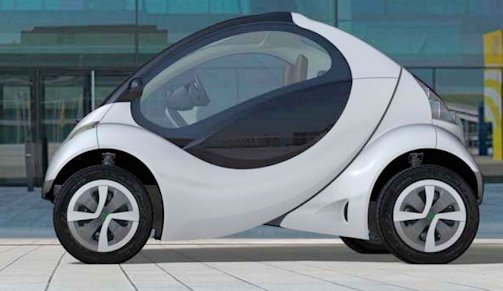
The Hiriko is a foldable two-seat light electric vehicle developed by the Hiriko Driving Mobility consortium in the Basque Country (Spain). The electric car was the commercial implementation of the City Car project, developed since 2003 by the Massachusetts Institute of Technology's Media Lab.
The name Hiriko comes from the Basque word for "urban”. Powered by 4 electro-engines, one at each wheel two seats of separated battery packs the roof integrated solar panel 2 ventilators for air circulation along with laminated glass. The small car has disk brakes on all wheels due to the position of driving, the car does not need to be equipped with airbags
The car has Frontal access and can move in all directions when folded driven by a haptic wheel 15- or 16-inch aluminium rims variable trunk concept, Including a sound system, windscreen wipers interface for a smartphone “urban” communication system (traffic, parking, charging) unbreakable, heated anti-steam glass. Inside includes seats, driving console and folding driving wheel. The unusual Robo Wheels, incl. motor traction, steering, braking system and suspension
C.B.A. Compañía Balear de Automóviles
Automotive manufacturer of Spain from 1982 to 1986.

Compañía Balear de Automóviles was a Spanish manufacturer of automobiles in the 1980s.The brand name was CBA.
History
The Swede Thomas Wadström founded the company in Palma de Mallorca in 1982 and began producing automobiles. In 1985, the development of electric cars, therefore, the series production of the previous models was delivered to Clásicos Canarios de Automóviles . In addition, Aboleiro received a license from Madrid for Citroën dealers.
The company produced classic style vehicles that were based on chassis of the Citroën 2 CV, so had two-cylinder engines. There were the models Condesa , pick-up and Duquesa vans also with a classic look . The bodies were made of fiberglass plastic.
Around 100 were manufactured in total.In 1986, the company was dissolved.
Castro (J. Castro Sociedad en Comandita)
Automotive manufacturer of Barcelona. Spain from 1901 to 1904.
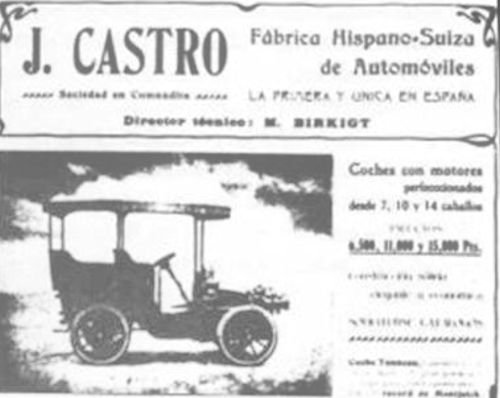
Castro Sociedad en Comandita was a Spanish manufacturer of automobiles in the early 1900s .The brand name was Castro .
History
Juan Jaime Castro founded in 1901 in Barcelona, a company for the production of automobiles. He took over La Cuadra and its chief engineer Marc Birkigt and made Birkigt his partner. On December 11, 1903, the company went bankrupt .
In 1904, the production ended after only eight vehicles produced. Later it became Hispano-Suiza.
The company offered three models with two-cylinder engines .
One was the 10 HP . In one model, the displacement was 2281 cc, the other 6805 cc ( bore 190 mm, stroke 120 mm). In addition, there was the 7hp and the 14 HP with four-cylinder engineand 2,217 cc. The vehicles had a cardan drive .
CEYC (Centro Electrotécnico y Comunicaciones)
Automotive manufacturer of Madrid,Spain from 1922 to 1931.

Centro Electrotécnico y Comunicaciones , in short CEYC , was a Spanish manufacturer of automobiles in the 1920s and early 1930s.
History
The company based in Madrid was under the Spanish Ministry of War. Juan Antonio Hernandez Nünz was the designer and José Tafir Funes was responsible for the production. Between 1922 and 1931 created about 1160 vehicles,The cars was at first presented to the military authorities in 1923 and to the public at the Barcelona Motor Show in 1924, as little as only one of which still exists today.
The vehicles for the Spanish military were given the brand name CEYC many built for military purpose, but also cars built. The model 4/10 HP appeared in 1922 and remained in production until 1928. For the drive provided a four - cylinder two-stroke engine with 792 cc displacement (60 mm bore , 70 mm stroke ) and 16 hp power.
The Compania Euskalduna de Construcción y Reparación de Buques SA of Bilbao made the same model for private buyers at their factory in Madrid between 1925 and 1928 with some help from British Morris at the time. The brand name was Euskalduna . Under the brand name Diana , a larger model was marketed, but there was no mass production. Between 1929 and 1931, only a prototype was created. The four-cylinder four- stroke engine with 2270 cc displacement (85 mm bore, 100 mm stroke) made 40 hp. The body could accommodate six people.
SPANIA GTA Tecnomotive S.L.
Automotive manufacturer of Torrent Spain from 2005 on.
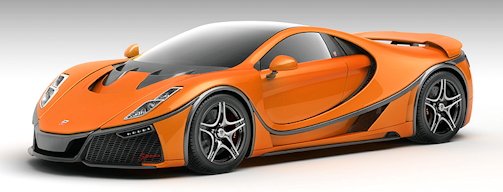
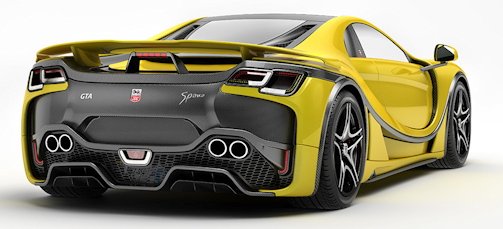
SPANIA GTA is a Spanish manufacturer of sports automobiles from the 2000s. The brand name is GTA .
History
The company from Torrent began in 2004 under the direction of Domingo Ochoa with the development of automobiles. 2008 saw the presentation of the first vehicle. Production started in 2011. It was founded by Domingo Ochoa, who is also the current CEO of the company involved in promotional cups,and later participate in championships such as the European F3 Open GT. The model is the GTA Spano is a supercar For the first models provided by 2015, a V10 engine with 8300 cc displacement and 618 kW (840 hp), since then makes the engine, which still has 8 liters of displacement, 680 kW (925 hp) They have designed, developed and produced the GTA Spano in-house. The first production units were delivered to the customers in 2012, with full scale production in 2013.
The GTA Spano which was presented to the public in 2008 as GTA Concept . Since 2010, the 618 kW (840 hp) vehicle is produced and sold, in the spring of 2015 debuted at the Geneva Motor Show a revised version with 680 kW (925 hp). The V10 engine, which is 8 liters instead of 8.3 liters after the facelift, comes from the Dodge Viper . The Gullwing builds on a carbon monocoque and is powered by the rear wheels. This reaches 100 km / h in less than three seconds. 99 GTA Spano were produced until the facelift, another 99 are to be produced.The price for the first and second generation of the GTA Spano is € 630,000 .In 2014, the GTA Spano played a role in the movie Need for Speed .The car is also available in some video and mobile games, including Forza Horizon 3 , Asphalt 8: Airborne and CSR Racing 1 and 2 .