
France
Exagon engineering
France since 2009

Exagon Engineering is a French automobile construction office and racing team at the Circuit de Nevers Magny-Cours.
History
Founded in 2004 by Luc Marchetti, Exagon is managed by Cathy Muller, a former racing driver and sister of Yvan Muller. The team earned its first merits in the winter of 2005 when they upgraded a Kia Rio, with which Yvan Muller took part in the Andros trophy and was able to compete again the following year. The racing team participates in the World Touring Car Championship, the Supercopa Seat Leon and the Trophée Andros. Since 2009, Exagon has been building the electric cars of the Trophée Andros Électrique. These "Andros" cars were used in 2011 at the Grand Prix of Pau, one of the first circuit racing for electric cars. With less success, the team participated in various competitions, such as the French GT Championship, the FIA GT Championship and the French Rallycross Championship. Only from 2007, Exagon regularly participated in the touring car world championship. At the wheel were the Belgian driver Pierre-Yves Corthals and the Moroccan Mehdi Bennani.
At the 2010 Paris Motor Show, Exagon Motors unveiled the prototype of a sports car, the Furtive-eGT. The Exagon Furtive-eGT is a sports car of the French car manufacturer Exagon Engineering, which was developed in collaboration with Siemens (drive), Saft (lithium-ion battery) and Michelin (tires).The drive is powered by two 148 kW water-cooled electric motors. With the semi-automatic 3-speed transmission, the sports car accelerates to 100 km / h in 3.5 seconds. The top speed is electronically limited 250 km / h. The range in city traffic is given as 360 km. The batteries have a capacity of 53 kWh.
Société A. Marguerite Morano-Marguerite
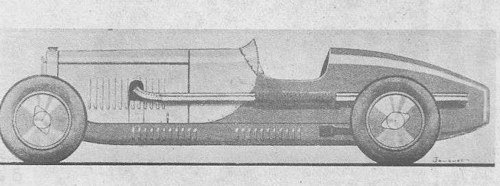
The Société A. Marguerite was a French automobile manufacturer from Courbevoie, France in the 1920s later with the brand name to Morano-Marguerite.
History
The company Société A. Marguerite from Courbevoie began about 1922 under the direction of the brothers Alexandre and Fernand Marguerite with the production of automobiles. In addition to the production of their own automobiles, which were marketed as Marguerite, also created chassis for other companies. In addition, complete unmarked vehicles were sold to other companies, which provided and sold them with their own brand name Automobiles Induco purchased chassis of models type BO 5 and type BO 7. Automobiles MS chassis models used type A type B and also type BO 5. The vehicles of the Spanish car brand Hisparco were based on chassis of Marguerite. Automobiles Madou took over five copies of the model type BO. In 1928 Zamorano de Biedema took over the company and changed the brand name to Morano-Marguerite. The company produced a total of about 450 vehicles and chassis.
The models were small, sporty vehicles. The vehicles had a conventional chassis with front engine and rear-wheel drive. In all cases, built-in motors from other manufacturers were used. The choice was open and closed bodies.
Marguerite type A built from 1922-1923 The Marguerite Type A was the manufacturer's first model a Cyclecar with two-cylinder engine from Train with 995 cc capacity The chassis was a conventional front-engine, rear-wheel-drive. The vehicles were built in the roadsters body design.
Marguerite type B built from 1923-1926 This was the manufacturer's second model. With four-cylinder engine from Chapuis-Dornier with 900 cc or 961 cc displacement and SV valve control. The chassis was a conventional front-engine, rear-wheel-drive chassis. displacement and SV valve control provided the drive. The vehicles were created as open touring cars and also as closed limousines. Automobiles MS obtained chassis of this model, completed the chassis into complete cars and offered these vehicles under the MS brand name.
Marguerite type BO built from 1923-1926 Four-cylinder engine from Chapuis-Dornier with 1095 cc, SV valve control, open two-seater type BO 2 built from 1927 to 1928 Four-cylinder engine from Chapuis-Dornier with 1095 cc capacity and OHV valve control , three -valve technology, dual carburettor, sports car with particularly low chassis Four-cylinder engine from SCAP with 1100 cc displacement from 1923-1926 also a larger Four-cylinder engine from Chapuis-Dornier with initially 1494 cc capacity and OHV valve control, later 1095 cc, longer wheelbase, touring car and sedan
Morano-Marguerite type BO 2 1928 Four-cylinder engine from Chapuis-Dornier with 1095 cc capacity and OHV valve control, three-valve technology, dual carburettor, sports car with a particularly low chassis with deliveries of chassis to other companies.
Cottereau
French manufacturer of automobiles in Dijon 1891 to 1911

Cottereau et Cie was a early French manufacturer of automobiles and bicycles.
History
This firm, founded in Dijon, rue des Lantillères, in 1891, it made its reputation in France, with top-of-the-range automobiles.
The cyclist Louis Cottereau and his brother Henri Cottereau founded the bicycle production company in Dijon in 1891 and started building automobiles in 1898. In 1911 the company was renamed Constructions Industrielles Dijonaises and from then on, the vehicles were marketed as CID. The Cottereau, one of the oldest firms in the French car manufactory history, produced their first car in 1898 in Digione. The Model Populaire was fitted with a single-cylinder engine, 3-speed gearbox (the reverse gear was an optional!), rear brakes only and wooden wire wheels. It had a double transmission chain and a drop-feed lubrication which was adjusted by the manual oil batcher near the steering wheel.
Its first car, the Voiturine, was built in 1898, it was a small was a small four-seater car. It took this name to differentiate itself from the carts built by Léon Bollée. Built on a tubular frame, on which was mounted an air-cooled V-twin, it developed a power of up to 3 hp. The transmission was by chain and it had 3 speeds. Steering was by lever, as on all cars of that era. In 1900 a new air-cooled model with a power of 3.5 hp was proposed. But above all it was the first Cottereau to have a steering wheel. The car immediately received a favourable reception and was the precursor to other models with similar characteristics. with a V-twin. Shortly after, the firm tried its hand at competitive sports, but gave it up after a decade for focusing entirely on production. Its cars are distinguished by their round shape with a large radiator which becomes the brand's emblem. This had an air-cooled V-2 engine of 1272 cc displacement and 5 PS performance. This was followed by the models 3 ½ CV and the four-cylinder models 10 CV and 20 CV.
In 1903, the Popular was launched, a middle-class car that enjoyed great success This mid-range car, powered by a 1,040-cc single-cylinder, was capable of delivering 8 hp of peak power at 1,100 rpm. Its maximum speed was 45 km/h. Equipped with 3 speeds without reverse gear, its braking system acted on the rear wheels only.
The single-cylinder 5 CV model was added, and in 1904 a three-cylinder model with a displacement of 2500 cm³. In 1906 there were, among other things, the 8 CV, 12/14 CV and a six-cylinder racing car with a displacement of 18,300 cm³. The four-cylinder 22/26 CV came in 1908 with 4200 cm³ displacement, and in 1910 the 9 CV single cylinder model.
Cylinder number / capacity - 1/ 1040 cc
Power - 8 bhp at 1100 rpm
Max speed - about 45 kph
Type body - banquets Tulipe
Lumeneo
Automotive manufacturer of France From 2009 to 2013.
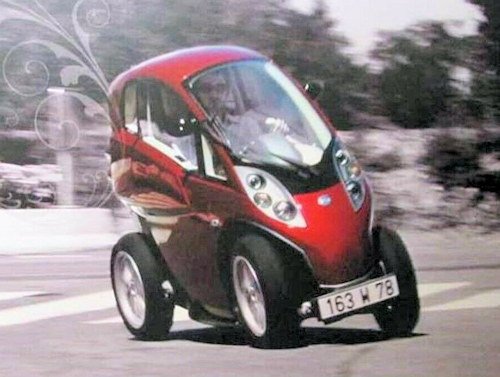
Lumeneo is a French Automotive manufacturer company from 2009 to 2013 that built the Lumeneo Smera.
History
Created in June 2006, Lumeneo is the result of several years of conceptualization work based on a clearly defined concept to meet the needs of city dwellers in urban mobility. From its origins to mid-2009, 2,336,000 euros have been invested in the capital of this company. At the Start July 2009, the company announced the opening of its capital to new investors to support the industrial and commercial launch of the Smera. The total amount represents 1.6 million euros. Eco-Mobilité Partenaires, SNCF's investment fund for sustainable mobility. However, the company went bankrupt in mid-2013.
The Lumeno Smera at the 2008 Paris Motor Show. The Lumeno Smera is an electric car that was developed by the French car manufacturer Lumeneo, based in Yvelines in Île-de-France.
After the presentation of its prototype at the Geneva and Paris shows in 2008, the production model of the Lumeneo Smera, a very compact electric car, was presented at the 2010 Geneva International Motor Show. With two seats in line (1 + 1), this small city car 86 cm wide tilts in turns up to 20 ° depending on speed, road quality and the angle of the road. curve, among others. A lithium battery pack and two 20 hp motors each give it a maximum speed of 110 km / h and a range of 100 km. The technology of this car is in its brushless permanent magnet motor. The Smera is a vehicle in its own right and therefore can be driven with a Bike license. Available in Berry red, mineral silver, deep black, pearl, tanzanite blue.
The Smera has a built-in charger, so charging can be done from any household electrical outlet. In 15 minutes, the car is recharged enough to cover 10 km. After 6 to 8 years of use in a car, lithium batteries will be reusable for less demanding use in fixed storage. They will gradually replace lead-acid batteries in many equipment and will thus have several lives before being recycled.
Specifications
- Number of doors / places: 2/1 + 1
- Length / width / height: 2,500 / 860 / 1,480 mm
- Boot capacity with 1 person: 150
- Boot capacity with 2 people: 15
- Max power: 30 kW / 40 ch
- Max voltage: 144 V
- Battery capacity: 10 kWh
- Battery weight: 80 kg
- Max speed: 110 km / h
- Acceleration 0-100 km / h: 8 s
- Range: 100 km
CGE (Compagnie Générale d'Électricité)
Automotive manufacturer Paris , France From 1941 to 1946.

The Compagnie Générale d'Électricité (CGE) Tudor is a French electric passenger car the CGE Tudor.Built from in the 1940s
History
The French front-wheel drive pioneer Jean-Albert Grégoire designed from 1941 on behalf of the Compagnie Générale d'Électricité an electric car . The production vehicles were convertibles . In addition, there were a few prototypes as vans , plans for a four-door, four-seat sedan for use as a taxi as well as some coupes that were on display at the Paris Motor Show in October 1946. The selling price was expensive at 105,000 francs .The chassis consisted of an aluminum frame.
The electric motor was arranged centrally. The batteries were mounted front and back.The drive was provided by an electric motor . By recuperation , the batteries were charged when braking.The maximum speed was 58 km / h, and the range 90 kilometers.]With a wheelbase of 2350 mm and a track width of 1160 mm, the vehicle length was 3700 mm and the vehicle height 1400 mm. The weight of the vehicles was 970 kg, of which the batteries alone weighed 460 kg.
Between 1941 and 1946 with about 200 cars made.
