
USA
Lambert (Buckeye Manufacturing Company)
Automotive manufacturer of Union City, Ohio and Anderson, Indiana, United States from 1905 to 1917.
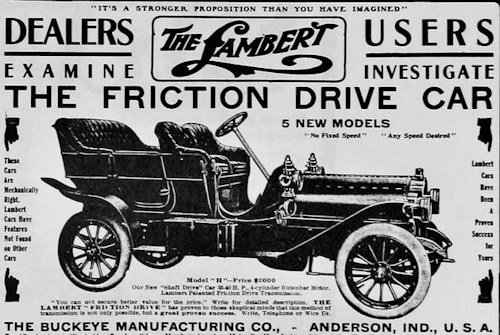
The Lambert Brothers and Company as Buckeye Manufacturing Company was a manufacturing company that originally made parts for small wagons and later Automobiles as Lambert.
History
The Lambert automobile and Lambert truck were built by the Lambert Automobile Company as an American vehicle from 1905 through 1916. The early motors were built at the Lambert factories of the Buckeye Manufacturing Company and later they were outsourced to other proprietary manufactures.
The company was originally founded in Union City, Ohio in 1884 as Lambert Brothers and Company. In the early 20th century, they put the Buckeye gasoline buggy and parts for the Lambert Automobile Company and the Union Automobile Company. One of its subsidiaries was the Pioneer Pole and Shaft Company, which was headed by George A. Lambert, the son of founder John W. Lambert. Other affiliates were the Union Automobile Company, the Lambert Automobile Company and the Lambert Gas and Gasoline Engine Company, which were headed by John W. Lambert himself. Originally, yokes were made for buggies and other wagon parts. The company employed six workers and a few boys as helpers. After a few years, the company name was changed to JH Osborne and Company. Then some tools were added to the assortment. The company developed a hand-operated drill that bore the name of this company. In 1890 Mr Osborne left the company, which then reverted to its original name. In 1891, the Buckeye Manufacturing Company burned down. The damage to buildings and goods amounted to $ 15,000, of which $ 12,000 was borne by the insurance. With this money, the corporate buildings were rebuilt.
Then Buckeye Manufacturing Company moved to Anderson, Indiana, to Evalyn Industrial Park, on Third Street and Sycamore Street. In 1903 bought 20,000 square meters at the Columbus Avenue to. The Anderson Weekly Herald reported that the new factory would have up to 28,000 square feet of production space and 350 to 400 people work. It would be equipped with state-of-the-art facilities, such as electric cranes. The building investment should amount to $ 150,000. A contract for the steelworks should be signed with the general contractor a few days after publication of the newspaper article. The factory produced gasoline engines and steel stampings for Lambert automobiles.
The site was named Hannah Croak Grounds and belonged to Mrs. Hannah Carey. The transaction was executed by the Sears Real Estate Company. The Buckeye Manufacturing Company then joined the Lambert Gas and Gasoline Engine Company. In the new factory parts for Lambert-cars were produced. Series production began in 1905.
Lambert came in second in an automobile race conducted in July 1905 from Chicago to St. Paul. There was a total of 53 automobiles entered into the race and Lambert's was the only gasoline powered automobile to finish. The success of Lambert's 16 horsepower (12 kW) automobile against others of 40 horsepower (30 kW) was attributed to the Lambert friction gearing disk drive transmission.
Vehicles
The Lambert chassis of the high end employed a three-point suspension to save driving power by decreasing the lift required of the automobile body because of road surface variations. It saved wear and tear on the automobile body and its parts. The others used ordinary suspension. Sometimes a shaft drive was provided on some models, however most Lambert automobile models were with a chain drive to the rear axle. The Lambert automobile chassis with the gearless friction drive speed change transmission was the basis for the Lambert automobiles and trucks built from 1906 through 1916. The valve action of the engines were hardened steel cams that were applied to the cam shaft. The cam faces were slightly convex, and worked on hardened rollers, carried in swinging forks, which bore against square ended sliders. The valves were alum mum heads driven to shoulder on riveted steel stems. The valve action was direct with no side action on the sliders. The compression was between 50 to 55 pounds of pressure.
The Lambert opposed cylinder motor had a number of features not usual in that form of gas engine in that era. For example, the oiler was of the precision variety, in which a ratchet actuated worm drives a worm gear carrying a spring actuated oil force pump successively over the oil leads to be supplied, the plunge spring being compressed by a circle of wedges, and the rise from each compression being regulated by an individual temper screw. Oil leads dropped oil on the crank wrist rod ends. The cranks had full disk arms and the crank shaft journals ran in bronze bearings.
The Buckeye stationary engine, designed by John W. Lambert, was patented in 1894. The company started building these stationary engines as customers were not interested in Lambert's automobiles.
There was no link to other Lambert and Buckeye Motor Car Companys , which used the same brand name Buckeye and Lambert .
Buckeye Wagon & Motor Car Company

Buckeye Wagon & Motor Car Company was an early American manufacturer of wagons and later automobiles. The brand name was Buckeye.
History
The Buckeye Wagon Company was founded in 1904 at Canal street, Dayton Ohio. They at first made horse drawn wagons. Charles Anderson was president and WL Wirsching secretary. In 1910, they changed the name to Buckeye Wagon & Motor Car Company and began producing automobiles. The brand name was Buckeye. In 1911 ended the production of motor vehicles.
The model was an open type-high wheeler for commercial use. With its large wheels, it was suitable for the then bad roads in America at the time. The open commercial vehicle had a 3000 pounds carry weight and heavy-duty transmission. It had a four-cylinder engine with 25 hp power. The chassis had 100-inch (254 cm) wheelbase.
There were no connections to People's Automobile Company and Logan Construction Company using the same brand name.
Buckeye (Peoples Automobile Company)
The People's Automobile Company and also as Buckeye Automobile Company was an early American manufacturer of buses and light passenger cars and one of the first companies to offer automobiles as a kit car . The brand names was as People's and Buckeye.
History
The company was founded in 1900 in Cleveland , Ohio . Paul Gaeth was hired as a designer. The goal was the production of buses . In the same year began the production of passenger cars and buses . From 1901, another model supplemented the range, which was marketed as Buckeye and was also available as a kit car . In January 1902, the bankruptcy began .Gath later founded the Gaeth Motor Car Company .
In the year 1900, a long strike of local tram staff took place in Cleveland. This gave resident business people the idea of building buses to carry passengers. The People's Automobile Company was for this purpose with a capital of 50,000 US dollars with the "People's Rail-less Streetcar" It seems that the company approached something naïve; the striking workers barely allowed any alternative means of transport to undermine their strike. The proposed bus was with a length of 6,71 m (22 feet) and 26 seats hopelessly too heavy for the single-cylinder engine with up to 3 hp The designer of the Rail-less Streetcar was the local engineer Paul Gaeth , who had previously built his own car with the Gaethmobile. However, he had great difficulty getting a first prototype up and running. Finally, a few copies were completed. The anticipated problems with underpowering occurred; it was probably sold a few of these buses.
Most, however, the engine was removed to use it in a light, two-seat runabout . But the lying under the seat mounted engine was far better suited. The People's Runabout was a conventional construction with wire spoke wheels , a drive chain that ran longitudinally centered to the differential on the rear axle , and the usual steering lever; Steering wheels prevailed later. A contemporary shot shows no drumsat the wheels, suggesting that the lever mounted to the right of the driver acts to slow down either the transmission or the differential (or both). The vehicle was sold for $ 650; a price equivalent to that of the popular Oldsmobile Curved Dash with initially 4 ½ hp, six cars of this brand were created.
As the Brand name Buckeye Here, the single-cylinder engine made 2.75 hp. The engine was mounted under the seat. The steering lever was in the middle of the vehicle. The vehicle had wire spoke wheels. Body shape was a two-seat runabout. The kit included all items except the body and the tires. The price was $ 447.50. As a complete vehicle, the company demanded $ 1,000. A source suspects that the large price difference should encourage those interested to buy the kit instead of the complete vehicle.
It appears that a subsidiary, the Buckeye Automobile Company , was founded to do so . The customer could order the car for $ 1,000 ex works or as a kit (without body and wheels) for $ 447.50.
There was no link to the Logan Construction Company and the Buckeye Wagon & Motor Car Company , which used the same brand name Buckeye .
Auto-Mobile (Dawson Manufacturing Company)
Dawson Manufacturing Company was an early American manufacturer of automobiles. The brand name was Dawson.
History
George Dawson was from Cincinnati. He founded the company in 1899 in Basic City, Virginia and manufactured a first vehicle and also the first of its industry in the state of Virginia. He offered it in a car magazine and received some inquiries, but no firm orders. Then he sold the first vehicle to Luther Gaw and John Clark. Work on a second vehicle began, but it was not completed. In 1901, the company was dissolved when Dawson went back to Cincinnati.
The only model was built in 1901 called Auto-Mobile hand-built by Dawson. The open wooden body was mounted on a tubular steel frame as a runabout to accommodate three people. This was a steam car the steam engine had two cylinders and was made of brass. This droves over a chain to the rear axle. It was steered with a steering lever. The top speed was stated at 40 km / h on good roads with its 30-inch wheels.
There was no connection to the JH Dawson Machinery Company, which later used the same brand name.
Cartercar History

The Cartercar Company was an early American automaker, based in Michigan USA.
History
The Cartercar Company was first based in Jackson (Michigan) in 1905, Detroit, Michigan in 1906, and Pontiac, Michigan, in 1907 to 1915.
The carter car was praised in the press, especially because of its friction disc gear. This friction disc transmission an indirect precursor of today's CVT gearbox; both offer stepless drive ratios. After about 6500 km, the paper pulleys, which were part of the gearbox, had to be replaced, which cost only US $ 5, which is half the price of a new grease filling in a conventional spur gearbox.
From the first to the second full year of production sales doubled; In 1906 there were 101 sold, 1907 already 264 The following year, 325 cars were sold.
After leaving the Jackson Automobile Company in 1905 due to a disagreement with his partners over the selection of gearboxes, Byron J. Carter created the Motorcar Company in Jackson. The new company relocated to Detroit at the end of the year, along with its financiers. Carter rebranded his company Cartercar Company in early 1907. After acquiring the Pontiac Spring and Wagon Works in Pontiac, which made leaf springs, carriages, waggons, and a high wheeler, the company relocated again in November 1908. Albert G. North and Harry G. Hamilton, the company's founders, purchased Rapid Motor Vehicle Company, a manufacturer of commercial vehicles and smaller buses.
On October 26, 1909 Cartercar was taken over by General Motors (GM). Thus, the company was one of the 25 companies that its founder, William C. Durant, had acquired in the year and a half since the founding of GM as a holding company; another was the aforementioned Rapid Motor Vehicle Company, which gradually organized General Motors as the group's commercial vehicle division and finally as GMC.
Like most of Durant's purchases, this acquisition was speculative. Although he avoided technologies such as electric or steam drive, but covered his companies quite different price segments and sought technical unique selling points. At Elmore it was the two-stroke engine, Rapid and Reliance Motor Truck Company covered the commercial vehicle sector and at Cartercar it was the friction gear. Durant had read about it and thus issued a check on the future. That he was not covered, showed the technical development, which broke away quickly from the friction gear.
Asked why he bought Cartercar, Durant later replied, "you say I should not have bought Cartercar. Yeah, how could anyone know that Cartercar would not be right? They had the friction disc drive that no other car had. How should I know what these engineers would say next? "
Cartercar Model R Touring; Four-cylinder from 1912. The exhibiting museum exaggerates something; not the Cartercar, but the Metz built from 1909 to 1919 was the most successful car with friction gear.
The company started with a single-cylinder engine, later came two-cylinder boxer engines, which were used until 1909. From 1910 only four-cylinder engines were installed. Two models, both with four-cylinder engine block, published in 1912; the model R had 4160 cc, while the model S had 5437 cc displacement. Both drove the rear wheels over a chain. There were other cars with friction discs, such as the Lambert, the Metz and the Petrel, but none of them was produced as long as the Cartercar. Because the friction disc was able to stop any translation and was not bound to fixed gears, the Cartercar was touted as the "car with a thousand gears". Another copy claimed: "It is difficult to improve a carter car".
