
USA
- Details
- Parent Category: Motor car History
- Category: USA
Chalmers Motor Car Company History
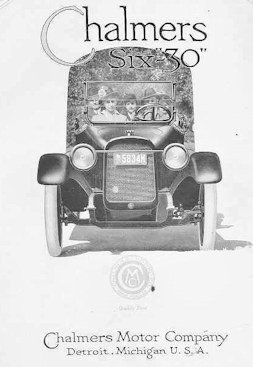
The Chalmers Motor Car Company, was an American automaker that was based in Detroit USA from 1908 to 1924.
History
The Chalmers Motor Car Company, previously the Chalmers-Detroit Motor Car Company, was founded by Thomas-Detroit. Hugh Chalmers, the vice president of NCR Corporation at the time, purchased the company in 1908 and renamed it Chalmers-Detroit Motor Car Company. In the same year, the first Chalmers-Detroit automobiles arrived, which were essentially reissues of the previous Thomas Detroit.
At the end of 1910 Chalmers rebranded his company in Chalmers Motor Car Company and the cars were called Chalmers in the future, The output had expanded to roughly 20,000 copies per year. A Chalmers also won the Glidden Tour in 1910, the most important roadworthiness test for automobiles in the United States at the time.With their 2921 mm wheelbase and the 34 "wheels the Chalmers were very expensive cars at the time. The 30 Touring and the 30 Roadster cost $1500 USD.
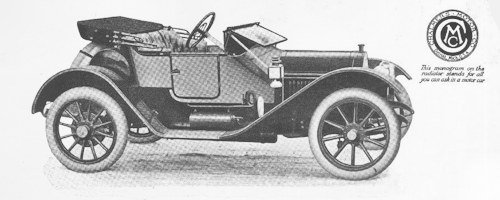
As a result of the First World War in 1921 Chalmers rented part of his company building to the Maxwell Motor Company, in 1922 the merger took place. Maxwell bought the buildings and land from Chalmers for $ 1,987,000 and took over the company's debts. The new man at the head of Maxwell-Chalmers was Walter P. Chrysler. At the end of 1923 Chalmers had to stop production, and a year later Maxwell appeared now the first Chrysler.

- Details
- Parent Category: Motor car History
- Category: USA
Dayton Electric Car Company
Automotive manufacturer of Dayton, Ohio; United States from 1911 to 1914.

Dayton Electric Car Company, was an American manufacturer of electric automobiles in the 1910s. Marketed as Dayton.
History
The Dayton Electric Car Company, originally Dayton Electromobile Company, company was based in Dayton, Ohio. It manufactured automobiles from 1911 to 1914 The offer included electric cars from the time. The JLB Motor Car Company took over the company, manufactured individual vehicles from existing parts and ensured the supply of spare parts by the end of the year.
In 1911 there was the Model 101 in two different chassis lengths. The shorter with 203 cm wheelbase formed the basis for coupes with two and three seats, Victoria and Stanhope. A four-seat coupe had 218 cm wheelbase. By 1912 the range was extended to three models. In addition, there was now a choice between chain and cardan drive. The Model 102 was a coupe and had 218 cm wheelbase. The Model 103 was called Straight Front Coupe and had the shorter wheelbase of 203 cm. Model 4 was a Victoria on the same basis. In the period from 1913 to 1914, there were only coupes. For the Model 1021 the wheelbase was 218 cm and for the Model 1022 234 cm.
- Details
- Parent Category: Motor car History
- Category: USA
Eisenhuth Horseless Vehicle Company
American Automotive manufacturer New York.USA From 1896 to 1909
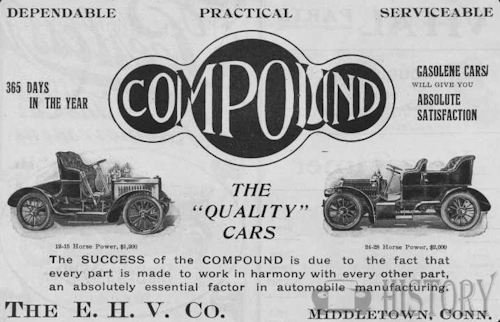
Eisenhuth Horseless Vehicle Company was a early manufacturer of automobiles who were originally based in New York City.Brand names were compound and Later, Eagle Motor Car Company .
History
Eisenhuth Horseless Vehicle Company Later as the Eagle Motor Car Company , John W. Eisenhuth experimented since 1896 with vehicles and engines. The vehicles were marketed until 1900 as Eisenhuth .In 1900 he joined forces with DF Graham. In 1901 they took over the RM Keating Motor Company from Middletown , Connecticut . In 1903, they presented a prototype at the New York Automobile Show at Madison Square Garden in New York City . This was called Graham-Fox . In 1904 they founded the Eisenhuth Horseless Vehicle Company in Middletown and began mass production of automobiles. The brand name was compound . Later, the name changed to Eagle Motor Car Company . 1908 ended production.
Unusually, the gasoline engine . In two cylinders , an explosion took place, and the pressure of the exhaust gases operated a third cylinder, which was centrally located. This type of three-cylinder engines was used until 1907. In other models from 1907 with two- and six-cylinder engines , this feature is not known. All vehicles had a front engine and cardan drive to the rear axle.

Their automobile was an unusual model called the Compound with three cylinders. Two were working cylinders, the larger middle one further expanded the exhaust gases of the outer working cylinders, this concept received later the name: '5-Stroke engine'.A number of body styles and commercial vehicle were sold.
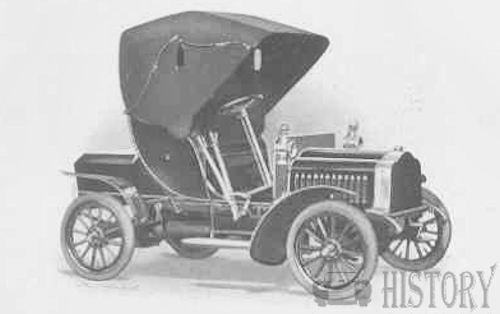
The 1904 Compound was a touring car model. Equipped with a tonneau, it could seat 7 passengers and sold for $6000 to 8000. The vertical-mounted straight-3, situated at the front of the car, produced 16 hp with .96" wheel base and 28" tires A 3-speed sliding gear transmission was fitted. The car weighed 3100 lb (1406 kg).1904 made the engine 20 hp . The wheelbase was 254 cm. There was a choice of five- and seven-seat touring cars .
In 1905 it became the Model 3 . The engine was specified with 24/28 hp. The wheelbase remained unchanged. The only structure was a tonneau with lateral access. The Series 4 represented a smaller and weaker model. Its engine made 12/15 hp. The chassis had 206 cm wheelbase. Tonneau with side entry and a two-seat runabout are known .

1906 model 9 van
Aluminum body capable of carrying up to 2 tons with straight-3 16hp engine and 96" wheelbase. In 1906, the offer was reduced to a model range. The engine made uniformly 16 hp. A short chassis with 207 cm wheelbase formed the basis for a two-seater, which was called Doctor's Stanhope . In addition, there was a longer chassis with 245 cm wheelbase. Model 5 was a five-seat touring car. With model 7 ½ was called five-seated Tuxedo . The Model 8 with the construction Royal Victoria had four seats.
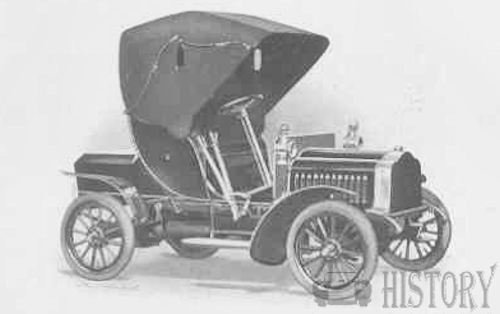
1906 Doctors Stanhope
2 seater with Special aluninum body,small wheel base of 82 inches with 28" wheels with extra large carrying space.
In 1907 there were only the Doctor's Stanhope of the previous models . His wheelbase had been slightly extended to 208 cm. Three new model series complemented the range. The Model H had a six-cylinder engine with 40 hp, a wheelbase of 292 cm and a structure as a touring car with seven seats. A two-cylinder model had 20 hp and 245 cm wheelbase. The model I was a Victorian with four seats, the Model K , a five-seater touring cars and the Model L is a two-seat runabout. The weakest vehicle had a two-cylinder engine with 16 hp. His wheelbase was also 245 cm. Construction was a touring car with five seats.
1908 stood only two-cylinder models with the 20-horsepower engine on offer. The chassis had a uniform 245 cm wheelbase. Model N was a touring car runabout, Model O a four-seat tonneau, and Model P a five-seat tonneau.
- Details
- Parent Category: Motor car History
- Category: USA
Hamilton Motors Company
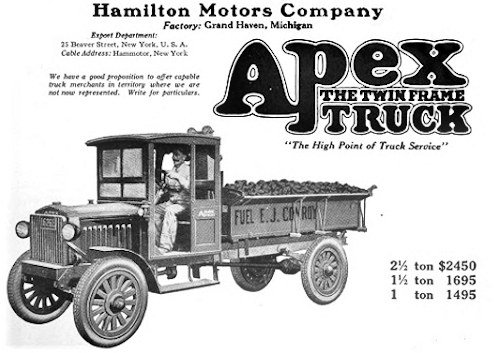
Hamilton Motors Company was an American manufacturer of motor vehicles and Commercial vehicles in Grand Haven, Michigan the brand names as Hamilton, Panhard and Apex.
History
Guy Hamilton had headed the Alter Motor Car Company. After their bankruptcy, he founded the new company in Grand Haven, Michigan. He continued the production. Passenger cars only emerged in 1917 and were called Hamilton. Trucks were first marketed as Panhard but Panhard et Levassor vehicle company in France allegedly complained about the name so it was again changed to finally as Apex.
The offer was only the model A-14. It was largely a model of old age. The four-cylinder engine made 28 hp. The chassis had 284 cm wheelbase. The only construction was an open touring car with five seats. A model with a six-cylinder engine was announced but not completed very few cars built. The main sales came from Commercial vehicles,the trucks came with load sizes from 1-1/2- and 2 1/2-ton Apex trucks, with 3-speed Fuller transmissions and Torbensen rear axles
By 1921 their production ended
- Details
- Parent Category: Motor car History
- Category: USA
Fee-Bock Automobile Company
Fee-Bock Automobile Company was an early American manufacturer of automobiles and automotive dealers. The brand name was Fee-American.
History
Fee-Bock Automobile Company headed by Robert L. Fee from Detroit, Michigan. Sold vehicles came from Elmore. At the suggestion of his co-worker Edward Zolle the development of own automobiles began. The first public presentation took place in February 1907 at the Detroit Automobile Show. Fee realized that selling vehicles that came easily available was easier than making them yourself. So overall, only a few vehicles built.
The model Construction was an open touring car with room for five people.This came with a two-cylinder two-stroke engine the performance was stated at 18/20 hp. this drove the rear axle via a cardan shaft.
By 1908 ended vehicle production.