
USA
Douglas Motors Corporation
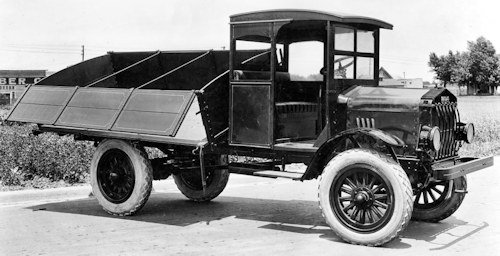
Douglas Motors Corporation was an early American manufacturer of motor vehicles. The brand name was Douglas.
History
The Douglas Motors Corporation company was founded in early 1918 in Omaha, Nebraska. Previously as the Drummond Motor Car Company. By 1918 began the production of passenger cars and commercial vehicles.
The cars only built for one year as a three-seater roadster and five and seven-seat touring car. came powered with a V8 engine from Herschell-Spillman with 75 hp. The chassis had 310 cm wheelbase. Most expensive model was a Speedster Special with 320 cm wheelbase.
For the trucks were payloads between a small 0.5 and larger 3.5 tonnes.
By 1919 the car production ended. Trucks were created until 1935.
Leata (Stinebaugh Manufacturing Company)
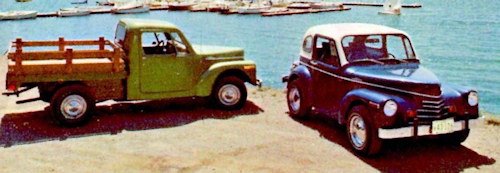
Leata was a unusual short-lived US-American custom car brand that was in the mid-1970s.
History
Leata Manufacturer was the Stinebaugh Manufacturing Company in Post Falls ( Idaho ).Founded in the 1960s by machinist and inventor Don E. Stinebaugh , the company produced ATVs for professional applications, the largest of which, with six wheels and three driven axles. Of particular note was their handmade body made of fiberglass. was also successful one developed by Stinebaugh engine for snowmobiles . Stinebaugh received 48 patents during his lifetime.
At least the first three copies were Continental - four-cylinder engines with 60 bhp (44.75 kW). Gearboxes came from BorgWarner , rear axles were supplied by Spicer , the small sports steering wheel came from the catalog of car dealer JC Whitney and many other components came from Ford . The Leata was made from purchased components. The chassis built a special racing car manufacturing facility in Spokane for Stinebaugh. It had the short wheelbase of 1778 mm (70 inches) , independent suspension front and all-around coil springs .There was a hydraulic dual circuit brake system . The wheels had radial tires of dimension 78 × 13 BR The tank held 38 liters (10 US gallons)
Cost reasons and issues with emissions regulations led Stinebaugh to use Ford's Pinto engine with 2.3 liter displacement, electronic ignition and a power output of 83 bhp (61.9 kW) instead of the Continental engine . The saving per unit was US $ 180. T
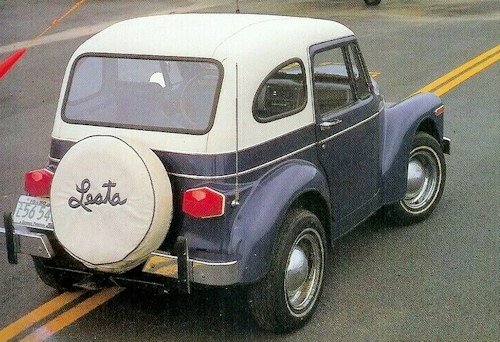
The Leata was designed as a pure two-seater. The first model was a coupe or "Berlinetta". The body was again designed by Stinebaugh. That this was impressed by the styling of the first Lincoln Continental is also evident on the Leata with a tapering bonnet, fender cut-outs in the style of the VW Beetle , straight discs and even a Continental Kit at the rear, Inside Stinebaugh was more interested in hot rods . The covers of the individual seats as well as door and side panels are made of metallic shimmering vinyl with diagonally quilted inserts in the seats. The floor is covered with a soft nylon carpet. The dashboard appears frivolous with black displays and white numbers; The carrier probably comes from Ford. There were real wood deposits that were also available with matching vinyl available. Stinebaugh attached particular importance to ensuring that all materials used were flame-retardant.
The driving characteristics themselves should be quite impressive; After all, the vehicle is shorter than a smart but much more motorized and lighter. A customer with his Leata also hit 40 MPH, the car then slid on the roof 20 meters further. He got out unhurt and turned it on the wheels. It turned out that the Leata was still mobile. After that, the Stinebaughs cut off the demolished roof and replaced it with a new one.
Fiberglass has also been used for the body because, from a certain point of view, this material contributes to the rigidity of the structure. The fact that this worked, was revealed when Stinebaugh for the prescribed crash test a Leata in front of a gathered local press with 40 MPH (about 65 km / h) bounced against a concrete wall.
The extensive construction by hand allowed to experiment with variants. At least one cabriolet was built and a pick-up on a longer chassis with a 2388 mm (94 inch) wheelbase was built. Also, a slightly strained, closed version was tried. called "Sedan"For 1976, only coupe and pick-up were offered. The price rose to US $ 3295; that was US $ 500 more than a Ford Pinto cost. The car was not even profitable. Supposedly, a waiting list with 2000 customers have passed.The production ended in early 1976, singing and soundless. In total, only 22 Leatas were built, including 18 coupes, the convertible, three pick-ups and the "Sedan". After that body styles and inventory were sold. A 2.3 litre Leata with electronic Four speed Synchromesh Borg Warner transmission. Heavy Oaty Spicer rear end. 13.78 steel beltedradial ply tires.well equipped parts Real instrumentation. Speedometer; ampmeter; fuel, water and oil gauges set in recessed Walnut grain trim the glovebox. radio and heater controls. a padded dash. Deluxe harness type belts. Wing . foam padded vinyl upholstered seats. Deep pile 100% nylon carpeting.hydraulic brake drum System.A frame coil spring. Independent ftomt suspension. Leaf spring rear Suspension. Ten fuel tank. Truck bed Wheelbase 94", Price $3495.00. coupe 70" wheelbase. Price $329S.00.
Finally, the marketing director got a new job. Stinebaugh had come up with the idea to convert Chevrolet Chevettes to small luxury cars. To do this he made special body parts, again made of fiberglass. The Leata Cabalero was modeled after much larger Personal Luxury Cars , but also reminded from the front of the Toyota Cressida of the first generation. Again there was a coupe and a pickup truck. For the latter, he built a frame to give the self-supporting body of the Chevette the necessary rigidity.
The 1977 presented Cabalero was much easier to build than its predecessor. About a hundred made.It was followed by a series of large sports cars, all retro items and at a price of US $ 75,000.
The production ran from 1975 to about 1978.
General Automobile & Manufacturing Company
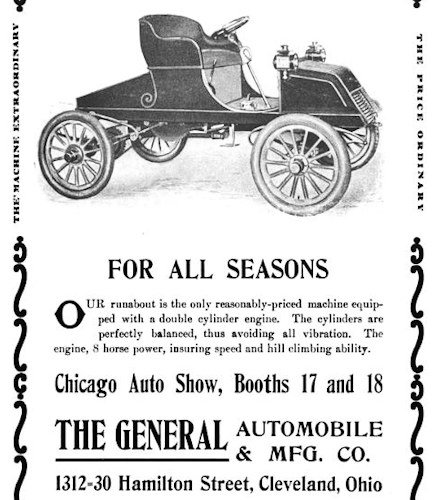
The Hansen Automobile Company, and later as General Automobile & Manufacturing Company, was an early American car manufacturer from Cleveland in Ohio, from 1902 to 1903. The brand names were Cleveland, Hansen and General.
History
Rasmus Hansen created the Hansen Automobile Company in 1902. He was a Danish immigrant who arrived in the United States when he was 18 years old. The automobile he built was a solidly made Voiturette runabout with a 6 HP single cylinder engine that was exclusively offered in the design. Cleveland was the name given to the earliest cars.
The Hansen sold quite well. In September 1902, the company was reorganized as General Automobile & Manufacturing Company. The background was a planned capital increase to finance larger investments. This went hand in hand with the new brand name General, an upgraded vehicle with 8 HP power for US $ 900, - and a new 14 HP two-cylinder model, which cost US $1000. The withdrawal of investors led to the bankruptcy of General Automobile & Manufacturing Company in September 1903. After that, 25 started vehicles were completed. These were acquired by the Studebaker Brothers Manufacturing Company in October, including the equipment and inventory.
A modern attribute of all vehicles was an inclined radiator mounted on the car front. Behind it was a storage room that probably contained the water tank and was a bit larger in the General models. The Hansen HP 6 was a typical motor buggy with a water-cooled single-cylinder engine, which was mounted transversely to the travel direction under the seat. General 8 HP and General 14 HP were two-cylinder models. It is known from the 6 HP that the four-stroke engine had a 4½ inch (11.43 cm) cylinder bore and a 5¾ inch (14.605 cm) stroke 1.5 litres. The power transmission took place on all models by means of drive chain on the rear axle It was optionally delivered with wire spokes or artillery wheels. [For the General models, a wheelbase of 78 inches (1981 mm).
Oldsmobile (Olds Motor Vehicle Co) History

Oldsmobile were from the year 1897 in Lansing (Michigan) produced by the Olds Motor Vehicle Co. Vehicles.
History
Oldsmobile’s were first manufactured by the Olds Motor Vehicle Co. in Lansing, Michigan. In 1908, the cars named as olds automobile and later as Oldsmobile’s. General Motors (GM) took over the company, originally founded as RV's Olds Motor Car Company by Ransom Eli Olds, and continued to use the Oldsmobile brand until 2004. The Olds Motor Works were before Ford, the first commercially successful car manufacturers in the United States, the mass-produced. In the brand's 107-year history, GM produced 35 million Oldsmobile vehicles; thereof about 14 million in the Lansing plant. In the 1960s and 1970s Oldsmobile was one of the most successful brands in the US and also stood for technical peculiarities and innovations.
By 1901 the company produced 635 cars and in the early 1900s the Curved Dash" was the first mass-produced car in the USA not Ford as many believed.

From the thirties for several decades, Oldsmobile got into the habit of equipping the model’s name with a pair of digits, the first representing the body type (the digits 6, 7, 8 and 9 were used) and the second the type. of engine if 6 or 8 cylinders, even before the outbreak of the Second World War, the company's models premiered first in semi-automatic and later fully automatic versions.
During the conflict the production was converted to that of war material and the first cars returned to light only at the end of 1945. The company's image in the post-war period was associated with its new V8 engine which offered power on average much higher than that of the competition. The Oldsmobile, which within the General Motors group was located halfway between the Pontiac brand and the Buick, was also used to preview some innovations on the automotive market, at least in the US, such as the removable hardtop, the engine turbocharged and the front-wheel drive (with the Tornado).

Its popularity on the domestic market had a continuous growth until the eighties, when it began its slow decline that led the parent company to decide to close it in 2000; it actually closed on 29 April 2004 with the exit from the assembly line of the last vehicle produced, the Alero model.
In May 1981 the RE Olds Transportation Museum was inaugurated, i.e., the museum dedicated to the cars produced by
Under the Oldsmobile logo, General Motors produced 304,634 cars in 2000, but only two years later it was just 162,000 vehicles. This decline continued, with the result that General Motors Corporation discontinued production of Oldsmobile vehicles on April 29, 2004. The last model that came off the line at GM's Lansing plant at Oldsmobile was an Alero that was brought to the RE Olds Transportation Museum.

WE Burns and Brothers Carriage Works
Automotive manufacturer Havre de Grace in Maryland;USA From 1908 to 1912.

WE Burns and Brothers Carriage Works , was an early American manufacturer of carriages and automobiles . They were sold as Burns .
History
WE Burns and Brothers Carriage Works in Havre de Grace in Maryland ,was founded by Walter Elsworth Burns in 1896 the company started with carriage production. His brothers Reese, Alfred, Charles and Jonathan were later also joined the company. In addition, cars were built between 1908 and 1912. Sales remained low.
First built was a highwheeler, the vehicles were well suited to the bad roads at that time, especially in the western US. However, Maryland is in the East, where highwheelers were little in demand. Only in 1912 the vehicles were adjusted and made lower.From 1908 and 1909 there was a model with an air-cooled two-cylinder engine and 16 hp power. The engine power was transmitted via a friction gear and two chains to the rear axle. The wheelbase was 229 cm. There was a choice of superstructures as the High Wheeled Buggy and the two-seater Transformable Coupé .
1910, the wheelbase was extended to 244 cm. In the buggy, the engine now made 14 hp. The coupe , however, had a four-cylinder engine , which was specified with 18/20 hp.From 1911 only two-cylinder models were available as a transformable coupe in the range. In the year the engine made 12 hp. The chassis still had 244 cm wheelbase.In 1912, the engine power was increased to 15 hp and the wheelbase extended to 254 cm.
