
USA
Custer Specialty Company History

Custer Specialty Company was an American manufacturer of electric and gasoline mobility automobiles. The brand name was Custer also Cootie.
History
Levitt Lucerne Custer founded the company in Dayton, Ohio in 1916. By 1920 began the production of motor vehicles, mobility scooters and child cars. 1942, production ended due to the war. Between 1953 and 1960 emerged again vehicles, which were now marketed as Custer.
The offer included five models, all of which were electrically powered. The Cootie was a children's car, the Cabbie a mini-locomotive, the Chair an electric wheelchair, the carrier a transport vehicle for use in factories and the coupe a city car for two people.
The highest production figures reached the Chair, much to the delight of Lucerne Custer, who was himself war-injured. Second was the cootie. The only roadworthy product, the Coupe, was 1981 mm long and 1575 mm high. Until the provisional cessation of production in 1942 but only a few copies. After the Second World War, a Custer appeared again in 1953. This time it was a very simple platform car with two seats, which was powered either by a 4 -stroke gasoline engine with 6 bhp (4.4 kW) or an electric motor. The gasoline model cost 695 US dollars and reached a top speed of 64 km / h. The electrically driven vehicle had a range of 32 km.
In addition, further electrically operated vehicles were created.
After Custer's death on August 30, 1962, his wife Gladys Custer led the company. A fire on September 11, 1965 destroyed the factory. Subsequently, the company was dissolved.
Hercules Corporation
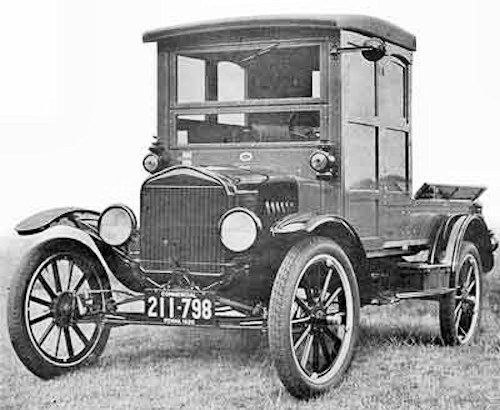
Hercules Corporation was an American manufacturer of engines and car bodies Commercial vehicles.
History
William Harvey McCurdy founded the Brighton Buggy Company in 1894 in Cincinnati, Ohio. He made carriages. In 1900 the factory became too small. McCurdy began construction of a larger plant in Evansville, Indiana. 1902 saw the move into the work. The company name was now Hercules Buggy Company, which produced bodies for motor vehicles. Between 1906 and 1909 created vehicles for Sears.
On November 8, 1912, the Hercules Gas Engine Company was founded. Customers were Ajax, Arco, Atlas, Champion, Economy, Erren, Hercules, Jaeger, Keystone, Reeco, Rohaco, Thermoil and Williams. With engine production in 1934 caused about up to 400,000 gasoline engines. In 1919, an electric car was produced called Hercules Electric, but remained a prototype. On November 23, 1920, McCurdy merged its individual companies into Hercules Corporation. William H. McCurdy was president, John D. Craft vice president and manager, Lynn McCurdy second vice president, treasurer and sales manager, and Frank G. Cowan secretary.
In 1920, Lynn McCurdy, the founder's son, visited the Indianapolis Automobile Show. There he became aware of a prototype of Guard Gale. He took over the project, hired Garde Gale as general sales manager of his automobile division and announced in December 1921 production for 1922. The brand name was now McCurdy. In the same year the production ended. In total, between two and seven vehicles were created. At least two were sold. The prototype of Guard Gale was the Gale Four with a four-cylinder engine. The McCurdy, had a six-cylinder engine from the Continental Motors Company. Parts for the chassis were also purchased. The wheelbase was 323 cm. The vehicles were body worked as open touring cars. The original price is called both $2095 and $ 2500
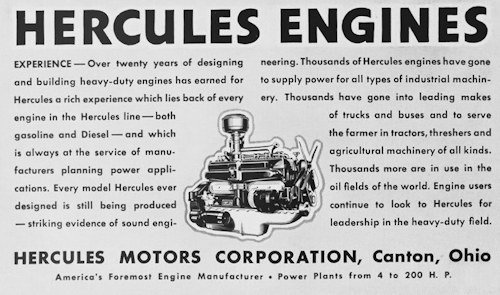
Significantly more important to the company was the production of coaches, gasoline engines and bodies for commercial vehicles and passenger cars. So, in 1922, delivered 84,000 coaches, 62,000 petrol engines and 40,000 bodies.
In 1957, George Caddick took over the company and reorganized. The successor company was called Hercules Manufacturing Company and had its headquarters in Henderson, Kentucky.
Corbitt Company Inc. History
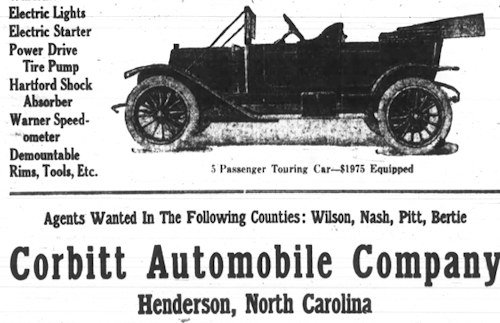
Corbitt Company Inc. was an American manufacturer of motor vehicles . The brand name was Corbitt .
History
Corbitt Company Inc. , previously Corbitt Buggy Company , Corbitt Automobile Company , Corbitt Motor Truck Company and Corbitt Company .Richard J. Corbitt founded the Corbitt Buggy Company in the 1890s . The seat was in Henderson , North Carolina . First he made carriages . In 1907 it became the Corbitt Automobile Company , as the production of passenger cars began. Commercial vehicles were added in 1910 . The car production was discontinued in 1914. In 1916, the company was renamed Corbitt Motor Truck Company and 1946 Corbitt Company .Between 1957 and 1958, the company now called Corbitt Company Inc. again produced trucks .
There were trucks with two and three axles and semitrailers . Some vehicles had a payload of 15 tons . The United States Armed Forces participated in both World War I and in World War II from vehicles.
In addition, buses were created .The first school buses in North Carolina came from Corbitt.
The first car model was a highwheeler . A two-cylinder engine powered the rear axle via a chain. The open body could accommodate two people. In 1907 was dispensed with fenders , which were available from 1908. Headlights were added in 1909. Of these models created until 1909 about 100 vehicles that were sold only in the vicinity.
1910 came more modern and especially lower vehicles on the market. From 1910 to 1911 they had a two-cylinder engine, which was specified as 18/20 hp . The wheelbase was 229 cm. The Model A was a four-seat touring car and the Model B a two-seat runabout .
From 1912 all vehicles had a four-cylinder engine and a chassis with 305 cm wheelbase. 1912 made the engine 30 hp. Available were Model A as a two-seat Roadster, Model B as a four-seater touring car and Model C as a five-seater touring cars.
In 1913 the engine was indicated as 30/35 hp. The vehicles were now Model D , Model E and Model F called. The superstructures remained unchanged.In 1914, only the engine power changed to 26 hp.
(GMC) General Motors Truck Company History

GMC (General Motors Company) is a brand of General Motors, which was introduced by the General Motors Truck Company since 1911.
History
GMC, formerly known as GMC Truck, is a brand name used on trucks, vans, off- roaders offered for sale in North America and the Middle East by General Motors.
At the end of 1908 GM took over the Reliance Motor Truck Company and in November 1909 the Rapid Motor Vehicle Company, a truck manufacturer established in 1900 as the Grabowsky Motor Vehicle Co. in Detroit by the brothers Max Grabowski and Morris Grabowski.
The trucks and buses were initially sold as Reliance and Rapid. In January 1912, they were first used at the New York Auto Show at Madison Square Garden with the logo GMC issued and sold from February 1912 under this trademark of GMTC. the base of the " General Motors Truck Company ", hence the " GMC Truck " (introduced in 1912) and remained until 1996.
The GMC brand was largely reserved for the Group's commercial vehicles. In the understanding of their home market every SUV is a truck.

During the Second World War, all efforts focused on the military sector, with the production of approximately 600,000 vehicles for the US military.
For over 50 years from 1925 GMC was also present on the market as a bus manufacturer after absorbing a Chicago company, Yellow Coach.
For many years, GMC's production was the same as that of Chevrolet with the latter representing the lower-end models and GMC presenting exclusive solutions for off-road use. For example, it was obtained that the Chevrolet K5 Blazer was equivalent to the GMC Jimmy except for some minor cosmetic changes. The same situation continues today with for example the Chevrolet Silverado marketed by GMC as GMC Sierra.
By 1981, GMC Truck & Coach Division became part of GM Worldwide Truck & Bus Group.
GM disappeared from the mid-size commercial vehicle market in 2011. In the heaviest truck class in the US, only Navistar sold more than GM in 1979, but in the 1980s, overall demand and market share waned, leaving GM within a few years to Volvo.
Since the second decade of the 21st century, only pick-ups, pickup trucks and GMV brand SUVs.

Liberty trucks History
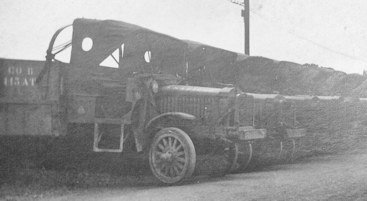
Liberty truck is the name of a truck used by the US armed forces in the First World War from 1917 to 1919.
History
During World War I The first experience of the Army with trucks as transport vehicles for military goods as well as towing vehicles for artillery in 1916 On April 6, 1917, the United States declared war on the German Reich. addition to some 2 million soldiers, they brought a variety of motor vehicles, including 51,554 trucks including 9452 Liberty trucks to Europe. The trucks were also left in large numbers to the allies. Liberty truck does not designate a car brand, but a model produced by several manufacturers.
Immediately after the entry of the United States, a body was created under the direction of the US Army Quartermaster Corps, which included the military and the Society of Automotive Engineers and the automotive industry. The aim was to create a simply constructed, particularly robust commercial vehicle with easily exchangeable components. Since model diversity leads to considerable disadvantages in every military operation, in particular with regard to spare parts stocking, maintenance and repair, it was decided to manufacture a manufacturer-independent vehicle by standardizing all components. As a result, a large number of companies involved volunteers in the development process.
Besides commercial vehicle manufacturers such as Diamond T, Selden, Pierce-Arrow, Sterling, Velia, Packard, Garford Company, Brockway Motor, Gram Amber, Republic and Bethlehem, a total of 62 automotive suppliers such as Waukesha Engines (Motors), Westinghouse Electric (Electrical Components), Continental Motors Company (Engines), Kelly-Springfield Tire Company (Full Tires), Splitdorf Electrical Co. (Magneto), Timken Company (Axis) and Muncie Gear Works (Transmission). Thanks to the special dedication of the volunteers, not least because of the patriotism that prevailed in the USA, it was possible to start serial production just a few months after the planning began. The first Liberty truck left the production hall on October 9, 1917.The vehicles were transported across the Atlantic to Saint-Nazaire, the main supply port of the United States in France. They served the American Expeditionary Forces as well as the Allies to deliver the enormous demand for ammunition, fuel, equipment and food to the front. Also, special water transport units (water tank train) have been set up, wherein a Liberty truck with three water tanks for each 250 gallons was equipped. In addition, there were versions with telecommunications equipment for the United States Army Signal Corps, mobile workshops, tow trucks and headlight vehicles; they also served officers as a transport opportunity (crews usually marched on foot). On the way back from the front, the vehicles carried heavily wounded soldiers; After the ceasefire in 1918, they were also used for the transfer of the first dead in temporary tombs brought war dead to permanent military cemeteries.
The United States Department of War had established a number of technical specifications in the contract award: Thus, to increase the off-road capability, a high ground clearance and a limited slip differential required. Since the vehicles predominantly as supply vehicles in slower file driving should be used, one was four-speed transmission with very low-translated creeper required as well as a large-sized cooler to prevent overheating of the engine. To increase the range was a large fuel tank intended.
All but one of the first vehicles had a Continental engine, with recourse to engine parts from a number of suppliers; for example, the cylinder heads were supplied by Waukesha Engines. Mandatory was also an engine mount at three points. The engines with 27 bhp (about 27 hp, 20 kW) on the Liberty Model A truck and 52 bhp (about 53 hp, 39 kW) on the Liberty Model B truck powered the rear axle. The latter allowed a maximum speed of 15 mph, which corresponded to the then usual standard for trucks. Also, the Solid rubber tires were then still considered the state of the art in commercial vehicles; some models were also equipped with wooden wheels that were studded with a metal ring. The overall dimensions of the vehicle were given as 6.52 × 2.1 × 1.87 m: the wheelbase was 4 m. Doors did not have the simply constructed vehicles.
The US Army as the customer paid a fixed price of $ 600 per vehicle. In order to avoid delays and other problems with possible royalties to owners of patents, an existing truck construction was used. The train was a design by the Gramm-Bernstein Motor Truck Company in Lima (Ohio). The Liberty truck, regardless of the manufacturer of the name United States contributed to the radiator, is one of the first robust automobiles, the economically supply could transport under the special conditions of war.
Use after the war
After the end of World War, most of the American war machine was returned to the United States. However, the repatriation of thousands of lorries and the marketing of vehicles that are also suitable for civilian use would have made the sale of new vehicles in the USA considerably more difficult in the medium term. As a result, the US government, including at the insistence of automotive industry stakeholders, renounced the repatriation of Liberty trucks. In the communication, cost reasons were given priority for this decision.
Many of the vehicles left behind in France and Belgium were converted to civilian trucks in Europe. The sale led to difficulties for French commercial vehicle manufacturers and contributed to the temporary insolvency of the large manufacturer Berlet. On the other hand, it allowed the creation and rise of new companies that bought the vehicles cheaply and specialized in the conversion and marketing of Liberty trucks. These included the French company Establishment Willem (which became one of the major commercial vehicle manufacturers in France) and the Belgian company Belge of the Liberty car-club (from which later became the Société Franco-belge of the car Liberty was born).
Thanks to the robust and - as usual at the beginning of the 20th century - construction designed for an unbroken lifespan, even today some Liberty trucks are in roadworthy condition - after almost 100 years. In addition, well-preserved vehicles are on display in several museums.
Models
- Liberty Standard AA 3/4 tons; 4 × 2 ("Model AA")
- Liberty Standard A 2 tons; 4 × 2 ("Model A")
- Liberty Standard B 3 tons; 4 × 2, rear dual tires ("Model B")
- Liberty Standard C 5 tons; 4 × 3, rear axles double tires ("Model C")
