
USA
Pope-Toledo (Pope Motor Car Company)

The Pope Motor Car Company was an American automaker, which was 1903-1909 based in Toledo (Ohio) . She produced automobiles under the name Pope-Toledo .
Predecessor company was the International Motor Car Company , also from Toledo in Ohio. ABC and the Pope Manufacturing Company were the nucleus of the first US automaker that Colonel Albert A. Pope built around the turn of the century. In this group, the vehicle manufacturers controlled by the group were merged in 1903. The result was the International Motor Car Company, the Pope Motor Car Company .
The Pope Toledo was built until the collapse of the group in 1909. In 1909, the company was acquired by Richard D. Apperson of the American National Bank in Lynchburg, Virginia . After an attempt to revive the prestigious brand she disappeared shortly afterwards from the market. The equipment was sold to the Overland Motor Company , which in turn owned John North Willysand later came to General Motors .

The 1909 XXII 50hp touring car
Pope-Toledo was an upscale brand within the Pope Empire, which also included the electric and luxury car manufacturer Columbia , the car and motorcycle manufacturer Pope-Hartford or a Waverley Department called manufacturing plant in Indianapolis (Indiana) , where under the name Pope-Waverley built inexpensive electric vehicles.
The 1903 offered model was an open two-seater with four wheels and front engine. It was powered by a series end-cylinder engine with 2983 cc, which - unusual for the time - had a removable cylinder head. The engine power was transmitted via a three-speed gearbox and one chain to both rear wheels. The car had a mainly wooden frame, which was combined with a steel subframe that carried the main mechanical components. The wheelbase was 2261 mm and the track 1422 mm.
The 1904 model was a larger touring car. He had a tonneau construction with rear entry, offered five people and cost US $ 3500 The front-mounted four-cylinder in-line engine developed 24 bhp (17.6 kW) and there was a three-speed helical gear. The trolley with a steel frame made of box sections weighed 1066 kg. The modern, rear-wheeled car had levers for ignition timing and gas in the steering wheel, then an innovation.
In 1907, there were also limousines and touring cars with seven seats.
Luxury Pope-Toledo limousine from last year of production

Pierre Cardin Automotive

History
In the 1970s, it was a common practice, especially in the American automotive market, to upgrade high-volume vehicles with specially designed equipment variants. Some manufacturers linked these special versions with the names of well-known designers, who should also give exclusivity. AMC introduced this concept in 1971 with the Hornet "Gucci" a few years later it took over Lincoln for the expensive models of the Mark Series .
Pierre Cardin also participated in these upgrades. One of the vehicles refined with his name was the AMC Javelin "Pierre Cardin" (1971-1973) or - far more exclusive - the Sbarro Stash Cardin made in Switzerland in 1976. Three years later, finally, the American luxury brand Cadillac offered a factory "Pierre Cardin Edition "of the DeVille / Fleetwood range .
With the company Pierre Cardin Automotive founded in 1980, the French fashion designer went one step further: his name now became part of the name of an automobile manufacturer. Whether Cardin himself was involved in the company is unclear. Pierre Cardin Automotive was based in the World Trade Center in New York. It sold the Cardin Evolution I. The very expensive vehicles were difficult to sell. In 1984, the company ceased its activities. There was no successor model.
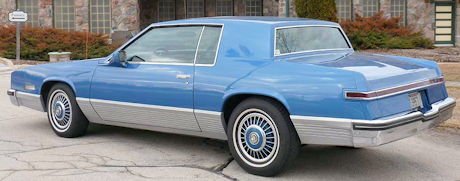
The basis of the Evolution I was the Cadillac Eldorado Coupé 6th generation. Chassis, drive technology and passenger cell were taken over unchanged from the original vehicle, as well as the glazing and the essential sheet metal parts to the fenders. The design of the front and the rear and the interior was on the other hand independent. It was attributed to Pierre Cardin. Whether Cardin was actually responsible for the design, however, is doubtful.
Particularly striking was the revised front end of the Evolution I. Instead of the conventional stem Cardin Automotive added a self-designed, more than 50 inches long unit, which continued the line of the standard fenders slightly sloping. As a result, the front overhang of the car grew considerably. Over the entire width of the front of the car was a radiator grille made of horizontal chrome struts; the headlights were hidden behind flaps that continued the design of the grill. Overall, the front of the Evolution I should have used less chrome than that of the standard Cadillac Eldorado. The front bumpers were from the Oldsmobile Toronado which was based on the same platform as the Eldorado and had almost identical dimensions.
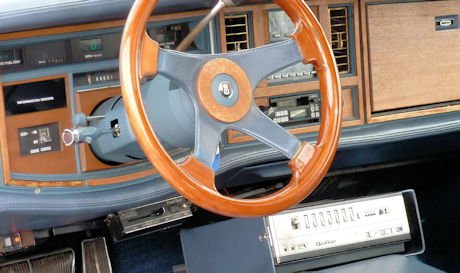
The interior has been significantly upgraded. Although the Evolution I took over the instrument carrier of the Cadillac Eldorado. Unlike in his case, the dashboard, however, was covered with high-quality real wood. The seats were upholstered in English leather. A stereo system, a Sony TV with VCR and a housed between the back seats refrigerated minibar could be delivered; the latter was equipped with crystal glass. The paint consisted of 30 layers were applied by hand.
The rear end of the Evolution I was redesigned. Instead of the narrow vertical tail lights of the Evolution I wore a narrow light strip, which reached above the license plate over the entire width of the car. New were finally the rearview mirrors, which were in a conspicuous, aerodynamically encased housing. Some but not all copies of the Evolution I used the door handles of the Oldsmobile Toronado.
The drive source was the unchanged adopted, 6.0-liter eight-cylinder engine from Cadillac, which had a - in practice problematic - cylinder shutdown. This made 106 kW (144 hp). Thus the car reached a top speed of 165 km / h. The purchase price of the Evolution I was 1981 in the basic version at $ 55,000 and $ 63,000 with full equipment.
The production scope of the Evolution I is not clear. Pierre Cardin Automotive initially planned to produce a series of 300 vehicles. However, it is generally doubted that such a volume of production was actually achieved. A assumed 100 vehicles were manufactured..At least one vehicle was subsequently converted into a cabriolet.
Norwalk Motor Car Company

The Norwalk Motor Car Company was an American automaker , which was in 1910-1911 in Norwalk (Ohio) and 1912-1922 in Martinsburg (West Virginia) resident. The brand name was mostly Norwalk .
History
Arthur E. Skadden , previously plant manager at the Pressed Radiator Company in New Castle (Pennsylvania) , founded in March 1909 in Norwalk, the car-Bug Company for making a Highwheelers . Although this simple vehicle was quite successful and was built by the end of 1910, Skadden renamed the company in April 1910 to Norwalk Motor Car Company and produced more technically sophisticated roadsters and touring cars with four-cylinder engines, which at 4113 cc displacement 35-45 bhp (26-35 kW). The financial ceiling was thin, and new investors were not found, so the company had to declare bankruptcy in 1911. The engine supplier and largest creditor whoModel Gas Engine Company in Peru (Indiana) , bought on machinery, buildings and the three remaining cars.
Skadden moved to Martinsburg and co-founded his company with Gilbert McKown , James M. Rothwell , Charles F. Glaser and Thomas W. Martin . The last made in Norwalk Model 45 was taken over unchanged. This can be a six-cylinder model. From 1913, the models A and B were built with six-cylinder engines of 8603 cc displacement and up to 70 bhp (51 kW), which supplied Continental . They had an American Underslung frameand cost between $ 2750 and $ 3750. But by the end of 1914, the bailiff was already at the door. In February 1915, the production was discontinued, but the company was not dissolved. Skadden continued to stand by her and initially dealt with the repair and painting of automobiles.
Only in 1918 he moved again to a car production. The vehicles were more conventional high-frame automobiles and equipped with four-and six-cylinder engines from Lycoming . The prices were around 1000 US $. Norwalk also produced cars for Piedmont .
Arthur Skadden died in 1919 and his widow continued to run the business. In September 1922, the company was dissolved.
Brand name Clark-Norwalk .This brand name in 1910 contributed some vehicles that sold the sales agency in Cleveland . In late 1910, one of these vehicles was presented at the Cleveland Armory Automobile Show .
H. A. Moyer Automobile Company
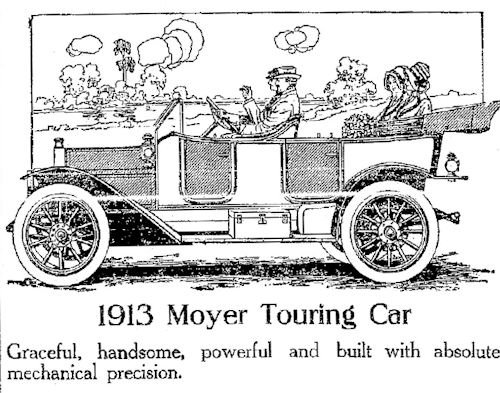
H. A. Moyer Automobile Company (1908–1915), a manufacturer of luxury automobiles in Syracuse, New York, was founded by Harvey A. Moyer (1853–1935) of Clay, New York.The company began business in 1876 in Cicero, New York, as H. A. Moyer Carriage Company. As the era of the horse-drawn carriage came to an end, Moyer switched assembly to motor vehicles, although he still produced carriages for some time after that.
The company later opened an automobile-manufacturing factory and changed their name to H. A. Moyer Automobile Company. They produced sedans and touring cars between the years 1908 and 1914. A six-cylinder touring car cost $3,250 and a four-cylinder was $2,500.
The first cars had a water-cooled, T-head engine and were produced with both runabout and tudor touring car models. By 1912, the company was producing six-cylinder, four-door touring cars.
Over the years, approximately 100 automobiles were built every year, not exceeding 1,000 total.The company headquarters were located at the corner of Wolf and Park streets in Syracuse.
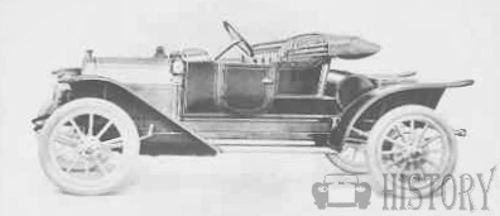
1912 Moyer Runabout
The company was run by father and son, H. A. Moyer and Bert W. Moyer (1873–1935). The founders believed that they sustained in the manufacture of automobiles the reputation made by the company years earlier, when a Moyer Carriage meant the "best carriage that could be made".
The Moyer automobile first appeared in newspapers across the country in 1911 and was announced with much formality, such as this quote from the Lowell Sun that talked about "out-of-town cars";
"The Moyer manufactured by H. A. Moyer, the celebrated carriage builder, is the result of 35 years of experience in the manufacture of high grade vehicles for pleasure use and combines all of the valuable features of that experience as to fine qualities, thorough proportion, elegant finish and design, together with thorough attention to every detail of construction. "
In the first five years of business, close to 500 Moyers were sold. Moyer customers came from all over the United States. The automobiles came in "all colors", and the famed cartoonist Tom Powers ordered a "gaudy" one of robin's-egg blue.
The latest model in 1913 was a two-passenger roadster equipped with a 4½ by 5-inch (130 mm) motor, combination electrical self-starter, ignition and a lighting device. According to Moyer engineer M. Power, the new motor developed 12 percent more power at 1,000 feet (300 m) per minute piston speed than the S.A.E. rating, while the maximum horsepower was developed at a piston speed of over 1,600 feet (490 m) per minute.
Like most new car manufacturers of the day, H. A. Moyer discovered that participation in auto shows was a good marketing tool and provided much needed mention in local newspapers. The shows were also a good place to show off the newest models with the latest technology. The Moyer exhibit in the 1915 Syracuse Automobile Show included a new six-cylinder touring car, a four-cylinder touring car, roadster and chassis.
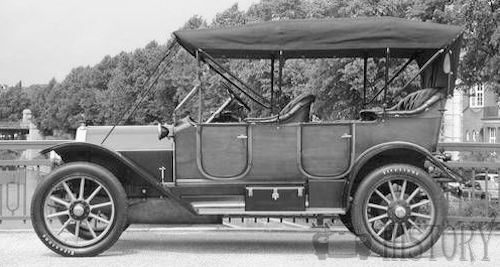
1912 Moyer touring car
End of production
The Moyer was built so well and expensively that it could not be sold at a profit. It had features "too fine" for the appreciation of the average motorist including porcelain-finished cylinder blocks that "literally sparkled when the hood was raised." As a result, the company could not adapt to mass production.
H. A. Moyer becomes a dealer for Stearns-Knight and Velie Automobiles
Following the end of Moyer car production, Moyer became a dealer for Velie Automobiles and Stearns-Knight automobiles. Stearns-Knight operated for only a short period before merging with Willys-Overland.During the period of handmade cars, the competition from new plants in Detroit, Michigan, and Buffalo, New York, was too tough and Moyer was forced to liquidate the business. He later made an attempt to produce typewriters, but the effort did not succeed.
The closing of the plant caused considerable suffering in the city's First Ward because of the resulting unemployment.
Lozier Motor Company
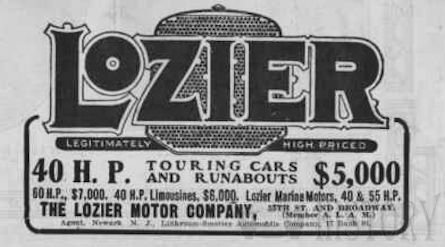
The company was founded by Henry Abraham Lozier from Indiana as Henry A. Lozier and Company in Cleveland ( Ohio). It made sewing machines and bicycles . The latter were sold under the Cleveland brand name and have been very successful. At the height of the bicycle boom, Lozier began to look for other products. Plant manager George R. Burwell and engineer John G. Perrin proposed internal combustion engines. Under Burwell's guidance, a development team was founded, including bicycle mechanic Frederick C. Chandlerbelonged. In 1898 they experimented with a steam car on the Serpollet principle and constructed a similar to the Rochet - motor tricycle vehicle with De Dion Bouton - single-cylinder engine . It is possible that even Harry A. Lozier , the son of the company founder, part of this development. One of the first engines powered a motorboat that successfully completed a Cleveland test drive across the Erie Canal and the Hudson River to Plattsburgh on Lake Champlain , where new production facilities were planned. At that time, the company name was changed to Lozier Manufacturing Company .ABC and the Cleveland Three-Wheeler A production of 100 tricycles has been prepared. In 1898 Henry Lozier sold the four-factory distributed bicycle production (including in Toledo, Ohio ) for four million US $ - and with great profit - to the American Bicycle Company (ABC) of Albert Augustus Pope in Hartford, Connecticut , the largest bicycle manufacturer in the United States. Part of the deal were rights and existing components on the motor tricycle , which was presented in January 1900 at the annual bicycle exhibition in New York's Madison Square Garden .It was manufactured by the ABC as Cleveland Three-Wheeler at the Lozier-based Cleveland site from 1900 to 1901 . About 100 were built.
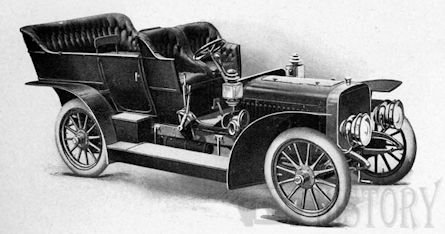
In 1901, two more prototypes were created, one with steam and one with gasoline. Burwell was not convinced of the result. In 1902 he sent the engineer JM Whitbeckto Europe with the task to inform himself about the state of the art. The following January, John Perrin left the company. Unofficially, however, he remained connected to him; Burwell paid his wages and expenses. But Perrin looked at the importers of foreign models on the East Coast and reported on technical details. As the wealthy photographer and businessman James L. Breese breaks down his Mercedes Burwell offered him a free repair. Of course, on this occasion he examined the advanced technical solutions of the German vehicle. In May 1903 Henry Lozier died and Harry took over the company entirely. Whitbeck brought detailed drawings of vehicles leading manufacturer like Mercedes-Benz, Mors , Charron , Darracq and CGV
In 1905, at the New York Auto Show in Madison Square Garden, the first own car was introduced, which had been largely developed by John Perrin. Lozier were luxury cars and included brands like Alco , Pierce-Arrow , Locomobile , Cunningham , Chadwick , simplex or Thomas for a time the most expensive, available in the US cars. In 1910, the models were offered at prices between US $ 4600 and US $ 7750. In the same year there was a Cadillac for US $ 1600 and a Packardfor US $ 3,200. The Americans' average annual salary at that time was around US $ 750.-, a Ford Model T Touring cost $ 1910 US $ 950 ; a price that was to halve by the end of 1916.
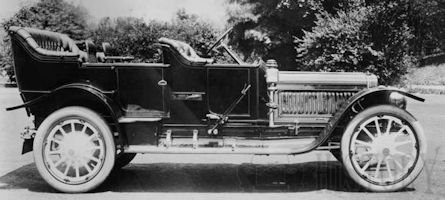
As early as 1909, a group of investors around the Detroit Athletic Club and Harry M. Jewett , who already controlled the Paige-Detroit Motor Car Company , with a financing offer to Harry Lozier. Like Packard's successful business model, the new investors wanted to invest in Lozier and increase production. After initial hesitation and under the assurance of a 51% majority, Lozier agreed in February 1910. The new co-owners organized $ 2 million in capital, half of which they contributed and half of which were raised on the New York Stock Exchange . The architect Albert Kahn was building a new factory on Mack Avenuecommissioned in Detroit. She was moved in 1911. Kahn had previously built the Packard factory in Detroit as the first production facility in reinforced concrete construction.
Burwell retired at this time; Successor as chief engineer was George Perrin. Frederick Chandler also joined the company. After a time in Hamburg as a representative of the brand in Germany, he became sales manager at Lozier. However, it soon became apparent that the views of investors and senior management teamed less and less together. With the emergence of new car manufacturers Lozier also came under more and more pressure. In July 1912 Harry Lozier had to leave. Frederick Chandler left in 1913 with four officers, including Whitbeck, the company and started his own company, the Chandler Motor Car Company, which produced similar cars as Lozier, but at a much lower price. Chandler took many executives from Lozier, a bloodletting from which Lozier never recovered. Perrin would also like to have gone, but was contractually tied to Lozier until 1915. Jewett appointed Joseph M. Gilbert as the new Managing Director.

In 1913, however, Lozier presented in Los Angeles the model Big Six , whose engine developed 88 bhp (65 kW) and which was equipped with electric lighting as standard. The touring cars and roadsters cost US $ 5,000, the sedans and landaulets US $ 6,500. It was followed by the Light Six Metropolitan (52 bhp (38 kW)) with electric starter and electric lights. The Runabout cost US $ 3250, the coupe US $ 3,850 and US $ Limousine 4450.
Lozier wanted to save himself with vehicles of the middle class and offered 1914 a constructed by Perrin four-cylinder car for US $ 2000. This Model 84 was not successful in sales and the financial situation of the company deteriorated constantly. The move to smaller facilities did not help either. After an unsuccessful merger attempt with Ford , the company had 1915 bankruptcy login.
Because of its small market segment only a few thousand Loziers were manufactured during the short existence of the company. 1912 was the best year with 600 vehicles.
Until 1918, various bankruptcy administrators were still maintaining production (5 cars a day), then the company finally closed its doors.
In 1911, a Lozier was reported at the first Indianapolis 500 race. The car with Ralph Mulford as driver finished after a controversial decision of the race management the second place behind Ray Harroun with his Marmon Wasp , but many spectators said that Mulfords Lozier had actually won the race. On March 19 of the same year, Lozier's announcement proclaimed that a 51 bhp (37.5 kW) model 51 driven by Teddy Tetzlaff would have set a world record over 100 miles (161 km) in 1:14:29 h , Mulford was named AAA Champion of the Year in 1911.

