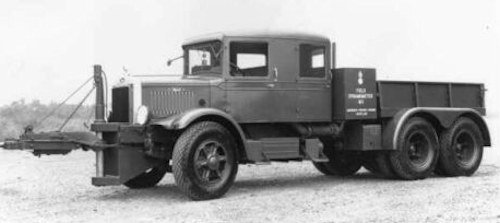
USA
Indiana Motor & Manufacturing Company
Automotive manufacturer of United States of America from 1910 to 1914.
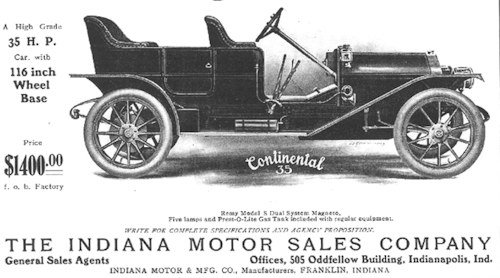
Indiana Motor & Manufacturing Company was an American manufacturer of automobiles in the 1910s. The brand name was initially Continental.
History
Indiana Motor & Manufacturing Company was founded in 1909 in Franklin, Indiana. John C. Billheimer was the president. In December 1909 began the production of automobiles. In the spring of 1912, the bankruptcy followed.
In June, the Security Trust Company sold the company to Frank M. Millikan. Frank N. Martindale became his partner. They continued the production. Towards the end of 1913, they changed the brand name for the model year 1914 to Martindale & Millikan. 1914 ended production. The Continental Auto Parts Company took over the remnants of the company, made spare parts and moved in January 1916 to Knightstown in Indiana.
The Thirty-Five had a four-cylinder engines motor with 35 hp. The wheelbase was 295 cm. In the first model year there was only a five-seat touring car. The following year, a four-seat torpedo and a two-seat runabout complemented the selection of bodies. In the model year 1912 accounted for the torpedo. There was a choice of Fore-Door touring cars with five seats and Fore-Door Roadster with two seats.
The Thirty there was only in the model year 1913. This engine four-cylinder made 30 hp. The wheelbase remained unchanged. The only structure was a five-seat touring car. At the same time there was the Forty had a 40 hp engine. His chassis was slightly longer with 297 cm wheelbase. He had it as a fore- door touring car with five seats and Fore-Door Roadster with two seats.
For the model year 1914 not only the brand name changed, but also the system of the model designation. The Model XXX (30) had a 30 hp engine. The wheelbase had been cut to 279 cm. The vehicles were body worked as touring cars. Even with the Model XXXII (32), the number was an indication of the engine output of 32 hp. The wheelbase was 300 cm. There were also touring cars.
Diamond Taxicab Company

Diamond Taxicab Company was an American manufacturer of taxi automobiles in the 1920s. The brand name was Diamond.
History
The company was founded in 1922 in the State of New York as a joint venture of Gray Motors Corporation, Apex Motor Corporation and Guy Disc Valve Engine Corporation. The headquarters was in Detroit (Michigan). President of the Society was the US Senator from Oklahoma and Attorney Robert L. Owen (1856-1947). The initiative was initiated by Nat D. Jacoby, head of the New York taxi company Black and White Cab Company. Significant participants included Frank L. Klingensmith, Frank F. Beall and HT Hanover. Other board members were the engineer OD Heaven Rich as secretary and Fred H. Lewis, president of Lewis Spring & Axle Company. The secured Diamond Taxicab Co. a suitable area. First, the planned output was 10 vehicles per day.
1922 was a first partial order over 250 Black and White -Taxis one. was allowed production initially at Elcar Motor Car Company in Elkhart (Indiana). The order of Black and White amounted to a total of 1000 taxis. Jacoby had now taken control of the company and also launched Diamond. Changes in the Management Board were not noted. Obviously, Jacoby planned a far-reaching reorganization with the founding of a parent company, under the roof of diamond taxi and bus transport companies should be organized. This concept should be transferred to all major US cities. Similarly, the major competitors went Checker Cab and Yellow Cab before dealing with the Checker Cab Manufacturing Company and the Yellow Cab & Coach Manufacturing Company each had their own production facilities secured. However, there were different views, because of Gray Motor such intentions were denied. Much resistance but it might not have been, because at Apex Motor 's financial situation deteriorated rapidly, leading to its closure early 1,923th Previously, Jacoby had acquired the taxi prototype, including design plans and distribution rights.
The transfer of the first Diamond -Taxis was around August 1922. As a result of the new plans, the taxi was reworked. It was designed more easily and got a smaller engine. In particular, it was designed for two instead of five passengers. Jacoby had found that taxis rarely carried more than two passengers at the same time and expected these measures to lead to a drastic reduction in operating costs, which should largely be passed on to passengers. The fare should sink so instead of the usual US 30-40 cents per mile to 10 cents. The vehicle now from the Driggs-Seabury Ordnance Corporation in New Haven (Connecticut) are assembled and no longer Diamond. But after Driggs-Seabury was in financial difficulties in November 1923, this company lost the taxi order to the Elcar Motor Car Company in Elkhart (Indiana), which already produced their own taxis under the brand name Elfay , Martel and Royal Martel.
The Diamond Taxi was not made exclusively for Black and White. Like the larger competitors Checker and Yellow with her as franchisors-built Checker Cab and Yellow Jacoby should ensure only a basic set of orders. It seems that the home market was saturated. Plans to manufacture vehicles for eastern regions such as Baltimore, Boston, Philadelphia and Washington, DC have not been implemented. Until the final closure in 1925, Diamond made his own taxi. The production volume amounted to 1000 vehicles [1] [3], whereby it is unclear how many of them were produced for Black and White. That it was more than 250 copies of the first order is unlikely. In January 1925, Klingensmith left Gray Motor, which was about to go bankrupt. That was also the end for Diamond.
AM Graffis, chief engineer at Elcar Motor Company, constructed the first one. The prototype this was at Apex Motor. This taxi was typical of the time as a Town - Landaulet designed with open chauffeur compartment and a hood over the back seat. The sheet metal parts were "removable" for easy replacement after an accident can, indicating a bolted body. This is described as "wide" and "low" with "little glass". Jacoby as a connoisseur of the taxi market expressed his wishes. So, the windows were actually smaller than usual, in order to grant the passengers more discretion. He also insisted that the discs be easy to replace. The pads were removed during the morning cleaning. It was a selling price between US $ 1900, - and 1950, a spare wheel, lighting, battery, magneto, starter The engine was a four-cylinder from Herschell-Spillman. The second vehicle is the version adopted by Driggs and the third is a further development of the first, which originated at Elcar.
Nash Healey history

Nash-Healey was a British - American car brand, which produced from 1951 to 1954 luxury sports cars. The vehicles were from the Donald Healey Motor Company in Warwick, Warwickshire, England, designed and manufactured to the marketing done by Nash Motors.
History
Donald Healey had his automobile factory founded in 1946 and is the leading manufacturer of Gran Turismo, sports cars and racing cars specializes in small numbers and it earned a good reputation. Healey was in long-distance races quite successful and had the Healey Silverstone a competitive racing car in the program.
Company President Donald Healey travelled in 1949 with his son, racing driver Geoffrey Healey, to the United States to promote his cars and look for more powerful engines; So far, he used the larger four-cylinder engines of the manufacturer Riley, as they were used in its RM series (2443 cc). Only for the 3 Litre he resorted to the six-cylinder engine from Alvis, an OHV engine with a capacity of 2993 cc. The power of the two engines 104 bhp or 77.6 kW with Riley engine resp. 106 bhp or 79 kW with Alvis Engine was comparable. By 1949, Cadillac had released a ground-breaking new OHV V8 engine with 5424 cc (330.9 ci) and 160 bhp (117.76 kW).
The very wealthy American racing driver Briggs Cunningham ordered from Healey a custom-made Silverstone with this engine. Due to the impressive performance Donald Healey planned to launch a small series of this car. Therefore, the Healey wanted to use their stay in the United States, to negotiate with Cadillac for the supply of engines. Although they were not averse to the deal, the deal did not materialize because Cadillac's parent General Motors intervened and banned the delivery. The reasons are unclear; a whole range of other companies such as Allard in the UK and Kurtis respectively Muntz (only 1951) in the United States used them.
On the return journey with the passenger ship RMS Queen Mary, the Healey’s met by chance George W. Mason know, the president of the Nash Kelvinator Corporation and thus manufacturer of the Nash -Automobiles. This was ready to provide for Healey engines, manual Borg-Warner three-speed gearbox, cardan shafts and differentials
Upon arrival of the ship, a corresponding contract was signed. Mason also wished to sell the new sports car through its own dealer network, because Nash had no sporting model and no image carrier to offer. Of course, for Healey, selling in the United States became much easier, even though he was not allowed to bring the car out under his own name and had to make concessions in design.

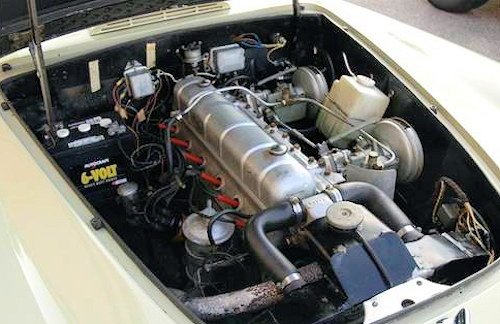
For the first time Healey used a series- six-cylinder engine in Le Mans in 1950; At that time, the chassis of a Healey Silverstone had been modified accordingly. Nash Healey agreed delivery of the Dual Jet fire Six with dual ignition of in Nash Ambassador was offered. The two-valve engine with OHV valve control had a displacement of 3845 cc (234.6 cc); Bore × stroke was 85.70 × 111.10 mm. The engine also had mechanical tappets, a compression ratio of 7.3: 1, a single carburettor a power of 115 bhp @ 3400 / min (86 kW). Healey, however, this engine has been revised: It received a "sharper" camshaft, instead of the cast iron cylinder head, such as an aluminium, with which the compression could be increased to 8: 1, and two SU carburettor instead of the simple single carburettor. This enabled a stable performance increase to 125 HP @ 4000 / min (93 kW). The Nash factory code for the car was 25162. No engine options were offered at the factory. However, some owners took advantage of the generous space and built V8 engines from other manufacturers, such as Cadillac.
The Healey brand had a brief but fairly successful racing career since 1946, the year it was founded. A big hit was the 4th place at the 24 Hours of Le Mans in 1950 for Team Tony Rolt / Duncan Hamilton with a Silverstone Special with the 3.8 litre Nash six-cylinder engine similar to the later production version. In this race, only 29 of all the 66 cars started.
1951 the team reached the same drivers with a new coupe (car no. 19) the class win and 6th place, though it was so late that there is hardly time for training remained. With the front of them Aston Martin, the supplied Nash Healey an exciting circuit duel; in the finish he had come up to eight seconds.
The biggest success was the third final rank of the British Leslie Johnson and Tommy Wisdom at Le Mans in 1952 with a new Barchetta (starting No. 10) behind two Mercedes-Benz 300 SL but ahead of the factory teams of Ferrari, Aston Martin Jaguar, Lancia, Talbot -Lago, Porsche, Osca and others at the same time, they finished second in their class, second in the Rudge-Withworth Biennial Cup for the best performance in two consecutive years and won the Motor Gold Challenge Cup. Donald Healey later said that the car had no technical problems other than a (locally repaired) exhaust and would not have consumed a drop of oil! The fourth placed Cunningham with Chrysler -V8 was on target 80 miles (130 km) back. A second Nash-Healey with the start number. 11 of the French Pierre Veyron and Yves Giraud-Cabantous was considered faster, but did not finish.
In 1953 John Fitch should have taken one of the Nash-Healey, but he moved to Cunningham, so Leslie Johnson and Bert Hadley (GB) formed a team. They drove to 11th place. Veyron / Giraud-Cabantous were once again among the 35 of 60 vehicles that failed to finish. winners of the race were Rolt / Hamilton to Jaguar two former factory driver of Nash-Healey.
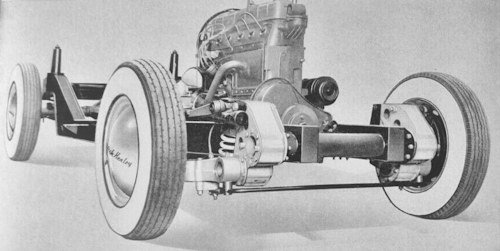
The chassis of the Nash-Healey (Type N) is derived from that of the Healey Silverstone (Type E). Like all Healey chassis, it was designed by AC Sammpietro. To provide more comfort, it was designed a little wider and also reinforced for the much heavier engine. It consists of a box frame (18-gauge steel plate) with cross struts. Also typical of Healey, designed by Sammpietro front axle with a swing arm independent suspension, two crank- arms and a cornering stabilizer was used along with the patented steering. This is based on the principle of a rotating plate and a steering linkage, which transmit the forces from the steering gear to the wheels. The rear leaf springs of Silverstone were replaced with coil springs. Depending on the source was a rear axle of Nash resp. Salisbury used. She was led on a Panhard. The vehicle also received hydraulic support from Bendix for the drum brakes, which is important for the US market. The Roadster has a wheelbase of 102 inches (2591 mm), the track front and rear each 1346 mm (53 inches); behind it was widened from 1952 to 1397 mm (55 inches). Steel wheels with plain chrome wheel caps were factory-fitted; the tire size was 6.40 × 15. Later, spoke wheel caps were optional.
Because the Nash-Healey was designed for sale in the United States, the vehicles were built with left-hand drive. There is an indication that a single vehicle may have been steered to the right, but the chassis number indicated G525 indicates a Healey 3 Litre (Alvis-Healey). Nash-Healey use the letter "N" as the first position of the number; Alvis-Healey "G".
First series
The car received a roadster design with formal similarities to the earlier Healey Sports mobile and 3 Litre (Alvis-Healey). The design contributed to Healey designer Benjamin Bowden, supplier of the bodies was the Panel craft Sheet Metal Company in Woodgate, Birmingham, like all Healey factory bodies, these were also made by hand from aluminium. As the only construction of Healey but they lack the typical diamond-shaped radiator grille as Healey mark; Mason insisted on using the radiator grille of a Nash to underline the brand affiliation, after all, the Nash-Healey was indeed intended primarily as an image carrier.
Panel craft completed the bodies in a single series in early 1950, so they only had to be recalled. 30 bodies were additionally produced for the Healey 3 Litre (Alvis-Healey); these differed externally, above all, through another front. Final assembly took place at Healey in Warwick, paying attention to the use of Nash hardware to simplify maintenance. The interior was high quality and included leather trim and an adjustable steering wheel. Overdrive, cigarette lighter and white wall tires completed the basic equipment. The car weighed 1179 kg and was therefore by no means an extraordinary lightweight at that time.
The transport routes resulting from the applied production processes are the main reason for the skyrocketing cost of the sports car: Nash delivered its components to Healey to Warwick, where the chassis was built and the parts of Nash were installed. Complemented to "Rolling Chassis", they were shipped to Birmingham to Panel craft. There they received bodywork and interior equipment and then went back to the mentioned final assembly and final acceptance to Healey. Because most of the Nash-Healey were sold in the United States, the passage across the Atlantic was still ahead of them.
The prototype of the Nash-Healey was shown in 1950 at the car shows in London and Paris, the vehicle production itself began in December 1950. By the end of the year 36 cars were completed. The official presentation took place at the International Auto Show Chicago early 1951. More 68 Nash-Healey came to the end of March 1951. / Altogether 104 copies were built from the first series.
Officially, only the colours Champagne Ivory (Ivory) and Sunset Maroon (Wine Red) were available. Healey might ship the vehicles in Champagne Ivory on the assumption that this colour would be well received in the United States; Having arrived in the United States, Nash painted her on Sunset Maroon. This subsequent change of colour could explain why some specimens have got a lime green colour.
The biggest obstacle to success was the price: a list price of US $ 3767 to US $ 4063 was not competitive.
Second series
Pininfarina in Turin had been commissioned by Nash, in competition with the in-house styling department under Edmund Anderson to make proposals for the lines of the upcoming models; some details like the radiator grille were taken over; the rest came from Nash.
In this environment, Nash Pininfarina asked for a revision of the Nash-Healey Roadster. This received also the order for the production of the body. For this reason, Healey suffered a production stoppage from April 1951 to January 1952 and a late introduction of the 1952 model; During this time, production was set up in Turin. Pininfarina built the car bodies no longer made of aluminium, but steel sheet; only bonnet, trunk lid and doors were made of light metal. The weight increased to 1247 kg. Among the few changes to the chassis belonged to a slightly wider rear track.
Although the car seemed sportier, nevertheless, the new lines were taken somewhat ambiguous. The in-head headlight front was typical of the Nash design and was as controversial and discussed at the Nash-Healey. The hubcaps wore on request imitated spokes. After all, won a 1953 Nash Healey in Italy an international Concours elegance in its class Nash, the vehicle did not call more Roadster, but convertible (Cabriolet), and gave him the plant code 25262.
Pininfarina built from February 1952 until the end of the model year 150 Roadster Series 2 with the 3.8-liter engine to a list price (US $ 5908), of the equivalent of two well-equipped midsize car corresponded, after all, the chassis were now sent to Turin instead of Birmingham and came more or less completely back to final assembly and acceptance to Warwick.
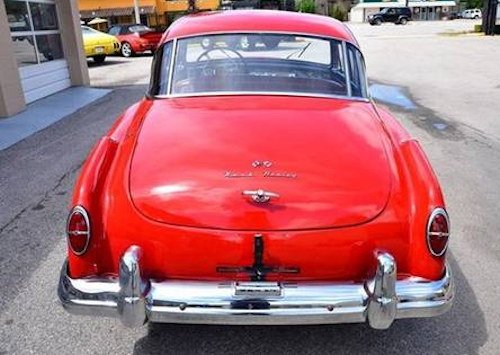
There was little change for the Roadster (factory code 25362) Pininfarina also built a two-seat coupé variant called Le Mans with a panoramic rear window on a slightly longer wheelbase of 2743 mm (108 inches) code 25367. Given the modest sales and the planned 1954 merger with Hudson motor Car Co. for American Motors Corporation, the 1953 model was built longer than usual. as of February, was the latest version of the engine, called Le Mans Dual Jet fire Six with a larger displacement of 4138 cc (252.5 ci) fluently introduced. At the factory, this engine produced 130 bhp (95.7 kW) at 3700 rpm.After the usual treatment by Healey the compression increased from 7.6: 1 to 8: 1 and the power to 140-142 hp (104.5 kW) at 4000 / min.
Due to the poor sales figures, the model year was extended. For this year it is only known that 162 Nash-Healey were built, but not, as many in which of the four versions:
Roadster; 3.8 litres (until February 1953)
Coupe; 3.8 litres (until February 1953)
Roadster; 4.1 litres (from February 1953)
Coupe; 4.1 litres (from February 1953)
1954-1955
On June 3, 1954 and thus already after the merger of Nash with Hudson appeared the "new" Nash-Healey. The Roadster was not offered anymore. The coupe received instead of the one-piece a three-piece rear window and the factory code 25467. All of them had the larger engine with 4.1-liter displacement.
The restriction on the coupe lifted the Nash-Healey also from the 1953 introduced and now in free sales from the Chevrolet Corvette. Although Nash dropped the list price to US $ 5128, it was still not competitive compared to the US $ 3513 Corvette.
At the end of model year 1954, a few Nash-Healey remained unsold. Nash rewrote them to 1955 chassis numbers and described them as new models; a not uncommon practice at this time, which is also known for example by Kaiser. A total of 90 coupes of both "model years" emerged.
After the merger with the AMC, the production of the Nash-Healey was quietly ended. The decision was easy because the largest merger so far of US industrial history brought enough publicity and Donald Healey closed his company anyway in the same year to produce the Austin-Healey with Austin.
LaSalle History
LaSalle was the name of a under Cadillac from 1927 to 1940 led brand of the US automotive group General Motors.
History
LaSalle named after Robert Cavelier de La Salle was made by General Motors boss Alfred P. Sloan in the mid-1920s in the group's extensive range of cars a gap between the top brand Cadillac and Buick, which should be filled by a new brand.
Under the leadership of Cadillac then the LaSalle was developed, which appeared in March 1927 and was built at Cadillac. The body design of the LaSalle came from the hand of Harley Earl, and is considered as an example of a deliberately designed effect rather than pure functionality designed car body. Earl was hired by GM after the success of his LaSalle and in 1928 appointed head of the Art and Colour Section, the first design department of an automotive company. From the economic crisis as a result of the New York stock market crash in the fall of 1929, all car manufacturers were badly affected, including LaSalle. While in many cases, sales recovered noticeably from the middle of the 1930s, LaSalle did not see the sales figures that would have justified the continuation of the brand, according to GM bosses. In the summer of 1940, the mark was abandoned; in their place came with the Cadillac Series 61.
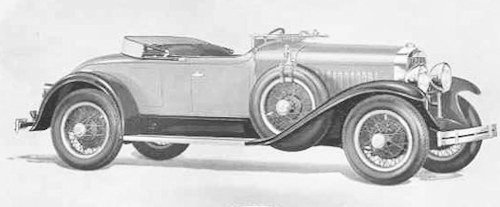
In March 1927 Cadillac launched the self-developed LaSalle (Series 303) as an independent brand below its own models. Offered on two wheelbases (125 and 134 inches) 11 different open and closed variants with Fisher bodies and (only on the short wheelbase) 4 versions with bodies of the body manufacturer Fleetwood. Both companies had recently been in GM ownership. The LaSalle models cost between $ 2495 and $ 4700, a few hundred dollars less than the slightly larger and more powerful Cadillac models. The technique was very similar to that of Cadillac's own models. The LaSalle was powered by a new five-litre V8 (bore × stroke: 79.4 × 125.4 mm, fork angle 90 °), which was constructively different from the previous Cadillac V8, but whose features were soon adopted for the larger Cadillac V8, compressed 4.8: 1, this machine came to an output of 75 hp. The manual transmission had three gears. The suspension was oriented with leaf-sprung rigid axles front and rear and mechanically operated four-wheel brakes on the then standard standard.
1928 accounted for some model variants; Fisher, however, delivered new base models (coupe and sedan), each costing $ 2,350. Fleetwood provided only three different Town Cabriolets on the short or long wheelbase available. The front drum brakes were increased in diameter to 16 inches.1929 appeared the Series 328 with 5.4 litres (328 cubic inches) enlarged V8. All models, except the Roadster and the open Phaeton four-seater, were now based on the longer wheelbase. Fleetwood also added a five-door Imperial Sedan with cutting disc to production. All versions received two electrically operated windscreen wipers and panes of safety glass.
In 1930 (Series 340), the short wheelbase models were eliminated and the bodywork stylistically approached the Cadillac models. The drive took over now almost unchanged from the Cadillac Series 341 of the years 1928/29 acquired 5.6-liter V8.1931 to 1933 (Series 345-A, -B and -C) did the unmodified V8 from the Cadillac Series 353 and Series 355 in LaSalle service. The model range was reduced in 1932 to 4 models with Fisher body (wheelbase 330.2 cm: Coupé, Cabriolet, Town Coupe and sedan) and 3 Fleetwood versions on longer wheelbase (345.4 cm: Sedan, Town Sedan and Imperial Sedan), 1933, the bodies were modernized with laterally pulled down front fenders and other details.
From model year 1934, General Motors pursued a new concept with the LaSalle. This was decoupled from the technology of the Cadillac models and provided with components of other GM brands. The LaSalle should be cheaper than a Cadillac to stimulate sales by the lower prices and thus help Cadillac on the sales crisis of recession time.
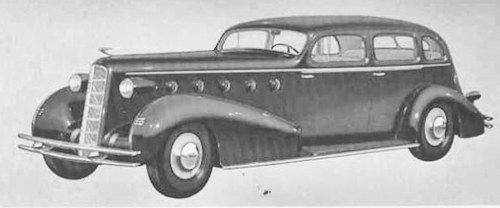
This new Series 50 (or Model 350) appeared in January 1934, rested on a new X-shaped tubular steel frame and had independently hung front wheels, three-speed gearboxes and a new 3.9-liter inline-cylinder engine that was fitted to Cadillac, but actually by Oldsmobile came from. On a wheelbase of 302.3 cm five different Fleetwood bodies were offered: sedan, Club Sedan, Cabriolet, Coupé and four-door convertible. The prices started now at 1595 dollars.
In 1935, all the bodies came from Fisher and got the new "Turret Top" all-steel roof. The offer included only coupe, convertible and two- and four-door sedan. The row eight-cylinder was enlarged with a slightly longer stroke to 4.1 litres, extended the wheelbase by 2.5 cm and the price further lowered (now from 1225 dollars).
In 1936, there were virtually no changes, in 1937, the LaSalle again received a Cadillac V8, namely the previous year in the Cadillac Series 60 published 5.3-liter. At the same time, the wheelbase was extended by 10 cm and the bodies were reworked, such as with higher front fenders. In 1939, the LaSalle received a new front end with a very narrow grille and side grills on the "catwalks", the transitions between fenders and body shell. A sunroof was available under the name "Sunshine Turret Top"; the surcharge was $ 40.
The last LaSalle (Series 50 or 52) with a slightly shorter wheelbase was introduced in October 1939. New was the Series 52 with a modified body, more inclined rear windshield, curved rear window and rounder rear. A model in 1941 was still planned, but not put into production.
Mack Trucks Inc.History
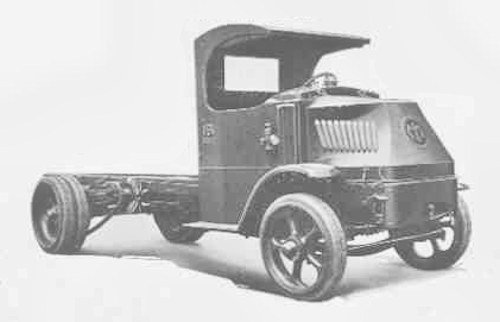
Mack Trucks, Inc. is an American commercial vehicle manufacturer . The company was founded in 1900 as the Mack Brothers Company and since 2001 has been part of the Swedish Volvo Group.
History
The Mack brand is known in the US mainly for heavy trucks for long- haul and construction . It has a reputation for producing robust vehicles.The company originated from the wheelwright Fallesen & Berry in New York 's Brooklyn district , which was acquired in 1893 by the brothers John M. Mack and Augustus F. Mack .The brothers made in 1894 a steam car and 1896 an electric car . These remained prototypes . Between 1903 and 1904, several vehicles were produced with gasoline engines . They were marketed under the brand name Manhattan .
The company, starting in 1900 under the name Mack Brothers Company , the automobile industry and moved in 1905 to Allentown in Pennsylvania. In 1911, the last five brothers Mack sold their company. A significant new investor was the bank JP Morgan , which also held shares in the Saurer Motor Company in Plainfield ( New Jersey ) and Swiss Saurer truck produced under license. On the initiative of Bank Morgan both companies were merged on September 23, 1911 to International Motor Truck Company . The share capital amounted to 2.6 million US dollars ; Both brands were preserved for the time being. The new holding company coordinated sales of the Saurer Motor Company and manufacturers renamed Mack Brothers Motor Car Company .
During the First World War , Mack delivered over 6,000 trucks to the armies of the United States and Britain , which became the basis for the special reputation of the Mack vehicles. British soldiers compared the appearance of the Mack trucks with bulldogs at that time , making the Bulldog the mascot of the brand and remains today. The legend of Mack Trucks has been used, updated and immortalized in many American films.
1922 was another reorganization. Saurer was abandoned, Mack became Mack Truck, Inc. The Mack Trucks was founded by the International Mack Truck Company , which was entrusted to longtime Saurer sales manager Robert Edison Fulton.In 1938 Mack introduced the first own diesel engine. 1956, the Brockway Motor Company was bought. In 1964, the Chrysler Mack planned to take over, but gave up this request due to antitrust concerns.
The French Renault Group acquired in 1979 10 percent stake in Mack Trucks, increased its stake in 1982 only to 20%, then in 1983 to 40% and gave it in 1987 to its own commercial vehicle subsidiary Renault Véhicules Industriels (RVI short) from. Finally, Mack Trucks was completely acquired by RVI in 1990. In 2001, Mack joined forces with RVI (since 2002 Renault Trucks) part of the Volvo Group. The company's headquarters were relocated to Greensboro , North Carolina in 2009 .