
USA
Disbrow Motors Corporation
Automotive manufacturer Cleveland, Ohio; USA From 1916 to 1917.
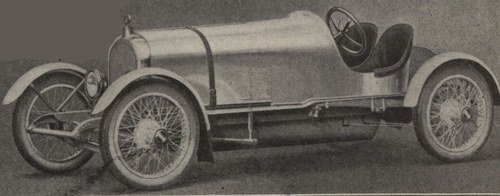
Disbrow Motors Corporation was an American manufacturer of automobiles in the 1910s. The brand name was Disbrow.
History
The racing driver Louis Disbrow founded the company in 1916 that was in Cleveland, Ohio. The production of automobiles ran from 1916 to 1917. Material shortage due to the First World War was one of the reasons for the production task. Still by 1917 the enterprise was dissolved.
There were several very sporty automobiles on sale. The Wisconsin Motor Manufacturing Company provided them with a four-cylinder engine with a T-head. Warner Gear provided the steering, power transmission, and clutch, while Parish & Bingham provided the pressed steel frame, Perfex provided the water cooler, Bosch provided the ignition, and Houk provided the wire spoke wheels. The wheelbase of the chassis was 290 cm. It had a light open two-seater roadster body that Disbrow had created installed on it. The usual floors were not used. The front fenders were made to move in tandem with the front wheels.
In Model A, the engine produced 90 hp and the Model B 110 hp. There was also the model C Special Disbrow. The engine had 16 valves. For 144 km / h maximum speed were specified.
the two-passenger runabout special type. a chassis with longer wheel-base and a four passenger body. The runabout is a very low built car with low seats and special upholstery.
The power plant and chassis units are all of standard make and are combined in such a way as to producea car of speedy performance, smart appearance and sturdy construction.The engine is a 90 h.p. 4 cylinder "T" head Wisconsin product, with a bore of 5 1-10 in. and stroke of 5 in.The outstanding features are the special cams and light reciprocating parts.The steering gear and transmission and clutch are all of Warner manufacture while axlesare American ball bearing.Cooling is by water. A tall, narrow Perfex radiator is used and is especiallywell suited to a car of this character.Equipment includes Bosch two-point ignition, starting and lighting, 100 miles per hour Stewart-Warner speedometer, Miller carburetor, Silvertown cord tires and Houk wire wheels with special lacing. The car Sold for $2650
Champion Wagon Company
vehicles manufacturer of Owego , New York , USA. From 1902 to 1921.

Champion Wagon Company was an American manufacturer of wagons and later motor vehicles .
History
The company was founded in 1888 in Owego , New York . As predecessor company Gere, Truman Platt and Company, whose factory including equipment in the year was destroyed by a fire. JC Dwelle was President, WS Truman Vice President, El Ringrove Secretary and Theodore Gere Treasurer and Factory Manager. They mainly manufactured wagon carts and then commercial vehicles .
In 1902, a few passenger cars were also built . The brand name was Champion . In 1911, the company got into trouble and 1913 was followed by bankruptcy .As a result, AC Barker from New York City invested in the company. In 1921 it was finally dissolved.
The cars were convertible and could also be used for utility purposes. Of these, three vehicles, of which one still exists. Some of the trucks had an electric motor and were delivered to the United States Express Company . Later emerged bodies for commercial vehicles based on the Ford Model T and other chassis .
There were no links to Champion Auto Equipment Company and Champion Motors Corporation , which used the same brand name.
Gas-au-lec (Corwin Manufacturing Company)
Automotive manufacturer Peabody, Massachusetts; USA From 1905 to 1906.
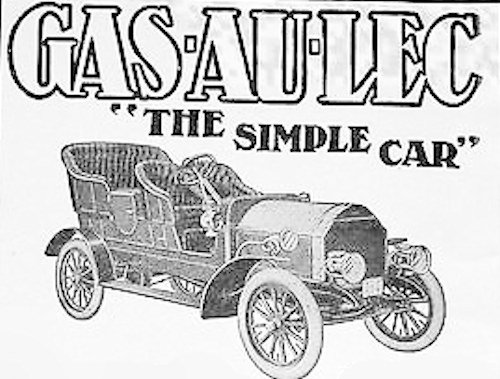
Corwin Manufacturing Company, previously Vaughn Machine Company, was an early American manufacturer of automobiles. The brand name Gas-au-lec later changed to Gasaulec.
History
The Vaughn Machine Company was based in Peabody, Massachusetts. 1905 began the production of automobiles. The brand name was short for gasoline, auxiliary and electric. The designer was Ralph Hood, who previously worked for the Simplex Motor Vehicle Company.
In 1906, Hamilton S. Corwin reorganized as president of the company. The new company name was Corwin Manufacturing Company. In the same year the production ended.
The offer included a hybrid type electric vehicle. The vehicle had a gasoline engine and an electric motor. The four-cylinder engine had a T-head, more than 7000 cc displacement and 40/45 hp power. He propelled the rear axle via a cardan shaft. The electric motor was intended on the one hand for low speeds and reverse driving. The chassis had 274 cm wheelbase.
1906 ended production. In total, four vehicles were created.
Henney Motor Company History
Automotive manufacturer Bloomington , Illinois , USA

The Henney Motor Company was an American manufacturer of carriages , automobiles and automobile bodies . The company was known before the Second World War , especially by his funeral cars on Packard chassis and after the war by the electric car Henney Kilowatt . Among other things, it also produced the Henney Super Wagon .
History
Henney Carriage Works was founded in 1879 by John W. Henney. The company's headquarters were in Freeport , Illinois . Initially, Henney produced carriages and buggies, but also commercial wagons and funeral cars . In the first decade of the twentieth century , Henney did not cope with the transition to automobiles; the company produced exclusively horse-drawn vehicles until the First World War . Due to decreasing demand, it was liquidated in 1916. In the same year, the son of John W. Henney founded a successor company called John W. Henney Co., which now made on motorized vehicles and from 1927 as Henney Motor Co. firmierte,
Since the 1920s, Henney was one of the best-known manufacturers of ambulance and funeral vehicles. In the late 1930s, Henney manufactured up to 1,200 vehicles per year.
Henney's models were initially based predominantly on Dodge truck chassis ; the engines came from Continental or Lycoming . The bodies were each independently designed. At times, they were modeled after the Weymann artificial leather bodies , stretched over a frame made of ash wood.
After Dodge had been taken over in 1928 by Chrysler Corporation, ended for Henney the purchase of Dodge chassis. Henney then created their own chassis, which were structurally based on constructions of Auburn , Buick , Cadillac , Pierce-Arrow or Reo . In 1934, Henney resumed production of its own chassis and instead used chassis made by Cadillac, Lincoln , Oldsmobile , Packard or Pierce-Arrow, depending on customer requirements . From 1938 onwards, Henney exclusively packaged Packard chassis. The connection to Packard existed until 1954. Henneys Packard- Hearseswere partly designed unusually. The burglars were in the style of a Landaulets, in which the loading area was spanned by a fold-down fabric top.
During the Second World War, Henney continued the production of ambulances. After the war, the company was continued under new management. Henney intensified its relationship with Packard by exclusively commissioning the factory-supplied 7 and 15-seat Packard sedans, the latter primarily used as aircraft feeders. In 1950, Henney also produced nine limousines on Lincoln-based government contract, which were used by the then President Harry S. Truman .
In the mid-1950s, sales of funeral and ambulance vehicles dropped considerably. Coupled with the simultaneous decline of Packard, Henney's economic situation deteriorated significantly in a short time. Management tried to merge with commercial vehicle manufacturer Reo; however, the efforts failed. Moving to Canastota , New York did not bring any improvement; The production of funeral and ambulance vehicles at Henney ended in 1954. A restart with the electric car Henney Kilowatt failed early.
In addition to the ambulance and funeral vehicles offered Henney 1921-1931 also passenger cars , which were sold but only to a small extent. In 1929, Henney tried to establish a luxury passenger car, which was modeled after the Cord L-29 . However, it was only produced in four copies; they were all sold to friends of the owner.
In 1959 and 1960, Henney made the model kilowatts, an electric car that used the body of the Renault Dauphine and was driven exclusively by an electric motor. The project was a collaborative effort between Henney and the National Union Electric Company , both of which were linked by the same CEO. The drive was organized by the Eureka Williams Company designed a vacuum cleaner manufacturer in Bloomington ; the electrical engineer Victor Woukwas an advisor. At its presentation, the kilowatt had 18 two-volt batteries. The range was 64 km. For the model year 1960 the system was revised. Now the car had 12 six-volt batteries. The range increased to nearly 100 km. Henney completed the cars from components that were delivered from France. In two years almost 100 vehicles were created, of which only 47 were sold. The majority of the cars were taken over by the National Union Electric Company.
The design department of Henney developed 1951 the Show Car Packard Pan American . Designed from the outset for exhibition purposes, only six vehicles were produced. It served as an essential model for the Packard Caribbean .
Manta Cars Inc

Manta Cars Inc. was an American manufacturer of kit cars and automobiles .
History
The company was founded on May 21, 1974 in Santa Ana , California . owners were the brothers Brad and Tim Lovette . They made automobiles and kit cars . The brand name was Manta . After the death of Brad Lovette, Craig Shirey became the partner of Tim Lovette. 1991, production ended. Overall, developed over 750 vehicles.
Warp Five continued to produce some models under their own name.
The first model was the Mirage . The vehicle in the style of a CanAm race car could accommodate two people. The base formed a tubular steel frame. A V8 engine was mounted behind the mid-engine seats and powered the rear wheels. The engine came in most cases from Chevrolet , rarely from Buick or Ford . The front suspension was taken over by the VW Beetle.
About 1976 followed the assembly . This replica of the 1969 McLaren M6 GT was based on a chassis from the VW Beetle. The Montage T had a steel frame and more powerful engines. Named are four-cylinder engines from the VW Scirocco and V6 engines from General Motors . The last model was the replica of a Corvette C1 of 1955.
Manta Montage rear view

