
USA
American Napier
Boston, Massachusetts USA from 1904 to 1912
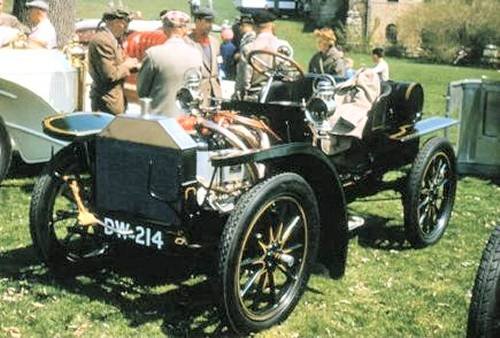
The British Napier Motor Company was an automobile sold by the Napier Motor Car Company of America from 1904 until 1912. Previously Napier Motor Company of America and American Napier Company , was an American manufacturer of automobiles .
History
The Napier Motor Company of America of Boston in Massachusetts initially imported vehicles from Napier & Son from England. In late 1904, the production of automobiles began after a license from Napier. The brand name was American Napier . In the middle of 1905, production was relocated to a large factory in the Jamaica Plain district . At the beginning of 1905 there were problems because the 200 workers went on strike. In April 1907, there were financial problems, which were solved in June 1907. At that time, production stopped. The company now traded as American Napier Companyand continued production in March 1909. After about a year, production stopped again before continuing the British Napier Motor Company in 1911. 1912 ended production.
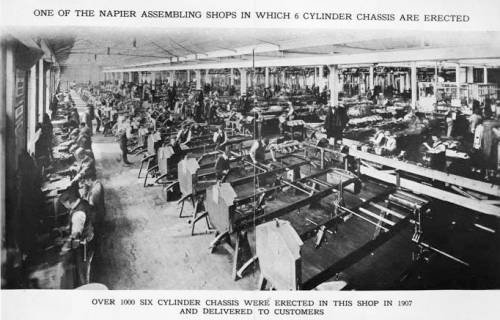
Napier production line for 6 cylinder cars
From 1904 to 1907 there were five models. The Nike had a four-cylinder engine with 18 hp and 229 cm wheelbase . He was the only model available from the factory with a bodywork - as a two-seat runabout . The Model D-45 had an equally powerful engine, but 264 cm wheelbase, and was delivered only as a chassis . Model H-70 with a four-cylinder engine and 28 hp power and model D-50 with four-cylinder engine and 40 hp power were more powerful. Top model was the Model L . It had a six-cylinder engine with 30 hp and 274 cm wheelbase.
From 1909 to 1910, three models were available. The Nike with four-cylinder engine, 20 hp and 234 cm wheelbase was available as a two-seat Victoria and two-seater runabout. The Four with four-cylinder engine, 40 hp and 295 cm wheelbase were available as Toy Tonneau , Tourabout and Runabout. The Six with six-cylinder engine, 60 hp and 320 cm wheelbase was a seven-seater touring car body.
From 1911 to 1912 the program was reduced to two basic types. The Four was specified with 15/24 hp and usually had 269 cm wheelbase. The Model A was a runabout and the Model 6-30 a touring car. The Model B touring car, however, had 300 cm wheelbase. The Six with 75 hp had 340 cm wheelbase. Model A was available as a Landaulet and sedan and the Model 6-50 as a touring car.
nitially, the company imported assembled Napiers from England. From late 1904 the cars were assembled under licence in Jamaica Plain, a section of Boston, Massachusetts, in a building formerly used by the B.F. Sturtevant Company. The cars were offered with both American and British built coachwork.

Chicago Automobile Manufacturing Company
Automotive manufacturer of Chicago , Illinois ,USA From 1905 to 1907.
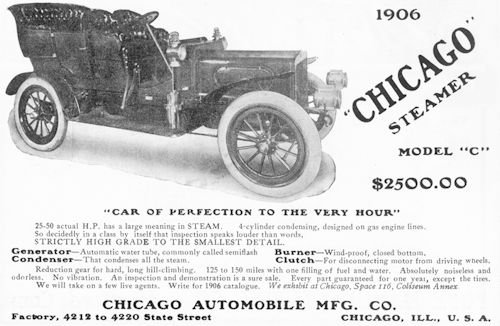
Chicago Automobile Manufacturing Company was an American manufacturer of automobiles in the early 1900s .
History
The Chicago-based company in Illinois manufactured automobiles from 1905 to 1907. The brand name was Chicago Steamer.
The offer included steam cars with detachable tonneau, mahogany finished dash. The four cylinders of the steam engine were arranged in a V-shape . The engine power was given as 25/30 hp . It was transmitted via a two-speed gearbox and a cardan shaft to the rear axle. a range of up to 150 miles on one filling of fuel and water.
For Model C , The chassis had 290 cm wheelbase . The open body offered space for five people. The original price was 2,500 US dollars .
There were no links to the other manufacturers of Chicago motor vehicles : Chicago Motor Vehicle Company , Chicago Motocycle Company and Chicago Electric Motor Car Company .
Chenowth Racing Products
Automotive manufacturer of USA From 1967 on.

Chenowth Racing Products of California built off road buggys and sand rail chassis since the 1960s they are known for the Fast Attack Vehicle (FAV).
History
Chenowth Racing Products. Inc. was the world's leading manufacturer of dune buggy chassis related components. Starting in a small shop Spring Valley. California, it became the standard of the Buggy Industry.
The FAV is manufactured by Chenowth Racing Products of California. It weighs 980 kg and has a maximum payload of 680 kg. The FAV is powered by a 200 hp, air-cooled Volkswagen engine , which provides a top speed of 130 km / h and an acceleration to 50 km / h in four seconds. Despite the required off-road capability, no four-wheel drive is provided. The 80-liter tank ensures a range of about 330 km. With additional tanks can be achieved 1610 km, but then decreases the potential payload considerably.
The Fast Attack Vehicle (FAV), also known as the Scorpion or Desert Patrol Vehicle , is a fast, lightly armored transport vehicle for US forces . The vehicle was produced in the 1980s and first became known to the public during the Second Gulf War . Members of the SEAL Team 3 were the first Allied units ever to arrive at Kuwait City , which had been hastily abandoned by the Iraqi forces. Meanwhile, the FAV was largely replaced by the Light Strike Vehicle replaced.
The vehicles are used by American special forces on reconnaissance missions or deep behind enemy lines. They are fast, very off-road and relatively heavily armed. Their disadvantage is that the crew is exposed to enemy fire without protection, with the result that their role as a reconnaissance vehicle has been weighted heavier than that of a weapons platform. Problems had the vehicles during the Iraq war, as they were too weak in unsustainably solid ground .
The crew consists of three persons. The driver is sitting in the front left of the vehicle. Right next to him is one of the two shooters. In the rear of the vehicle, the second shooter sits in the middle. The armament of the two shooters is directed forward. The front shooter can swing his weapon only limited, the rear shooter sits on a rotatable seat and thus has a larger pivot range of the armament.

Christman Motor Company
Vehicle manufacturer of California USA From 1901 to 1907.
Christman was an early American car brand. in Los Gatos, California from the 1900s
History
This brand goes back to Charles E. Christman. He was a blacksmith in Los Gatos , California . By January 1901 he produced his first vehicle.
He was looking for investors in San José . On March 20, 1901, he founded the Christman Motor Carriage Company in San José and the factory in Los Gatos. W. Peyton Smith became President, James F. Stephenson Vice President and Christman Superintendent. The plan was to produce a vehicle every day with 50 employees. On June 6, 1901, a newspaper reported that the factory had to be relocated to San José and that the third vehicle was currently under construction.
1902 took over the Golden State Automobile Company. The production of the Christman vehicles ended in 1902, although Charles Christman held his post in 1904 and 1905.
In April 1907 Christman founded the Christman Motor Car Company in Los Angeles . Participants were Elton S. Bogle, Arthur Kunze, Stephen S. Wilder and Harmon D. Ryus. They made in Los Gatos more vehicles. The production took place in the White Garage , where Ryus worked. The company exhibited vehicles at some local auto shows.
The vehicle of 1907 had large wheels, a wide gauge and a low gear ratio. So it was well suited for the early bad roads at that time. Still 1907 the production ended.
Bayer Brothers Carriage Works
Automotive manufacturer of Leavenworth , Kansas ,USA From 1905.
Bayer Brothers Carriage Works was an early American body manufacturer and later cars in 1905.
History
The company from Leavenworth in Kansas manufactured from 1857 bodies for carriages. In 1905, Henry Bauer led the company. In the year, four automobiles, which were marketed as a farmer . Charles Boyle was the designer. It is not known when the company was dissolved but around the same year 1905.
The only model was a tricycle. A two-cylinder engine mounted under the seat propelled the vehicles. It was steered with a steering lever.
A vehicle was sold and shipped to a carnival company. A buyer from Los Angeles paid 350 dollars for a vehicle.
A vehicle remained in the possession of Henry Bauer. Twenty years later, Henry Ford tried in vain to acquire this vehicle for his museum.
