
USA
HM Vehicles Free-way History
 |
|
|
Manufacturer |
H-M-Vehicles Inc. |
|
Production |
1979–1982 |
|
Assembly |
Burnsville, Minnesota |
|
Designer |
Dave Edmonson |
|
Class |
microcar |
|
Body style |
coupe |
|
Layout |
RMR layout |
|
Engine |
Tecumseh single-cylinder engine |
|
Transmission |
CVT, no reverse gear |
|
Length |
115 in (292 cm) |
|
Width |
53 in (135 cm) |
|
Height |
51 in (130 cm) |
|
Curb weight |
gasoline: 700 lb (318 kg |
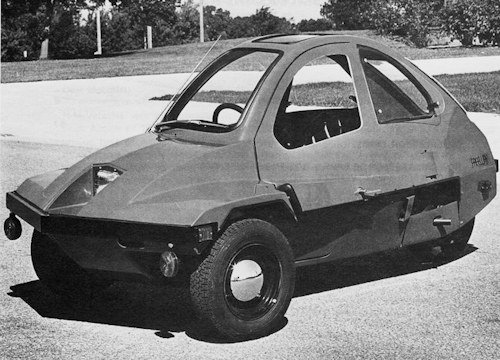
The H-M-Vehicles Free-Way was a three-wheel microcar manufactured in Burnsville, Minnesota, from 1979 to 1982.
History
The company was based in Burnsville , Minnesota . introduced in 1979 there are different names for the brand name as HM , HM Free-Way , HM Vehicles and HMV . In total, about 700 vehicles were created.
The model was a three-wheeled minicar with a single rear wheel. The Electric version had an electric motor with 6 hp . Alternatively stood cylinder - petrol engines with 340 cc displacement and 450 cc available. The closed body offered space for one person.
The H-M-Vehicles Free-Way (H-M meaning high mileage) During the 1970s Gasoline prices jumped almost 50 percent overnight causing oil prices to rise need for more fuel-efficient cars was needed. The 12 HP version was guaranteed to get 100 mpg‑ when driven at a steady 40 mph (64 km/h). The 12 HP version averaged 80 mpg‑, and the larger 16 hp averaged 60 mpg to 70 mpg. The standard fuel tank had a capacity of 3 US gallons (11 L) while a 9 US gallons (34 L) tank was optional.
These small commuter cars had a single seat and were powered by a 12 or 16 horsepower gasoline one-cylinder, air-cooled Tecumseh engine with only 345 cc 388cc, and larger 453-cc or a 4 hp electric motor. A diesel engine was offered, but none were ordered with offered, but motor was mounted behind the driver and was coupled to a snowmobile-style CVT belt drive transmission. Final drive to the rear wheel was by chain. The gasoline-powered Free-Way did not have a reverse gear in its transmission. An electrically powered reverse drive was offered as an option, but was never made available.
The Free-Way had a welded tubular steel frame, with a secondary perimeter frame at bumper height to protect the driver from impacts. Suspension was fully independent, with two wheels in front and a single wheel in the rear. With three-wheel independent suspension the fully enclosed two-piece fiberglass body was approximately 0.125 inches (3.2 mm) thick and had the colour moulded into the material and was available in three colours high-visibility red, yellow, or orange. The lower body included a full undertray to reduce the drag coefficient of the vehicle.
The Free-Way had a single headlight and per federal standards were intended to be licensed as a motorcycle, but in some states, they were titled as cars.
The basic price of the Freeway was just $1,650. About 700 Free-Ways were sold before the company closed in June 1982.
Neustadt Automobile & Supply Company
Automotive manufacturer St. Louis, Missouri; USA From 1901 to 1915.
The Neustadt Automobile & Supply Company, was an early American manufacturer of automobiles.
History
The New Town Perry Company was created in 1901 in Eighteenth street St. Louis, Missouri, by JH Neustadt and a Mr. Perry. They began making parts for the automobile sector. They specialised in making kit vehicles and finished automobiles. Neustadt renamed the company Neustadt Automobile & Supply Company after Perry left in 1904.
The predominantly used brand name changed in 1904 from Neustadt-Perry to Neustadt. Also featured as Berkeley, Bluff Climber, Genevieve, JHN, and Princess Traveler. 1908 ended vehicle production initially. From 1911 to 1914 Neustadt produced commercial vehicles in complete form. In 1915, three passenger cars were commissioned.
From 1901 to 1904. In addition to vehicles with gasoline engine, there were also steam cars until 1903. A great variety distinguished the assortment. There was a choice of one-, two- and four-cylinder engines, air and water cooling, planetary and friction gearboxes and power transmission via one or two chains. Cardan drive is not explicitly mentioned.
From 1911 to 1914 there were trucks .1915 created three vehicles with four-wheel drive for HM Boyd.
Bauer Machine Works Company
Automotive manufacturer of vehicles manufacturer of Kansas City , Missouri; USA From 1913 to 1916.

Bauer Machine Works Company was an American manufacturer of motor vehicles in the 1910s from Kansas City , Missouri .The brand name was Bauer .
History
The company was founded in 1894 becomes renowned for their manufacture of gasoline engines.1913 in Kansas City , Missouri . A plant was acquired, in which previously before the Caps Brothers Manufacturing Company , Farmer's Auto-Motor Car Company , Kansas City Motor Car Company and Kansas City Vehicle Company were active. 1914 began the production of automobiles and commercial vehicles .
The car was the Model 30 . This was fitted with a four-cylinder engine with 3620 cc engine capacity and 95,25 mm bore , 127 mm stroke , and 22.5 PS power. The wheelbase was 279 cm. The open roadster could accommodate two people.
The trucks also originated from parts left over by the last operator of the plant.
There was no link to the Bauer Taxicab Manufacturing Company , which used the same brand name.
1916 ended Automotive production.
Bauer Taxicab Manufacturing Company
Automotive manufacturer of vehicles manufacturer of Chicago , Illinois; USA From 1924 to 1927.

Bauer Taxicab Manufacturing Company was an American manufacturer of Taxi automobiles in the 1920s .The brand name was Bauer .
History
Perry Bauer, Pand AL Belle Isle, who worked in the taxi business, founded the company in 1924 . They started with the production of Taxi automobiles Designed in collaboration by Karl K. Kizer, t in Chicago in Illinois first show at the 1924 Chicago Auto Show.
The cars were used as taxis and known as the Bauer front-door taxicab. A four-cylinder engine from Buda powered the vehicles. The heavy built chassis was referred to as "wreck-proof" because of its rigid body construction this had a 115"( 292 cm) wheelbase. The sedan's door layout was unusual. A door that could not be opened from the inside led to the rear passenger compartment. Another door was mounted on the front passenger's side and struck the B-pillar . It should allow entry and exit to the rear, without disturbing other passengers and doors inside rather than open into the street area.
Bankruptcy began in February 1927 . The production ended from there upon.
There was no connection to the Bauer Machine Works Company , which used the same brand name.
Besasie Automotive Company Inc. (Baci)
Automotive vehicles manufacturer of Milwaukee , Wisconsin;USA From 1991 to 1996.
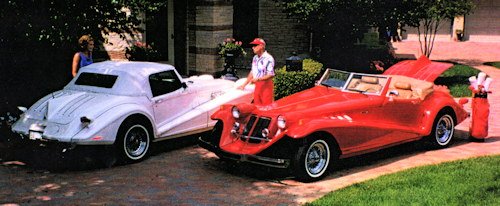
Besasie Automobile Company Inc. was an American manufacturer of Neo classic style automobiles from the 1990s. The brand name was Besasie
History
The company was founded on August 21, 1991 in Milwaukee , Wisconsin . owners were Joseph and Raymond Besasie, previously worked at Excalibur. The production of automobiles began around 1991 . he brand name was Besasie In addition, the was brand Baci protected.By 1996 ended production. In total, only 14 vehicles were created.
The model was the Baci The vehicles corresponded visually the 1930s. The choice was between Roadster and convertible body .The grille was strikingly mounted at an angle. The front fenders were long and reached up to the rear fenders. The headlights were partially integrated. The front bumper was split in three and covered with rubber.
STANDARD FEATURES:
Dual Air-bags ,AM/FM Stereo Radio/Cassette ,Full Analog Instrumentation,Cruise Control ,Dual Remote Control Side-View Mirrors ,Tilt Steenng Wheel,Dual Fog Lamps ,Leather Seating Surfaces and Trim ,Six-Way Power Drivers Seat,Power Door Locks ,Power Windows ,Power Soft-top ,Power Trunk Release,Remote Key-less Entry ,Elm Burl Inlays.
A all welded steel tube space frame engineered for torsional strength. grid frame made of steel tubes formed the basis. A V8 engine from the Ford Thunderbird with 5000 cc displacement powered vehicles. Later versions had an engine with 4600 cc capacity.
SPECIFICATIONS:4.6L
4.6L. SOHC V8 Ford
205 Horsepower
Electromc 4-Speed Automatic Transmission
4 Wheel Independent Suspension
Anti-Lock Brake System
15 x 7.0" Chrome McClean Wire Wheels
P225/70R 15 White Side-wall Dunlop Elite Tires
Power Rack and Pinion Steering
125" Wheelbase
204" Overall Length
72.3" Width
61.6" Front Tread
60.2" Rear Tread
3700.0 lbs. Curb Weight
