
USA
Courier Motors Company

The Courier Motors Company was a short-lived American automaker in the early 1920s. The brand name was Courier.
History
The vehicle was the successor to the Maibohm Motors Company built from 1916 to 1922. The beginning of 1922 fell Maibohm engine had massive difficulties to creditors. Following the bankruptcy of Maibohm engine as early as August 1922 Courier Motors Company took control Albert C. Burch, who previously in the commercial vehicle manufacturers Signal Motor Truck Company in Detroit and Clydesdale Motor Truck Company in, Ohio. The company produced the last Maibohm model B-6 in a slightly improved form as Courier Model D. It was believed that by focusing on perfected lubrication of the vehicle, it could improve its market opportunities and built dry sump lubrication for the engine and central chassis lubrication for the chassis in the otherwise almost unchanged vehicle. All these efforts proved ineffective. The production of the Courier Model D remained with 373 units in the model year 1923 well below the 623 produced copies of Maibohm Model B-6 in its last full model year (1921). Until July 1922 another 217 was added, while the then tarnished production of the Courier Model D is included in these 373 vehicles. Details of the production period of the Courier Model D missing, but it should have lasted from the end of 1922 until the end of 1923.
No less than nine body styles are listed. This discrepancy may either mean that models have been announced but not built, or, more likely, that these four are just variants. So, it could be analogous to its predecessor Maibohm Model B-6, the Sport Roadster to a modified version of the occupied Roadster, such as shortened fenders and treads instead of continuous footboards. Analog would be the sport Phaeton and the Sport to see, the latter to another interior with four instead of five seats had. With a high price difference could also be explained by the offered equipment. For Brougham may be noted that this term sometimes for Club Coupe was used. Accordingly, this would have been an upgraded coupe version with five instead of three seats.
In addition to the lubrication systems for the engine and chassis, the basic equipment included a nickel-plated radiator grille and headlamps with a dimming device. Open models had equipment in Spanish leather, and for closed stands a selection of imported fabrics was available. The customer could choose from five colours.
The specifications of the Courier Model D are thus largely identical to those of the Maibohm Model B / B-6. Deviations could be detected for the engine unusual dry sump lubrication for the engine and central chassis lubrication for the chassis. , the carburettor, the steering and some body styles. Of these there were a total of nine. The top-controlled six - cylinder engine had a displacement of 3.2 litres; the performance is different with 46 bhp.
The water-cooled six - cylinder engine was purchased from Falls. These were a modern engine with a one-piece moulded block and removable cylinder head, The Tillotson gasifier of the previous year was no longer used for the mixture Instead, they resorted back to the previously installed Stromberg. The manufacturer stated the fuel consumption at 20 MPG Accordingly, the Courier consumes a quart (0.95 litres) of oil to 500 miles. Like its predecessor, the vehicle is highly likely to have a honeycomb radiator, battery ignition, 6-volt system and fuel delivery via vacuum. The power transmission takes place via a dry disc clutch on a blocked with the engine, conventional, unsynchronized three-speed gearbox with reverse gear and by means of cardan shaft to that with differential in the rear axle.
The wheel base is compared with the previous model unchanged 116 inches The robust chassis is provided as a conventional lead frame constructed. It consists of two cranked side rails and five trusses, of which the second (from the front) supports the engine and gearbox and the rear most carries the fuel tank. Typically, the rigid axles are front and rear. On the Maibohm Model B and B-6 until model year 1921.
Preston Motors Corporation
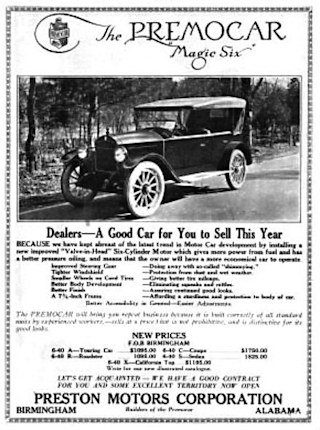
The Preston Motor Car Company is a former American automobile and commercial vehicle manufacturer. Brand names were Preston and Premocar.
History
The Preston Motor Car Company, from 1919 Preston Motors Corporation was founded in early 1918 by Charles A. Dexter in Birmingham (Alabama) for the production of automobiles and commercial vehicles designed by WH Tarpley from New Jersey. The company purchased the facilities of the former Birmingham Boiler Works. Many components of the Preston vehicles were sourced from the Sandusky Forging Company. Offered were vehicles from US $ 600 and a truck from US $ 1000. The vehicles were called Preston. The company's headquarters were now at the intersection of 18th Avenue and Vanderbilt Road in Birmingham. This was moved in the late summer of 1920. The vehicles were redesigns without Tarpley’s involvement and appeared under the brand name Premocar. Again, there were cars and commercial vehicles, the former, however, in a much higher-priced market segment. Initially, a six - cylinder Schieber engine system Fischer was to be used, as it already in larger design 1914 for the Mondex-Magic from New York City had been considered. At least one car with this engine and a list price of US $ 2290 - was actually built and used by the city of Birmingham to chauffeur around superscript visitors. It was given to US President Warren G. Harding, who delivered a much-noticed speech in October 1921, and composer John Philip Sousa in 1922.
The vehicles were Assembled Vehicles with the advantages and disadvantages of such prefabricated products. The former included low development costs, tried-and-tested components, flexible material purchasing and a favourable price, as well as the dependency on suppliers (which could have fatal consequences, especially for financially tightly financed companies) and lower brand prestige. In series, the car went as Premocar 6-40A for the model year 1921 with a more conventional case ohv six-cylinder. This is likely to significantly lower list price of US $ 1295, - have made possible. A Ford Model T Touring cost US $ 535, - and then US $ 440, - from late 1920 to mid-1922. According to one source was Premocar 6-40A at the same price as a two-seat Roadster or five-seater Touring available; according to other information, only the touring was offered. With minor changes, the 6-40A was produced until 1923. With regard to available designs and prices, different information is available. After a source, only Roadster and Touring were offered, but now for each US $ 2250, Other information indicates that prices for 1922 remained unchanged at each US $ 1295, -. Accordingly, there was also a new sedan for US $ 1995, For 1923 now be a 2/3-seater roadster and a 4/5-seater Phaeton at a reduced price of US $ 1095, - called. The sedan still cost US $ 1825, and a coupe for US $ 1750.
The Premocar 4-80 was a particularly powerful version of the 6-40A with a four-cylinder engine derived from racing Rochester Duesenberg. The 4.9 litre engine made in this "tamed" version to 76 bhp.
The company ended after 93 built vehicles of the model year 1923 the production was stopped prematurely and the company was placed under insolvency law in May 1923.
Chase Motor Truck Company History
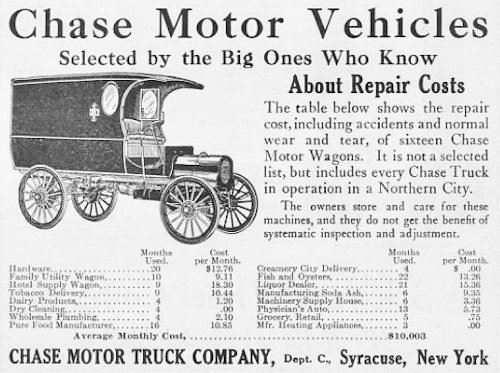
The Chase Motor Truck Company was an American manufacturer of automobiles and utility vehicles, trucks and tractors from the early part of the 20th century from 1906 to 1919.
History
The Chase Motor Truck Company from Syracuse, Onondaga County, New York, United States, the company was founded in 1906 by Aurin M. Chase in Syracuse New York. Chase had experience with agricultural implements; Previously, he had been vice president of Syracuse Chilled Plow Company, which belonged to his father. In 1905 he became deputy plant manager at the car manufacturer HH Franklin Manufacturing Company in Syracuse. The first Chase vehicles were at first high wheelers similar to the International Harvester and Brockway. The focus of the company was early on the commercial vehicle production, and as early as 1908 appeared the first truck, a cab with 3-ton payload and also designed as a high wheeler. From very early Chase put in their own engines, all air-cooled two-stroke.
The origin of the early Chase engines is not proven, but it is likely that they were made in-house. All Chase high wheelers had air-cooled two-stroke engines. First appeared a 15 hp two-cylinder engine with 4½ × 5 inch bore and stroke, resulting in a displacement of 159.0 ci, corresponding to 2606 cc. The rating was 16.2 HP. This two-cylinder was replaced in 1909 by a three-cylinder 134,5 ci (2171 cc) at 3¾ × 4 inch bore and stroke. Again, 15 hp are 12.675 HP'
For the larger 20 hp three- and 30-hp four-cylinder own production may be considered secure. These latter two were also the motors of the high-Wheeler model family used the longest. The three-cylinder PS 20 had 4⅛ x 4 inch bore and stroke, yielding a capacity of 160.4 ci, respectively. 2628 cc. The four-cylinder was reserved for commercial vehicles. The power was transmitted to a countershaft, at the two ends of drive gears were mounted. Of these, each led a drive chain to each rear wheel. The passenger cars and some light commercial vehicles received two-speed planetary gearbox, larger models a conventional three-speed gearbox.
The wheelbase of the vehicles designed for passenger transport was initially 84 inches (2434 mm), then 100 inches (2540 mm). Model F weighed 1,500 lb (680 kg) in both the two-cylinder and three-cylinder versions. The vehicles were right-hand drive throughout. Typically, the suspension consisted of a pair of longitudinally disposed Elliptic- leaf springs at the front and a transversely mounted semi-elliptic leaf spring rear, but there were also versions with longitudinally mounted semi-elliptic leaf springs back. The wood spoke wheels initially had the dimension 40 × 1¾ inches (1016 × 41 mm) and from 1909 40 × 1⅝ inches (1016 × 44 mm); Solid rubber tires were part of the basic equipment. The rates increased with the introduction of three-cylinder models from $ 750.- to $ 900.
All Chase motor vehicles manufactured until model year 1914 were high wheelers; Carriage-like motor vehicles with huge wheels. The engine in front under a hood instead of in or under the car body. The first model 15 HP was a two-seat runabout with 2.6 litre twin-cylinder engine, which was introduced for the model year 1907. The model’s name indicates its ALAM rating of 15 hp. For 1908, a version of this vehicle is occupied as a panel van. It seems that these early models had their air intake in the upper part of the "radiator grille". Also in 1908, the program was to the aforementioned High Wheeler extended lorry used 3 tn (2720 kg) payload. This too Cabover received an air-cooled two-stroke engine, which provided 30 hp.
The Chase 15 HP (1907-1908) was the first vehicle of this manufacturer and with its successor Model F the only one, which could be used also for the person promotion. Like all Chase produced before 1914, these were high wheelers, d. H. Carriage-like motor vehicles with huge wheels. Atypical of this category was on Chase, that the engine was mounted in front under a hood instead of in or under the car body. Between 15 HP, Model F and other types of the manufacturer, there were clear similarities as well as to some competing products, such as the International Motor Wagon or corresponding vehicles of Brockway. The latter had experienced assistance from Chase in the development. The first 30 Brockway trucks were built on Chase chassis.
The 15 HP was a two-seat runabout with a 2.6-liter two-cylinder engine. The model’s name indicates the power of 15 hp (according to a source: 10 HP). For 1908, a version of this vehicle is occupied as a panel van. It seems that these early models had their air intake in the upper part of the "radiator grille". Also in 1908, the program was a high wheeler truck with 3 tn (2720 kg) payload expanded. Also, this front handlebar received an air-cooled two-stroke engine, which provided 30 hp.
Chase Model F (1909-1912). This model had a longer wheelbase, a new body and a three-cylinder engine with 2.1 litre capacity. Again, it was an air-cooled two-stroke. The construction was called Surrey. Doors were neither front nor rear, and the rear seat could be removed in a few easy steps, leaving a light van with up to 700 lb (230 kg) payload available. This explains the alternative name used by the manufacturer Businessman's Roadster, the target audience was farmers and craftsmen in rural areas who worked with them during the week and were able to drive the family to church or picnic on Sunday. These Chase high wheelers were bigger than most competing products. The rates increased with the introduction of three-cylinder models from $ 750.- to $ 900.-.
All Chase high wheelers had air-cooled two-stroke engines. First appeared a 15-hp two-cylinder with 159 ci (2606 cc), which was replaced by an equally strong three-cylinder with 134.5 ci, (2171 cc). The origin of these engines is not proven, but it is likely that they were made in-house. For the larger 20-hp three-and 30-hp four-cylinder, this may be considered secure. These two were the motors used longest of High Wheeler generation. The passenger cars and some light commercial vehicles received two-speed planetary gearbox, larger models a conventional three-speed gearbox. The drive was applied to a counter shaft and from it with a gear at each end of the shaft and thus a driven drive chain transferred to the corresponding gear on the rear axle and thus to the wheel.
The wheelbase of the vehicles designed for passenger transport was initially 84 inches (2434 mm), then 100 inches (2540 mm). Model F weighed 1,500 lb (680 kg) in both the two-cylinder and three-cylinder versions. The vehicles were right-hand drive throughout. Typically, the axle suspension consisted of a pair of longitudinally arranged elliptic leaf springs at the front and a transversely mounted semi-elliptic leaf spring at the rear, as shown in the adjacent figure. But there were also suspensions with longitudinal semi-elliptic leaf springs behind. The wooden spoke wheels initially had the dimension 40 × 1¾ inches (1016 × 41 mm) and from 1909 40 × 1⅝ inches (1016 × 44 mm); Solid rubber tires were part of the basic equipment.
All Chase High wheeler built on the principle that had been introduced with the 15 HP. The 15 HP was the smallest model in the program. The largest, a four-cylinder cab with 2.7 t payload, followed in 1908. A number of commercial vehicles introduced in 1912 are known by name. Apparently, the setting of the Model F led to a reorganization of the vehicle program. However, hardly any information is available on the production time and the respective engines.
From 1908 Chase offered a "tractor-roller", which was more suitable for pulling equipment than for field work. This did not change until 1915, when two conventional tractors were introduced, but the larger one was discontinued after a short time. As early as 1908, a "tractor-roller" had been introduced, which was powered by an "air-cooled small engine". It is suspected that the tractor-Roller has received an in-house 15 HP two-cylinder engines. 1913 appeared the further developed tractor-scooter combination with three-cylinder two-stroke engine and 30 HP from PTO. In 1915, two conventional tractors replaced the earlier models. The Chase 40 HP Tractor is only known to weigh 6000 lb (2.7 tons), cost $ 1750, and was run in the program for a very short time. The smaller 8-16received a Waukesha four-cylinder engine with 8 hp at the drawbar and 16 hp at the PTO. This model was further developed in 1918 to Chase 9-18 and received a Buda four-cylinder with 9 hp on the drawing bar and 18 hp at the PTO. The variant manufactured in Canada from 1919 had a larger Buda engine (bore 4.25 inches, stroke 5.5 inches, resulting in a displacement of 312.1 ci or 5114 cc). Whether these changes were related to the Buda program or should be an improvement of the tractor is not apparent.
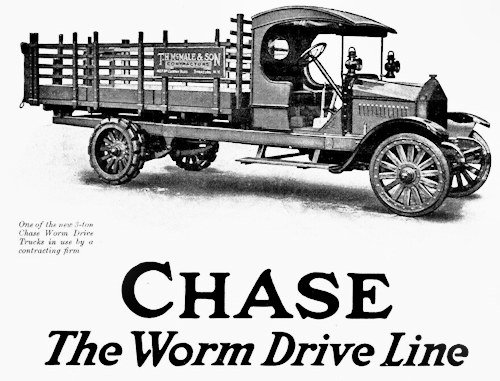
1912 ended the production of vehicles for passenger transport. For two years quite large high wheelers were built for commercial applications. From 1914 conventional trucks are occupied, which were Assembled trucks from purchased components. These vehicles were initially as trucks with payloads of 1, 2 and 3 ton and purchased, Water-cooled four cylinder four- stroke engines from Continental. These were quite modern constructions with cardan drive. The in-house engines are no longer detectable after 1914 in Chase commercial vehicles; it is unclear whether they have been produced for third parties. At the latest after 1915, the three-cylinder tractor also ran out. The new generation of Chase lorries with side-controlled Continental four- cylinder four- stroke engines is guaranteed were driven. The power transmission carried out via conventional four-speed transmission of Brown the lip or Cotta, a propeller shaft and a differential with worm drive to the rear axle; a then quite modern construction element.
From 1916 the program was significantly expanded. It now also included models with engines from other suppliers.1918, the now streamlined production range consisted of four commercial vehicles with payloads between 1 and 3½ tn, for the two lighter models four-cylinder engines were purchased from Waukesha and for the heavier Buda. The ignition systems supplied American Bosch.
By 1917 versions with payloads of three-quarter-3½-ton with Waukesha and Buda engines. The US Army also took an unknown number of these trucks. 1918, vehicles were also set up as farm tractors. The circumstances that led to the closure in Syracuse are unknown. A fresh start with the slightly revised tractor Chase Tractors Corporation in Toronto (Ontario, Canada) had already failed by 1921.
Richelieu Motor Car Company

The Richelieu Motor Car Company is a former American car manufacturer from the 1920s and built luxury cars.
History
The company was founded by former employees of the Duesenberg Motors Corporation (DMC), which had built in the First World War in New York predominantly aircraft engines. As a result, the rights arrived at the large volume Duesenberg- four-cylinder engine to the Rochester Motors Company, Inc. Richelieu was one of the customers who used these engines called Rochester-Duesenberg.
President of the Richelieu Motor Car Company was former DMC Sales Manager NG Rost, Vice President William Beekman, Fred Duesenberg's former assistant. The other board was composed of bankers and investors. It was founded in October 1921 and the launch of the only model T-85 at the New York Motor Show in late November of the same year. It seems that one of the investors Newton Van Zandt, previously with little success and often dubious methods the ReVere Motor Corporation had led one of the competitors who also used Duesenberg engines. For a short time, he was then employed at Duesenberg. It is not excluded that Van Zandt brought a ReVere to Asbury Park and this served without ReVeres knowledge as a blueprint for the Richelieu.
The T-85 was initially available only as a four-door touring with a body by Fleetwood. The design was sporty European. The wheelbase was 3327 mm (131 inches). With the nickel-plated, rounded radiator surround Richelieu reminiscent of large Fiat models. He had narrow-cut fenders and no continuous footboard. Instead, there was a nickel-plated tread to each of the four doors. Laced wheels Large, drum-shaped headlights and a horizontally split windshield completed the equipment.
The 85 bhp (63.4 kW) provided more than enough power in their time; the race version from which he was derived had 100 bhp (74.6 kW). However, the required price of US $ 3950, - for the four-seater was considerable: the Richelieu was a luxury car and more expensive than the established competition.
For 1923 there were more body styles, all of them produced by Fleetwood. The Touring was a two-seater roadster, each US $ 4200, and new was a seven -seater sedan to US $ 6000. Richelieu was not strong enough to survive the economic crisis of the early 1920s. In February 1923, the company had to disclose its numbers. The debts of US $ 46,851, - were compared to values of US $ 272. The management tried to establish a successor company called Advanced Motors and announced the construction of a light sports car called Barbarino. As a result, there was a court dispute with the designer Salvatore Barbarino and the Barbarino Motor Car Company. Advanced Motors was prohibited until the beginning of 1923 to issue more shares.
The T-85 was equipped with wheels of dimension 32 × 4½ inches. Power transmission a four-speed gearbox with directly found top gear; in sporty versions of the fourth gear was designed as overdrive. The rear axle was optionally stocked 3.0: 1 or 3.5: special spare wheel covers and a special version of the soft top. Nickel-plated steps and Houk spoke wheels were standard features. The position lights were moved to another location. Initially, the Richelieu factory was only available as a four-door touring. In 1923, a roadster was added. Some vehicles were later produced bodies of local coachbuilders such as the United Body Company in Rahway (New Jersey), which the company may had for a short time. As one of the suppliers of Locomobile bodyshells and custom-made for various European brands (Mercedes, Renault, Rolls-Royce), United Body had experience in the luxury car market. The bodies produced in small batches were also hand-made products of high quality. At that time, they usually consisted of a wood frame with sheet metal planking. The T-85 was initially available only as a four-door touring with a body by Fleetwood, a roadster and a sedan followed in 1923.
Pontiac History

Pontiac was a car brand of the US automotive group General Motors. Following the bankruptcy of General Motors in 2009 and the associated restructuring of the Group's model program, the traditional "Pontiac" brand was abandoned at the end of 2010.
History
The name "Pontiac" was first used by the existing since 1906 Pontiac Spring & Wagon Works. This name goes back to Chief Pontiac, a leader of the Ottawa Indians, who was leader in the 18th century in the fight against the then British colonial rule. The Oakland Motor Company of 1907 and the Pontiac Spring & Wagon Works Company merged in November 1908 to Oakland Motor Car Company. In January 1909, General Motors acquired half of the company's shares and then in the summer, after the death of Edward P. Murphy, the founder of Oakland, the remaining shares. The vehicles were from 1908 to 1926 under the Oakland brand manufactured. The first Pontiac brand vehicle was launched in 1926 by General Motors as a cheaper version of the Oakland Motor Car. Pontiac was next to LaSalle, Marquette and Viking one of four new brands of GM, with the gaps in the model program should be closed. The other brands were abandoned, while Pontiac completely replaced the Oakland brand from 1931.
For the next 25 years, In the mid-50s Pontiac came under pressure when Chevrolet offered more luxurious cars and also for the first time a V8 engine. An evasion to the top was not possible, there already sat the group brands Oldsmobile and Buick.Pontiac was then positioned as the sports brand of General Motors. The models Bonneville (1957), Le mans (1961), Grand Prix (1962), GTO (1964) and Firebird (1967) already showed by their naming the athletic claim.

In the 60s, this concept was very successful. In particular, the GTO has become a true trendsetter. In the 70s, the general conditions worsened. Stricter emissions regulations led to a decline in engine performance, which suffered especially Pontiac as a sporty brand. The oil crisis of 1973/74 led to a slump in demand for high-capacity cars. Pontiac responded with the introduction of smaller models: Ventura 1971, Astre 1974, finally the T1000 in 1981, the smallest Pontiac, which had been built until then. With these cars, the brand identity was lost because they were all just slightly modified Chevrolet models. The T1000 was even based on the German Opel Cadet City.

In the 1980s and 1990s, Pontiac, despite various attempts, failed to build on the successes of the 60s. The streamlined rationalization of the General Motors Group meant that the range of models offered by all Group brands was highly standardized. Most Pontiac models of this era were only equipment variants of models that could be bought in very similar form as Chevrolet, Oldsmobile or Buick. One of the few exceptions was the mid-engine sports car Pontiac Fiero (1983 to 1988), but this suffered under the unsuitable for a sports car four-cylinder engine and was not a success.

GM, as the parent company, discontinued production of Pontiac vehicles at the end of 2009 as part of its restructuring and announced the complete closure of the Pontiac brand by the end of 2010; now GM will focus on its core brands GMC, Buick, Cadillac and Chevrolet. On 25 November 2009, as the last model in the US, a white Pontiac G6 made, which went into regular trading; only the production of the Pontiac G3 in South Korea ran until the end of 2009.
