
Subaru Engines
- Details
- Parent Category: Engines Makes
- Category: Subaru Engines
- Hits: 117
Subaru EL15 Impreza Engine

Subaru EL15 is a horizontally opposed 4-cylinder gasoline engine manufactured by Fuji Heavy Industries . As a successor to the EJ15 engine , it was installed in the Subaru Impreza series from 2006 to 2011 .
History
It was installed for the first time in the new grade "1.5R" added to the improvement of the Impreza series in starting in 2006 . Due to the full model change to the third generation that took place in 2007 the following year, the 1.5 L grade "15S" (later changed to "1.5i" ) of the same car was equipped with EL15, and at this point EJ15 equipped model disappeared, and the company's 1.5 L engine was completely taken over by the EL15 .
Structurally, the engine is based on the EJ type engine , and many parts are shared Type MPFI Map-DIS. Ignition system. The timing of adoption differs depending on the region, but instead of the EJ15 and EJ16, the 3rd generation Impreza has all switched to the EL15.

Although the change does not appear in the basic specifications, the EL15 after the Impreza full model change in 2007 has been changed to some body parts such as the cylinder head and piston .The cylinder block has a bore pitch of 113 mm, which is not only the same as the EJ engine, but also the crankshaft and connecting rods are from the EJ25 , which has the same stroke .
The design of the EJ type engine is optimized and used. The same parts as the DOHC EJ engine are used for AVCS related parts .Since there are many common parts with the EJ engine, it is difficult to distinguish it from the DOHC EJ engine even when looking at the engine as a whole.The basic structure and parts used, the EL15 can be considered as one of the EJ engine series rather than a new engine . After the announcement of the EL15, there was speculation that the EL20 and EL25 were being developed as successors to the EJ engine , but the EJ20 and EJ25 continued to be installed in subsequent new models. As mentioned above, the EL15 is a variation of the EJ engine, and engines such as the EL20 and EL25 will not be released. In September 2010, the new-generation boxer engine and FB engine will become the official successor to the EJ engine. The development of was officially announced .

Installed vehicles
- Impreza ( GD/GG type , GE/GH type)
specifications
- Type: 1.5 L DOHC 16 valve EGI
- Displacement: 1,498 cc
- Inner Diameter x Stroke: 77.7 mm x 79.0 mm
- Compression ratio: 10.1
- Firing order 1-3-2-4
- Maximum output: 110 PS (81 kW ) / 6,400 rpm
- Maximum torque: 14.7 kgf m (144 N m ) / 3,200 rpm
- Fuel used: unleaded regular gasoline RON 95
- Air metering Type Mass / MAP
- Variable valve mechanism: Intake AVCS
- Details
- Parent Category: Engines Makes
- Category: Subaru Engines
- Hits: 51
Subaru ER six-cylinder engine (H6)

Subaru introduced its first six-cylinder petrol engine in its sports car the Alcyone VX and as the Subaru XT in the US, it was at the time a world first,the only water-cooled flat-6 car engine available.
This SOHC multi-point electronic fuel injection engine was based on the EA82 first-generation flat-4, with the same bolt patterns and design to the EA82 but with two cylinders added to the rear and 2-valve cylinder heads,with unique oil and water pumps.The valve timing system has two individual timing belts ,one is spring tensioner whilst the other uses a hydraulic version.
Technical
ER27 :model: Subaru XT ,Subaru Alcyone VX (1987 to 1991)
- 2672 cm SOHC , (2.7L)
- Power 145 hp at 5200 RPM (US)
- Power 150 hp at 5200 RPM (JDM)
- Torque output 211 N⋅m (156 lb⋅ft) at 4000 RPM
- Cylinder bore 92 mm
- Piston stroke 67 mm
- Compression ratio 9.5:1
- Block material aluminium
- Head material aluminium
- Fuel type Petrol (gasoline)
- Details
- Parent Category: Engines Makes
- Category: Subaru Engines
- Hits: 181
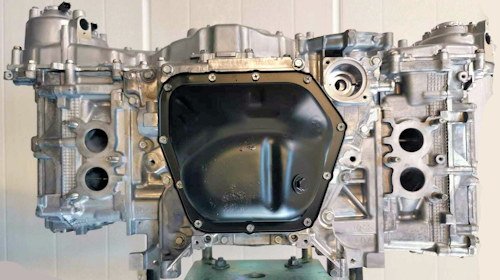
Subaru FA boxer engines

The FA engine first produced since 2012 was developed from the FB engine. It is a Petrol (gasoline) flat Water-cooled boxer 4 engine with DOHC 4 valves per cyl. with AVCS system.Reducing weight while maintaining durability were the primary goals in the design of this engine and was designed to be mounted as low in the car as possible. Although the FA and FB engines are used on a common platform, the FA shares very few of its parts with the FB, since it has a different block, cylinder head, connecting rods and pistons.
FA20D
The FA20D engine built at Oizumi in Japan is equipped with injectors ( Toyota D-4S injection system ) and the Subaru CFS variable timing system. It is used in the Subaru BRZ , and is identified by a Toyota engine code under the label 4U-GSE (the same installed in the Toyota 86 and the Scion FR-S) . Subaru recommends the use of 0W-20 oil. with an 86 mm × 86 mm (3.39 in × 3.39 in) bore and stroke for 2.0 L
From 2013 FA20D: 1998 cc DOHC, aka Toyota 4U-GSE; Subaru BRZ/Toyota 86
- Bore × stroke: 86 × 86 mm
- Stroke: 86 mm
- Capacity: 1998 cm 3
- Compression ratio: 12.5: 1
- Max power: 200 hp (147 kW) at 7,000 rpm
- Torque: 20.9 kg m (205 Nm; 151 lb ft) at 6,400 rpm
From 2017 to 2020 Subaru BRZ/Toyota GT86 (manual transmission)
- Power: 205 hp (153 kW; 208 PS) at 7,000 RPM
- Torque: 156 lb⋅ft (212 N⋅m; 22 kg⋅m) at 6,400 RPM
FA20F
A Subaru version with direct injection and biturbo (twin-scroll turbocharger) was introduced in 2012. Compression ratio for the turbo engine is lower at 10.6:1 . A later revised FA20F with improvments to camshafts, rocker arms, boost pressure, intercooler, was introduced for the 2015 model year cars.
FA20F: 1998 cc DOHC, turbo, 2012+ JDM Subaru Legacy 2.0GT DIT and 2014+ Subaru Levorg; 2014+ USDM and JDM Subaru Forester XT; 2015+ USDM Subaru WRX
- Capacity: 1998 cm 3
- Bore × stroke: 86 × 86 mm
- Compression ratio: 10.6: 1
- Firing Order: 1-3-2-4
Fitted to models:
Subaru Legacy 2.0 GT DIT (2012 Japan) and Subaru Levorg (2014)
- Power: 300 hp (221 kW) at 5,600 rpm
- Torque: 40.8 kgm (400 Nm; 295 lbft) at 2,000-4,800 rpm
Subaru Forester XT (2014-2018) USA
- Power: 250 hp (186 kW) at 5,600 rpm
- Torque: 258 lbft (350 Nm; 36 kgm) from 2,000 to 4,800 rpm
Subaru Forester badged as Forester XT: (2014-2018) (JDM)
- Power: 276 hp (206 kW; 280 PS) at 5,600 RPM
- Torque: 258 lb⋅ft (350 N⋅m; 36 kg⋅m) at 2,000-5,200 rpm
Subaru WRX (2015) USA
- Power: 268 hp (200 kW) at 5,600 rpm
- Torque: 258 lbft (350 Nm; 36 kgm) from 2,000 to 5,200 rpm
FA24F
The larger FA24F was introduced in 2018 increasing displacement to 2.4 L.The engine has now has all aluminum head and block. A turbocharger with Direct injection are now used.
2,387 cc DOHC, turbo, from 2019 on USDM Subaru Ascent, from 2020 on Subaru Legacy, and from 2020 on in the Subaru Outback.
FA24D
This has the same displacement as the FA24F turbocharged engine.with a bottom-mounted turbo with the addition of an oil cooler.
Like the FA20D, the FA24D uses the Toyota D-4S fuel injection system, which combines direct and port injection. with an identical 94×86 mm bore and stroke, but the compression level is increased to 12.5:1. The torque curve was revised, coming at a lower engine speed and without the significant torque decrease.
- Compression Ratio: 12.5:1
- 2022+ Subaru BRZ/Toyota GR 86
- Power: 170–173 kW; 231–235 PS (228–232 hp) at 7,000 RPM
- Torque: 250 N⋅m (25.5 kg⋅m; 184.4 lb⋅ft) at 3,700 RPM
- Details
- Parent Category: Engines Makes
- Category: Subaru Engines
- Hits: 93
Subaru EE diesel boxer engine

Subaru has its world premiere the first boxer engine diesel in a passenger car at the Geneva Motor Show in 2007.Subaru the world's first boxer diesel engine to be fitted in a car.
History
A 2.0L DOHC engine, designated the EE20 The engine has a total displacement of 1,998 cc (122 cu in) from a square 86 mm × 86 mm (3.4 in × 3.4 in) bore x stroke with a compression ratio of 16.3:1 and uses five main bearings.
The common rail solenoid injector is manufactured by Denso and operates at 180 MPa (26,000 psi). The IHI variable geometry turbo is mounted under the right side of the engine, close to the exhaust manifold, reducing turbo lag.
The EE20 was originally released with Euro-4 emissions compliance; an oxidation catalyst and diesel particulate filter using heat from exhaust gases, and the exhaust gas recirculation system that is water-cooled to meet regulations from the time Then updated to meet Euro-5 and later Euro-6 in 2015.
From 2008, the EE20 was sold in Legacy and Outback vehicles for the European market; First offered only with a manual transmission and later auto as the Lineartronic continuously variable transmission .The engine was also later fitted to the Forester and Impreza models sold only in Europe.By 2017, Subaru announced production of diesel automobiles would end and Subaru UK confirmed plans to discontinue diesel production by 2020.
Technical
- Engine Type: DOHC
- Cylinders 4
- Valves 16
- Fuel Type Diesel
- Displacement: 1,998 cm 3 (2.0 L)
- Bore × stroke: 86 × 86 mm
- Crank: five bearings
- Power 147 hp
- Redline of 4750 rpm.
- Torque 350 Nm (258 lb.-ft. ) at 1800 rpm
- Acceleration 0-60 mph 9.6 secs
- Details
- Parent Category: Engines Makes
- Category: Subaru Engines
- Hits: 62
Subaru AVCS system
Active valve control system

The active valve control system (AVCS) is an automobile variable valve timing technology used by Subaru. It varies the timing of the intake valves by using hydraulic oil pressure to rotate the camshaft in order to provide optimal air flow in and out of the engine. The system is closed loop using camshaft sensors, crankshaft sensors, air flow meter, throttle position as well as oxygen sensors and/or Air-Fuel ratio sensors in order to calculate engine load. The ECU is programmed to operate control valves that adjust the delivery of the hydraulic pressure in order to move the camshaft into the position that will provide the engine with the best performance while minding emissions standards.
AVCS is used on the Version 7 and up EJ207 engines, the EJ255 and EJ257, the second generation EZ30D (2005+ in the USA Market) found in the Legacy Outback, Legacy 3.0R and the B9 Tribeca. A Dual AVCS system utilizes both the intake and exhaust camshafts on the EZ36 found in the 2008 Tribeca. Dual AVCS is also found on Japanese Spec engines, although a complete list of the engines with Dual AVCS has yet to be compiled.
AVCS
The implementation of AVCS is quite different to AVLS. The latter just changes which cam is operating one of the two valves.
In AVCS, the engine computer (ECU) can command a solenoid which advances or retards the camshaft rotation by up to 35 degrees.
By retarding the cams at idle or very low engine loads, you achieve a smoother, easier idle. From idle through medium engine loads, AVCS advances the intake valves to begin opening during the last part of the exhaust stroke, when the exhaust valves are still slightly open. Some of the pressure created during the exhaust stroke flows into the intake manifold, having the effect of exhaust gas recirculation (EGR). The intake valves also close earlier during the intake stroke. This helps with engine efficiency and fuel economy.
At very high engine loads, AVCS advances the intake valves further to open even sooner during the exhaust stroke. This produces a scavenging effect – that is, intake airflow helps clear the cylinder of exhaust gas. It also closes the intake valves sooner on the compression stroke. This results in improved volumetric efficiency and helps to generate higher power output.
