

Wartburg 311 (1000)
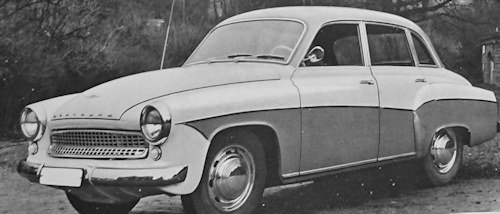 |
|
|
Production period: |
1955 to 1965 |
|
Class: |
Motor car |
|
Body versions: |
Saloon, station wagon, coupé, cabriolet, Kübelwagen, pickup |
|
Engines: |
Gasoline: 0.9-1.0 litres (27-37 kW) |
|
Length: |
4300 mm |
|
Width: |
1570 mm |
|
Height: |
1450 mm |
|
Wheelbase: |
2450 mm |
|
Curb weight: |
960 kg, from 1961: 920 kg |
The Wartburg 311 was a car of the Eisenach automobile factory, which was manufactured from 1955 to 1965.
History
The Wartburg 311 After the increase in capacity in 1962, the name Wartburg 1000 was added. Externally hardly changed, the vehicle was further produced until 1967 in a further developed variant as Wartburg 312. As sporty variants the Wartburg 313 and the Wartburg 312-300 were derived. With it called a shapely body, its functional design and variety reached the Wartburg 311 as much international recognition like no other car in the GDR. This also sold well in the non-socialist economic area and was therefore of great value for the foreign exchange procurement of the GDR. As a shortcoming was his two-stroke engine, which already fell into disrepute because of the uncultivated idle and the visible exhaust plume in his time. The obsolete, care-intensive suspension has been replaced by a new development in the Type 312. From the Wartburg 311 a total of 247,368 vehicles were produced. From the end of 1955 Wartburg 311 was developed from the IFA F9, the model created in the 1940 DKW F9 of the Auto Union was based.
The government of the GDR had decided to relocate the production of the F9 from Zwickau to Eisenach. (There, the F9 was further produced as EMW 309). Thus, the successor of the F9, the IFA F10, which had already been developed in Zwickau, was also sold to Eisenach. The frame of the F9 was extended by ten inches and received a much larger, four-door body. Honourable mention was the large, curved windows front and rear on the principle of full-view body. The trade name chosen was the name of the first motor vehicle produced by Eisenacher Fahrzeugwerke in 1898. The designation 311 as well as the following ones (313, 312, 353 and prototypes) are in BMW tradition all BMWs and EMWs produced in Eisenach had three-digit numbers, all of which started with a "3"; the F9 was led in Eisenach as "309".
The Wartburg 311 was made because of its frame construction relatively easily into different body types, also the repair of worn bodies was quite easy. On the other hand, non -self-supporting bodies were considered outdated at the time. The 1000 cc engine received in 1962 the quality label for top quality, since it is qualitatively superior in particular to the West German two-stroke engines of the Auto Union; after a mileage of 100,000 km, only the slightest complaints could be identified. Not least because of the lack of new cars, a few Wartburg 311 were scrapped in the GDR. Almost 180,000 Wartburg 311/312 units were sold domestically; of these, 127,000 were still allowed in 1985.
Highlighted the low centre of gravity and the generally very direct handling were. The intrinsically beautiful car has gained in attractiveness due to the new grill as well as the glossy synthetic resin coating. Criticized were the too stiff suspension of the leaf springs in view of the poor road condition and the poor quality of the windscreen wiper blades. In addition, the relatively high deadweight in international comparison was called for. Furthermore, the engine noise in the passenger compartment was too loud and the seats of the standard version felt tiring and criticized a tendency of the brakes to overheat and squeak.
The most important technical changes during the construction period were synchronized from 1958 gearbox and strengthened in 1961 to 40 hp engine in 1962 followed by a 991-cc bored engine, which now made 45 hp. At first were vehicles with larger engine than Wartburg 312 designates soon but we went to Wartburg 1000 on. The designation 312 was limited to the engine itself, but was picked up again in 1965 for the Wartburg 312.
Performance: 991 cc
- Engine Capacity 60.61 cu in, 991 cu cm
- Fuel Consumption: 32.4 mJimp gal, 7.0 m/US gal, 2.7 1 x 100 km:
- Max Speed: 77.6 mph, 125 km/h
- max power (SAE): 50 hp at rpm
As a visual change in all types falls on the end of 1958 changed grille, which was similar to that of the type 313. At the same time the brakes were improved. 1959/60, the suspension was a little softer and the steering smoother. Among other things, the Wartburg had now asymmetric low beam and the previously cumbersome locking the fuel cap has been greatly simplified. In addition, was central lubrication been abandoned due to lack of reliability, which is rather more magnified the problems of maintenance of outdated chassis. In 1962, a sophisticated fresh air heating system arrived. With the larger engine was from 1962 a newly developed intake silencer use, so that the intake noises during driving acoustically no longer stood out. The model 1963 fell outside on by modified tail lights, in addition, it had among other washer, new seats and mounting points for front seat belts. At the Leipzig Autumn Fair 1958, the Wartburg was shown with an elaborately designed bumper, which was not included in the series. In the engine of Wartburg 311 studies found a used fuel injection instead of a positive outcome, in the series, however, it remained at the carburettor engine.
Updates and Changes
January 2, 1956 from FgstNr. 0009/6: Standard start of production of the Wartburg 311 with a capacity of 900 cc and an output of 28 kW (37 hp) at 4000 rpm. The plant reported a top speed of 115 km / h and an average fuel consumption of 9.8 l / 100 km. Changes compared to the IFA F9 were in addition to the extended frame and the body with significantly enlarged boot a reinforced rear axle and telescopic shock absorbers and an increase in engine power by 5 hp.
From October 1955 until the end of the year, 162 vehicles were built parallel to the production of the F9.
June 6, 1957 from FgstNr. 6430/7: The previous 130- W - alternator was replaced by a 160 W version. The controller was - to protect against engine vibration - a new place on the left inner fender.
January 31, 1958 from FgstNr. 8501/8: The synchronized transmission with synchronized second, third and fourth gear has been introduced.October 15, 1958 from FgstNr. 1175/9: Improvement of the brake system: The total braking surface was increased to 920 cm²: The previous 38 mm wide brake shoes were replaced by 50 mm wide, the brake drums were also wider, which is why at the same time other wheels were introduced with a larger offset. Duplex brakes were used on the front axle.December 1, 1958 from FgstNr. 4557/9: The radiator grille was adopted from the Wartburg sports car.
July 31, 1959 from FgstNr. 21301/9: The bottom section in the rear was revised and at the same time a new screwed from the inside fuel tank was introduced.September 7, 1959 from FgstNr. 25501/9: The windscreen wiper system has been revised: stronger wiper motor, new improved transmission linkage.September 23, 1959 from FgstNr. 27501/9: In the clutch, a ball-bearing ring was used instead of the previously used graphite ring in the release bearing for better durability.November 12, 1959 from FgstNr. 603104: Introduction of softer leaf springs.December 9, 1959 from FgstNr. 605100: Asymmetric low beam was introduced.
April 5, 1960 from FgstNr. 6013356: The cable remote control of the trunk lock was replaced by a trunk lock. The hood hinges were strengthened.April 7, 1960 from FgstNr. 6013556: A new air filter with removable filter cap was introduced. In the carburettor (type H 362-18), a new main nozzle 120 was used instead of 115 previously.April 8, 1960 from FgstNr. 6013671: The unreliable central lubrication was replaced by individual grease nipples, new rack-and-pinion steering with higher gear ratios, rubber-bearing tie rod ends were introduced. A gas cap lock replaced the release of the hat rack.
1962: 992 cc engine with 45 hp: "Wartburg 1000", while replacing a conventional pump circulation cooling, and omission of the central lubrication, instead again single grease nipple.
Models
311/0 Standard Sedan:
This type made with 130,411 copies made from the main part of the production. It was usually painted in a single colour or with a colour-contrasting roof. Production began in 1955 and ended in 1965.
311/1 luxury sedan:
The luxury sedan had a number of additional features details. Externally, she was attracted by a contrasting two-colour painted with chrome strips, whose design changed several times during the construction period. Further distinguishing features of the standard sedan were trim rings of the wheels, exhaust trim, trim on the inner linings of the doors, designed as armrests door handles, cover strips on the windows, special design of the dashboard, high quality woollen upholstery cover and velour flooring, adjustable backrests, etc. From 1957 to 1965 55,660 vehicles were built.
311/2 Convertible:
The convertible was designed with two seats and four seats. The luxurious cars with real leather equipment were built in the VEB Karosseriewerk Dresden. From 1956 to 1960 2670 vehicles were manufactured. The production had to be stopped in favour of 311/3, the date from the body shop Meerane came. The following years was not an open variant in the program. The supply gap was briefly closed again for the type 312-300 HT.
311/3 Coupé:
From the bodywork Meerane the Wartburg 311 was manufactured from 1957 as a coupe, initially in an elaborate three-color paint with straight trim. In favour of the production of the Trabant P 50 Universal, the production of the coupe was relocated to Dresden in 1959. It was followed by a new design in a curved two-tone paint, which is considered very harmonious and brings the already successful body shape particularly to advantage. The large panoramic rear window was made in one piece only in the first years. By 1965, 5487 coupes were produced.
311/4 police truck (Kübelwagen):
The vehicle corresponds to a convertible in bucket construction. It remained a marginal phenomenon from 1959 to 1964, 791 pieces built.

311/5 Camping sedan with folding roof:
Contrary to the designation of the car manufactured in the Karosseriewerk Dresden this was a four-door station wagon, which was executed particularly luxurious. With the term camping sedan should apparently avoid the impression that it is a commercial vehicle - because nothing else were station wagons at the time understanding. With a large folding sunroof, side panoramic windows and seats, which could be transformed into a straight lying surface, promised the term camping not too much. The panoramic windows had, similar to the 311/3, soon soften split panes. While the first owners used the camping mostly in the intended sense, the vehicles were used in the second and third hand for purely transport purposes. The two-colour painting in its original form met with a split echo, the later variant was considered very successful. From 1956 to 1965 8362 vehicles were produced. Ultimately, the camping’s were more well-maintained than the station wagons, and after reaching the wear limit also station wagons were often rebuilt with camping-replacement cars, because they were still quite a long time as replacement parts. So it happens that the 311/9 today are much rarer than the 311/5, although the former were produced on a larger scale.
311/6 sedan, right hand steering:
For export markets with left-hand traffic, this version was built in 1961-1964 737 times.
311/7 Fast Transport Car (Pickup):
The VEB Karosseriewerke Halle comes from this pickup version of the Wartburg 311. It should help alleviate the acute shortage of vans in the GDR. In the first years until 1960, however, just 95 pieces were built. Characteristic of this extremely rare Wartburg variant is a harmonious round tail. 1961-1965, the pickups were now built-in relevant quantities, the round tail gave way to a little harmonious angular construction. However, matching trailers were also delivered. The vehicles were partially executed with fabric roof. By 1965, a total of 4938 vehicles were built.
311/8 Faltdachlimousine
Both the standard sedan and the luxury sedan were offered as 311/008 and 311/108 with large folding sunroof. This variant is very popular among vintage friends today. 14,749 vehicles were built them in the period 1956 to 1965.
311/9 Combi
As a pure transport vehicle, the Wartburg 311 in the Karosseriewerk hall was already produced in 1955 as a two-door station wagon. The vehicle had a wooden structure, initially with a roof made of plastic. In 1964, the rear end was straightened and installed a rear opening instead of hitherto side opening. Although from 1955 to 1965 at least 23,568 pieces were built, the station wagon is now almost gone.
Prototypes
- 311 / x Bellevue two-door
- 311 Convertible of the bodywork Dresden with panoramic window
- 311/1000 sliding door combination
- 313/2 Sport coupé two-door
- 314 P100 Notchback sedan four-door


