
HM Vehicles Free-way History
 |
|
|
Manufacturer |
H-M-Vehicles Inc. |
|
Production |
1979–1982 |
|
Assembly |
Burnsville, Minnesota |
|
Designer |
Dave Edmonson |
|
Class |
microcar |
|
Body style |
coupe |
|
Layout |
RMR layout |
|
Engine |
Tecumseh single-cylinder engine |
|
Transmission |
CVT, no reverse gear |
|
Length |
115 in (292 cm) |
|
Width |
53 in (135 cm) |
|
Height |
51 in (130 cm) |
|
Curb weight |
gasoline: 700 lb (318 kg |
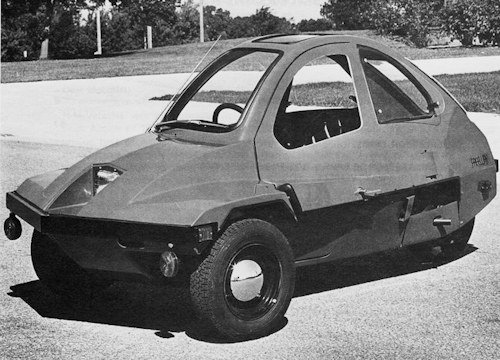
The H-M-Vehicles Free-Way was a three-wheel microcar manufactured in Burnsville, Minnesota, from 1979 to 1982.
History
The company was based in Burnsville , Minnesota . introduced in 1979 there are different names for the brand name as HM , HM Free-Way , HM Vehicles and HMV . In total, about 700 vehicles were created.
The model was a three-wheeled minicar with a single rear wheel. The Electric version had an electric motor with 6 hp . Alternatively stood cylinder - petrol engines with 340 cc displacement and 450 cc available. The closed body offered space for one person.
The H-M-Vehicles Free-Way (H-M meaning high mileage) During the 1970s Gasoline prices jumped almost 50 percent overnight causing oil prices to rise need for more fuel-efficient cars was needed. The 12 HP version was guaranteed to get 100 mpg‑ when driven at a steady 40 mph (64 km/h). The 12 HP version averaged 80 mpg‑, and the larger 16 hp averaged 60 mpg to 70 mpg. The standard fuel tank had a capacity of 3 US gallons (11 L) while a 9 US gallons (34 L) tank was optional.
These small commuter cars had a single seat and were powered by a 12 or 16 horsepower gasoline one-cylinder, air-cooled Tecumseh engine with only 345 cc 388cc, and larger 453-cc or a 4 hp electric motor. A diesel engine was offered, but none were ordered with offered, but motor was mounted behind the driver and was coupled to a snowmobile-style CVT belt drive transmission. Final drive to the rear wheel was by chain. The gasoline-powered Free-Way did not have a reverse gear in its transmission. An electrically powered reverse drive was offered as an option, but was never made available.
The Free-Way had a welded tubular steel frame, with a secondary perimeter frame at bumper height to protect the driver from impacts. Suspension was fully independent, with two wheels in front and a single wheel in the rear. With three-wheel independent suspension the fully enclosed two-piece fiberglass body was approximately 0.125 inches (3.2 mm) thick and had the colour moulded into the material and was available in three colours high-visibility red, yellow, or orange. The lower body included a full undertray to reduce the drag coefficient of the vehicle.
The Free-Way had a single headlight and per federal standards were intended to be licensed as a motorcycle, but in some states, they were titled as cars.
The basic price of the Freeway was just $1,650. About 700 Free-Ways were sold before the company closed in June 1982.

