
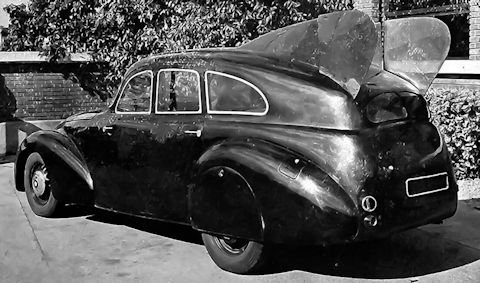
BMW Kamm K4 streamlined prototype
 |
|
|
Year: |
1939 |
|
Class: |
Prototype test car |
|
Body design: |
4 door Saloon |
|
Engine: |
Gasoline: 3.5 litres (66 kW) |
|
Length: |
5000 mm |
|
Width: |
1700 mm |
|
Height: |
1500 mm |
|
Wheelbase: |
2984 mm |
|
Empty weight: |
1500 kg |
The BMW Kamm K4 was a war time test car of the Bavarian engine works AG (BMW) from the year 1939/40 on the basis of the BMW 335.
It was similar to the test car BMW K1 of the K-Line manufactured in the year before in the 1930s a high-speed four-door sedan of luxury class with comfortable features and five full-size seats, pontoon body in streamlined form with incorporated fenders, ridge rear and 3.5 -Liter six-cylinder inline engine. The BMW K4 was from the beginning as a test car, so not designed for mass production. In 1939 and 1940 extensive test drives took place, whereby at times - as with the K1 - two large vertical air deflectors were temporarily mounted at the end of the roof. The advanced bodywork and technical innovations proved to be functional and efficient. However, even in this tempered form, the outer shape with its pontoon body, the unusual rear, the fully covered rear wheels and the temporarily mounted roof fins differed greatly from the then-production vehicles. The appearance of this model also came in the audience partly harsh criticism. The K4 therefore remained a unique piece as well. The body of the K4 was as in the test car K1
The car was not built in the BMW headquarters in Munich or in the automobile production BMW factory Eisenach (the former Dixi -Werk), but by Professor Wunibald kamm in the Research Institute of Automotive Engineering and Vehicle engines (FKFS) in Stuttgart. Special features of the K4 were similar to the K1 - its aerodynamic bodywork as well as numerous technical innovations, some of which moved into mass production only decades later.
The K4 was the fourth workable result of the work of the FKFS and Kamm and after the K1 the second test car based on the "big" BMW 335. In between, the models K2 and K3 were on the chassis of the smaller and lighter Mercedes-Benz 170 V, with the K2 was similar to the extremely aerodynamically shaped K1, while the K3 similar to the K4 was designed a little more conservative.
The BMW K4 carries, unlike the intended for mass production BMW pre-war cars from 1933 starting with the model 303 (1933-1934), no model name with three digits and a "3" at the beginning. Like many later concept vehicles, this received a model designation with a letter and a one-digit number. The K stands for "comb-wagon" and "comb-tail", the 4 for the fourth vehicle of this series of the FKFS.
The most striking feature of the BMW K4 is its unusual, aerodynamically sophisticated body with yet very spacious and comfortable interior. The low drag coefficient was achieved through a streamlined pontoon body with sash profile and fenders, a relatively round and low-pulled front with fitted flush headlamps, fully panelled rear wheel wells and a smooth, cased underbody. Another detail was the four-segment windscreen with only rounded side elements, as curved glass was still expensive and unusual. In addition, there were relatively smooth body side panels and flush-fitted front, rear and side windows. Of particular importance was the relatively long, gently sloping hatchback with gently retracted side panels and relatively straight-cut rear end.
Unlike the K1, the K4 wore the usual on other models since 1933 BMW kidney grill. Equally typical was the arrangement of the four doors, as they had already proven on the Model 326: the front doors were hinged behind (so-called " suicide doors "). The doors were thus in opposite directions, the door hinges each attached to the B-pillar .The two large vertical tail fins, which were temporarily mounted on the roof of the K4 , should conduct the air flow above the roof and behind the vehicle a cheap test fitment; in practice, the advantages of the fins as with the K1 - proved to be too low, since they also deteriorated the crosswind stability and straight-line stability . Since the test drives took place during the Second World War, had the large round headlights usually the war-typical headlight panels, which let out the light only through a narrow slot the front and side windows were relatively steep and allowed a spacious interior. In the rear was a large, accessible from the outside trunk. The interior was complex and comfortable. Due to the bulkier body compared to the original model BMW 335 and the elaborate interior, the weight of the K4 with about 1500 kilograms was relatively high and significantly higher than that of the standard 335.
The design body was built in 1940 according to the plans Kamm’s and FKFS of the Stuttgart bodywork Reutter & Co. GmbH. is known, the company mainly through the manufacture of automobile bodies for Porsche (before and after the Second World War). It was one of the last civilian vehicles before only military or military vehicles were produced in Germany due to the Second World War .
The BMW K4 had - like the K1 - a pre-production chassis of the model 335 thus also a box frame with a front suspension from upper arms and a transverse leaf spring below and a track width of 1306 millimetres. Rear he had a rigid axle with two longitudinal spring bars and a gauge of 1404 millimetres. The wheelbase was 2984 millimetres. Fitted with rack and pinion steering as well as hydraulically operated internal drum-drum brakes on all four wheels with cable-operated handbrake on the rear wheels. The innovative feature was a tire pressure regulating system, which made it possible to increase the tire pressure from the dashboard while driving and thereby reduce the rolling resistance of the tires something only seen today. The car was later seized from a Stuttgart research base at the end of World War 2.
Engine and Transmission
The BMW K4 was as the K1 - with the newly designed engine of the 335 provided, so a water-cooled six-cylinder four-stroke engine with 3485 cc capacity and long-stroke design (bore 82 mm, 110 mm stroke). With a compression ratio of 1: 5.8 two double carburettors equipped gave the motor 66 kW / 90 hp at 3500 rpm. The power transmission took place in the usual way by single-disc dry clutch on a manual four-speed transmission with rear-wheel drive. A special overdrive enabled the engine speed to be reduced at higher speeds, further reducing fuel consumption.

