
Brabham BT19 F1 Race car
|
|
|
|
Manufacturer: |
Brabham |
|
Production period: |
1966 |
|
Class: |
Race car |
|
Body versions: |
Single seat open |
|
Engines: |
V8 |
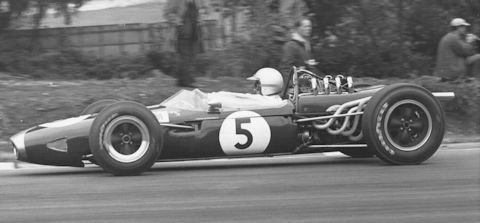
The Brabham BT19 was a Formula racing car that Brabham built in the mid-1960s. The name BT stood for the surnames of Jack Brabham and Ron Tauranac, the two constructors. In 1966 it was driven by Jack Brabham, who became the first driver to win a world championship Grand Prix in a car bearing his own name with an engine producing barely 300 bhp thought by its high budget competitors could not possibly compete with them.
The BT19 was a remarkable one-off, hastily adapted for the first season of racing under the 3 litre Formula 1. Coventry Climax announced during 1964-65 that they would not be building a new engine for the three-litre Grand Prix Formula proposed for 1966. This move left such British specialist constructors as Lotus, Brabham and Cooper out on a limb.
Lotus had Cosworth Engineering build them an engine with Ford money; Cooper turned to Maserati in Italy, who wheeled out a three-litre version of their age-old 2.5-litre V 12 engine of 1957.
Brabham looked to his native Australia and the Repco specialist performance equipment company there, who had helped fund his production racing car company upon its inception in 1961/62. Repco, had devised a racing V8 on the basis of an Oldsmobile unit Repco's Chief Engineer Frank Hallam and Project Engineer Phil Irving were instructed to produce a new engine to fit into the existing Repco Brabharn chassis The BT19 chassis was a typically practical Tauranac spaceframe design, its well-triangulated tubular frame unusual in that it used oval-section tubing. Suspension was with unequal-length wishbones at the front, comprising a transverse link and trailing radius rod at the top and a one-piece tubular wishbone at the bottom modified Triumph Alford and Alder uprights while the rear suspension employed single top links, reversed lower wishbones and twin radius rods which located cast uprights. Outboard spring/damper units were fitted all-round and Hewland's HD gearbox to its rear Goodyear tyres.
They took a very simple Oldsmobile 1785 production V 8 engine with an alloy block a linerless aluminium engine programme meant for a .Buick "compact" based round the General Motors Oldsmobile F85 cylinder block rather than a totally new and developed it extensively for Formula 1 use. It offered a maximum 315 bhp at 7250rpm from 88.9 mm x 60.325 mm cylinders, and displacing 2995-7 cc, there was a single overhead camshaft per bank. Installed in a very light and practical spaceframe chassis designed by Brabham's associate Ron Tauranac, this was to prove sufficient.
The chassis used originally had been laid down for a still-born flat-sixteen-cylinder 1.5-litre Climax engine in 1965, and it was quickly adapted to accept the new Repco engine. Running against H 16 BRM, V12 Ferrari, V 12 Eagle-Weslake, V 12 Maserati and ultimately V 8 Cosworth-Ford engines, this unit did amazingly well.
Jack Brabham's BT19 won the 1966 French Grand Prix and then won the British, Dutch and German Grands Prix consecutively, clinching the World Championship titles for himself and for his cars along with the BT22 In 1967 Ron Tauranac did 'a proper job' BT 24 car with which Denny Hulme won the Drivers' title, pipping his team-leader, who was content that his marque was for the second successive year Champion of the World.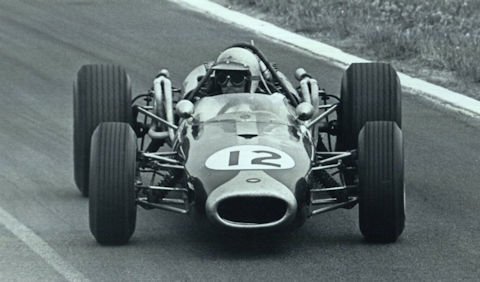
Related
Technical
-
Dimensions:
wheelbase, 92 in (234 cm);
track, front 53.5 in (136 cm); rear, 55 in(140 cm).
Engine:
90 degree V8
88.9 x 60.3 mm
2996cc; sohc
max power, 285-300 bhp at 7800rpm.
Max speed. depending on circuit and geanng, up to 165 mph (265 kmh).
Transmission
five-speed manual gearbox.
Suspension:
independent; front, double wishbones, coil spring/damper units
rear, top links, lower wishbones, radius arms, coil spring/damper units.

