
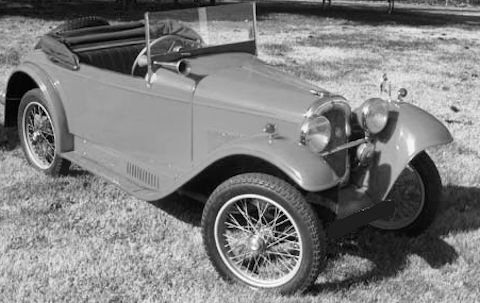
Aero 18
 |
|
|
Production period: |
1931 to 1934 |
|
Class : |
small car |
|
Body versions : |
Various |
|
Engines: |
Petrol 662-998cc |
|
Length: |
3200 mm |
|
Width: |
1190 mm |
|
Height: |
1460 mm |
|
Wheelbase : |
2230 mm |
|
Curb weight : |
500-700 kg |
The Aero 18 (also Aero 662 ) was a Czechoslovakian automobile from the 1930s that Aero built from 1931 to 1934.
Like its predecessor, the Aero 18 was called because of the typical noise of the manual starter "Cinkac" or "Cililink".A 662cc two-cylinder model
followed in 1931,motor size was increased enlarged to 998cc in 1932. The two-cylinder two-stroke engine had a capacity of 662 cc and made 18 hp. With rear-wheel drive and three-speed transmission, the car reached a top speed of around 80 km / h. The fuel consumption was 6 l / 100 km.
From the end of 1931, the car was provided with a second door on the driver's side. With the introduction of the Aero 20 in 1933, the Aero 18 also received front brakes. In 1934, the model was also revised externally front-wheel drive was adopted in a new series of Aeros, designed by Basek. They were low and handsome cars, whose length of bonnet belied their small engine capacity, which was still only 998cc.
A total of 2583 copies were built.
Long distance runs
Also František Alexander Elstner undertook a long-distance journey with the Aero 18 again. So the second SPEXOR expedition took place in 1933 with Aero models. It drove three vehicles more than 13,500 km across Italy to the Libyan Murzuk and then via Tunisia, Algeria and Morocco to Spain, from where it went back to Prague.

