
About
Technical
-
2 Litre DOHC 16V
110kW-147hp-150PS
Fuel Injection
Valves in V 46deg. 4 valves per cylinder
2 overhead camshafts (toothed belt)
oil capacity 4.5L (4.3US qt)
electronic Bosch Motronic M 25 fuel injection
Battery 12V 44Ah
alternator 55A
cooling system capacity approx 6.9L (6.5US qt)
Engine data (Catalyst, DIN):
4—cylinder in—line (86 x 88mm)
1998cm3
compression ratio 10.5:1
110kW (147hp) [150PS] at 6000rpm, 55.1kW/L (73.8hp/L)
196Nm (144.61bft) at 4800rpm
unleaded premium grade.without Catalyst:
115kW (154hp) [156PS]; N3Nm (149.81bft);
leaded premium grade.
Body, Weight:
vehicle weight 1490kg.Transmission:
5—speed manual
final drive ratio 3.42
Gear ratios: 1st 3.55; 2nd 216; 3rd 1.48; 4th 1.12; 5th 0.89; R 3.33.Chassis brakes:
Front disc brakes ventilated
diameter front 3.6cm, rear 23.6cm
tyres 185/65VR 14, wheel rims 5.5J.Data C20NE engine
Design: R4
Valve control: overhead camshaft with toothed belt drive
Number of valves: 8
Stroke × bore (mm): 86.0 × 86.0
Displacement (cm³): 1998
Power (kW / hp at 1 / min): 85/115 at 5,400
Torque (Nm at 1 / min): 170 / 3,000
Compaction: 9.2: 1
Engine management: Bosch Motronic ML 4.1, from model year 1990: Bosch Motronic M 1.5
Exhaust gas purification: Regulated three-way catalytic converter
Data C20XE engine
Design: R4
Valve control: Two overhead toothed belt driven camshafts
Number of valves: 16
Stroke × bore (mm): 86.0 × 86.0
Displacement (cm³): 1998
Power (kW / hp at 1 / min): 110/150 at 6,000
Torque (Nm at 1 / min): 196 / 4,800, from model year 1993: 196 / 4,600
Compaction: 10.5: 1
Engine management: Bosch Motronic M 2.5, from model year 1993: Bosch Motronic M 2.8
Exhaust gas purification: Regulated three-way catalytic converter
Note: Full Specifications and Service Repair Manuals available for registered users
© Motor-car.net
Manuals
Vauxhall Opel GSi (Kadett E-Vauxhall Astra)
|
|
|
|
Make |
Opel |
|
Production |
1987 to 1993 |
|
Class |
Sports car |
|
Body style |
3 and 5-door hatchback 2 door convertible |
|
Layout |
Transverse front-engine, front-wheel drive |
|
Platform |
T-platform |
|
Engine |
petrol: 1796 cc Family II I4 1998 cc Family II I4 |
|
Transmission |
5-speed manual |
|
Wheelbase |
2,520 mm (99.2 in) |
|
Length |
4,256 mm (167.6 in) |
|
Width |
1,662 mm (65.4 in) |
|
Height |
1,393 mm (54.8 in) |
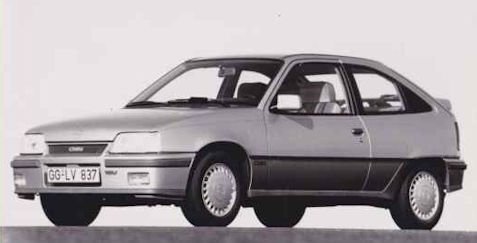
The Opel Kadett E GSi was initially offered only as a hatchback and from 1987 as a convertible and for the UK Market as the Vauxhall Astra GSI. This was initially sold with a 1.8-liter gasoline engine (internal code: 18E) with 85 kW / 115 hp without catalyst. From 1986 this was also offered with the 74kW / 100PS engine C18NE. For the model year 1987 accounted for the 1.8-liter engines and were equipped by two different 2.0-liter engines (C20NE with catalyst 85kW / 115PS and 20SEH without catalytic converter 95kw / 129PS).
The Kadet GSi has gas shock absorbers and compared to the other models tighter and shorter by about 15 mm springs. The engines of the Kadett GSi have an oil cooler with thermostat . The cadet GSi was delivered on request with anti-lock braking system and power steering . The version without power steering has a steering damper . On the front axle, the Opel Kadett GSi is equipped with ventilated disc brakes.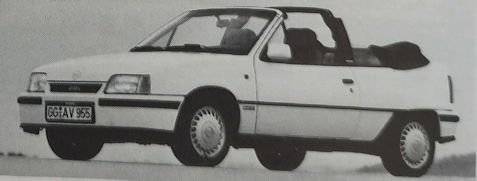
Plastic side panels are attached to the side sills. The side protection strips are narrower, ventilation elements have been integrated into the bonnet, and the rear lights have been darkened by recessed plastic strips. In addition, the rear fog lamp is located in the rear bumper, so the GSi cadet has two reversing lights. The rear wiper was moved due to the rear spoiler and driven by a hole in the rear window. In addition to the B-pillars, the tailgate between the taillights is covered with black foil. The Opel emblems are mounted on the bonnet and on the tailgate as a foil. These measures differentiate the GSi variant externally from the basic models.
safety areas of development result is a strong cabin safety cell, with energy absorbing crumple Zones front and rear and twin side-impact bars in each door. GSi also benefits from our sophisticated Body- lock restraint system. Taking just 22 milli-seconds to react in the event of a frontal impact, this seat belt tensioner can take as much as 160mm of slack out of each front belt, substantially reducing the chance of head or chest injury compared with conventional inertia reel bell systems. 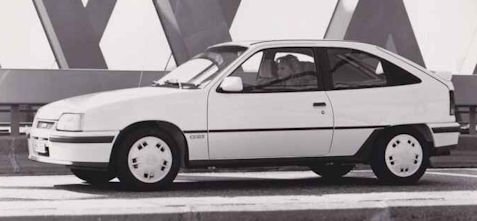
Accessories were electric windows, electrically adjustable and heated mirrors and an on-board computer available. The on-board computer displays the current consumption, tank range, average speed, average consumption, stopwatch and time. In the interior, the cadet GSi also differs among other things by sports seats, LCD instruments, three-spoke steering wheel with GSi emblem, check control system in the upper part of the dashboard, also by modified seat covers and two reading lights and door panels from the basic models. As a special extra, there were on request with Conolly leather-covered seats and side panels.
In the three-door hatchback version of the GSi achieved a drag coefficient of only 0.30, which was then achieved in the compact class of any other vehicle (Golf II GTI: 0.37). This value is also proof that the wind tunnel-tested spoiler of the GSi variant was not only an optical target, but a function, significantly reducing lift .
Cadet GSi 16V
The Kadet GSi 16V came on the market in spring 1988 and is the first Opel mass production model with four valves per cylinder. 2.0 litre 16v engine offers incredible snap-throttle response. 150PS of surging power and 196Nm of heavyweight torque maximum available all the way from 3300rpm to 6000rpm. it carries forged pistons sodium cooled exhaust valves, twin chill-cast overhead cams with aggressive profiles, an aluminium head with polished ports and a tubular stainless steel exhaust manifold. The special feature of the engine used (internal identifier: C20XE for the variants with regulated catalyst) is the joint development of the very elaborately designed cylinder head with Cosworth in England. The engine has in contrast to the GSi 8V 2.0 l (C20NE) a manifold and a knock control . Compared to the C20NE, the intake manifold is also much more elaborate.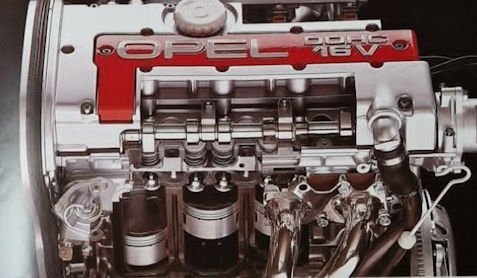
The Kadet GSi 16V is adapted in many ways to the performance of the engine. So, the rear axle was equipped with disc brakes (two-piston fixed calliper) instead of drum brakes. In addition, reinforced stabilizers are used, along with additional stabilizer on the rear axle. In the bodywork area, the 16V cad has a continuous centre cross member at the front and a flatter lower cross member at the front, which accommodates the slightly narrower but higher radiator. In addition, the wheel arches are reinforced in the upper area at the transition to the A-pillar. There are also modifications in the area of the steering and chassis. The five-speed manual transmission (F20) of the Kadett 16V was also adapted to the performance of the engine. The body had a C wvalue of 0.30 and a face of 2.03 m 2, giving a very good drag index of 0.61.
The interior differs by another shift knob (leather) and the 16V emblem on the steering wheel of the GSi 2.0. Externally, the cadet GSi 16V of the cadet GSi is distinguished by a 16V sign on the front bumper and on the tailgate. He also has a rear silencer with rectangular double tailpipes.
The special model Kadett GSi Champion, which was available as the series GSi with the 2.0i 8V (C20NE), as well as with the 2.0i 16V (C20XE), was offered from April 1990. Initially, it was only three-door available and had a standard British Connolly leather interior with leather seats by Recaro and leather-covered door panels. With the beginning of the model year 1991 in September 1990, the special model champion was no longer available only as a three-door, but also as a five-door. For all the champions, there was now a velour finish ex-factory. The still available only for the three-door cadet GSi Champion leather equipment. However, the five-door GSi could be ordered with a leather interior, but not for the five-door special model champion. Only the five-door base model GSi could be equipped with leather. This cost the five-door GSi 16V without further extras already about 40,000 DM. The five-door variant with full equipment in its original condition is therefore a rarity today, not least because the five-door was sold much less often than the three-door. Also standard in the cadet GSi Champion were the 15-inch alloy wheels with cross spokes with 185/55 R15 tires. It was except the cadet convertible The five-door variant with full equipment in original condition is therefore a rarity today, not least because the five-door was sold much less often than the three-door. Also standard in the cadet GSi Champion were the 15-inch alloy wheels with cross spokes with 185/55 R15 tires. It was except the cadet convertible The five-door variant with full equipment in original condition is therefore a rarity today, not least because the five-door was sold much less often than the three-door. Also standard in the cadet GSi Champion were the 15-inch alloy wheels with cross spokes with 185/55 R15 tires. The factory specifications for the cadet GSi
Performance:
16V were 7.9 s for the acceleration from 0 to 100 km / h and 217 km / h top speed.
Max speed 135mph/217kmh
acceleration O — 62mph/100kmh 8.0secs
power to weight ratio from 9.2kg'kW (6.7kg"PS)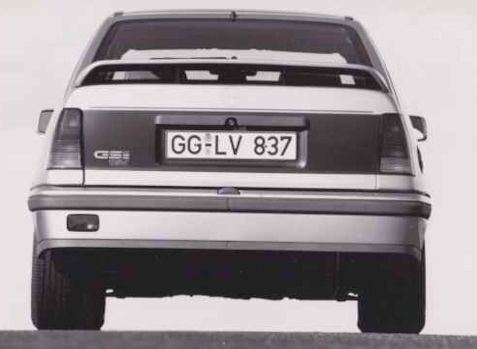
|
Featured
|
|
