
About
Technical
-
DIMENSIONS AND WEIGHT : 4 door hardtop
wheel base: 120 in, 3,048 mm
front track: 62.10 in, 1,577 mm
rear track: 60.70 in, 1,542 mm
overall length: 214.50 in, 5,448 mm
overall width: 79.60 in, 2,022 mm
overall height: 55.10 in, 1,400 mm
ground clearance: 6.10 in, 155 mm
dry weight: 3,760 1b, 1,705 kg
distribution of weight: 50.8%front axle, 49.2% rear axleENGINE : 318 cu in
front. 4 stroke; cylinders: 8, in line
bore and stroke: 3.91 x 3.31 in, 99.3 x 84.1 mm
engine capacity: 318 cu in, 5,211.07 cu cm
compression ratio: 9.2
cylinder block: cast iron
cylinder head: cast iron
crankshaft bearings: 5
valves: 2 per cylinder, overhead, in line, push-rods and rockers, hydraulic tappets
camshafts: 1, at centre of Vee
lubrication: rotary pump, full flow filter
lubricating system capacity: 8.27 imp pt,10 US pt. 4.7 1
carburation: 1 Carter BBD-4607 S downdraught twin barrel carburettor
fuel feed: mechanical pump
cooling system: waterTRANSMISSION
driving wheels: rear
clutch: single dry plate
gearbox: mechanical; gears: 3 + reverse
synchromesh gears: II and III
gearbox ratios: I 3.020,II 1.760, III 1, rev 3.950
gear lever: steering column
final drive: hypoid bevel
axle ratio: 3.230.CHASSIS
integral
Front suspension: independent, wishbones, lower trailing links, longitudinal torsion bars, telescopic dampers
rear suspension: rigid axle,semi-elliptic leafsprings, telescopic dampers.STEERING
recirculating ball
turns of steering wheel lock to lock: 5.80.
turning circle (between walls): 45.8 ft. 14 mBRAKES
drum, dual circuit
area rubbed by linings: total 328.30 sq in, 2,117.53 sq cm.ELECTRICAL EQUIPMENT
voltage: 12 V
battery: 59 Ah
generator type: alternator 37 Ah
ignition distributor: Chrysler
headlamps: 4, iodine.Note:
All engines and full specifications available for registered users© Motor-car.net
Service
-
gearbox oil; 4.92 imp pt, 6 US pt. 2.8 1, AQ-ATF Suffix A, change every 32,000 miles, 51,500 km
final drive oil: 3.34 imp pt. 4 US pt, 1.9 1, SAE 75 80 90,change every 32,000 miles. 51,500 km
greasing: every 32,000 miles, 51,500 km
normal tyre pressure: front 30 psi, 2.1 atm,rear 30 psi, 2.1 atm.
width of rims: 5"
tyres: 7.75 x 15
fuel tank capacity: 20 imp gal, 24 US gal
carrying capacity: 1,058 1b, 480 kg
318 cu in
fuel: 100 oct petrol
engine sump oil: 6.69 imp pt, 8 US pt, 3.8 1, SAE 5W-20 (winter) 20W-40 (summer), change every 4,000 miles,6,400 km
cooling system capacity: 26.58 imp pt. 32 US pt, 15.1 1.
valve timing : inlet opens 10° before tdc and closes 50° after bdc, exhaust opens 58° before bdc and closes 10° after tdc
Note: Full Specifications and Service Repair Manuals available for registered users
© Motor-car.net
Manuals
Plymouth Fury 5th generation
 |
|
|
Class |
Motor Car |
|
Model years |
1969 to 1973 |
|
Body style |
2-door hardtop |
|
Platform |
C-body |
|
Related |
Dodge Phoenix (Australia) |
|
Engine |
225 cu in (3.7 L) RG I6 |
|
Wheelbase |
120.0 in (3,048 mm) |
|
Overall length |
214.50 in, 5,448 mm (4-door hardtop) |
|
Overall width |
79.60 in, 2,022 mm (4-door hardtop) |
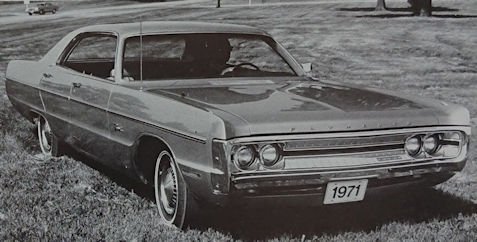
For model year 1969, the Fury received a new body like all top models of the Chrysler Group with unchanged technical base. This followed the design concept by Elwood Engel, which was also used in sister models with the 120-inch wheelbase for passenger cars and 122 for wagons.
A special feature of the body design was convex shape. The waistline was exceptionally high compared to previous models and also to the vehicles of other manufacturers; This emphasized the sheet metal parts of the fenders and doors. In comparison, the dimensions of the glass surfaces were reduced. The side windows were also slightly arched. As with an aircraft fuselage. The bumpers were integrated into the front and rear of the body.
The basic structure of the Fury body corresponded to those of the sister models; Some sheet metal and glass parts were interchangeable. However, the front of the Fury was independent. The twin headlights were now arranged horizontally and were embedded in a simple radiator grille. The front bumpers were - unlike the models of the Chrysler brand - designed for 1969 not yet circulating. top model was a two-door hardtop or as a four-door "VIP" or the Sport Fury.
For the 1970 model year, the front bumper now edged to the front grille, as did the full-size Dodge and Chrysler models. The basic models also had horizontally arranged double headlights; in the Gran Coupe model and in the higher-end Sport Fury version, the headlamps were concealed behind electrically operated flaps whose exterior continued the pattern of the radiator grille. The VIP was no longer available in 1970. Top model was the Sport Fury and the sport-oriented Sport Fury GT; the latter was only available as a two-door hardtop. For the model year 1971, only a few revisions were made to the styling. The radiator grille now had a horizontal slot running the full width,
For model year 1972 Plymouth revised the body of the Fury. The flanks had no horizontal beads and the front bumper now had the shape of two chrome-plated loops, which were separated in the middle by a metal bridge. In these loops, the headlights were embedded, which in turn were hidden behind a flap in the higher-quality versions. This design, which reminded some observers of a pair of glasses, found only at Plymouth; other group brands did not take over. It was only offered in this model year. The top models of the series were the "Gran Coupe" (a two-door hardtop) and the "Gran Sedan" (a four-door hardtop).
For 1973, the Fury again received a new, this time more conventional front end: It had for the first time prescribed for this model year heavy safety bumpers, which could not be integrated into the body as before, and dual headlights, which were embedded in a metal front mask.
The Fury series initially included a two-door convertible, two and four-door sedan with B-pillar, a two-door hardtop coupe, and a four-door hardtop. In addition, the large station wagons under the name "Suburban" . Fury models from the same year with six or nine seats were available. From 1971 Not all body versions were available in all trim levels.
Equipment levels
Plymouth's full-size range of models again consisted of the Fury I, Fury II, Fury III and Sport Fury ranges.
The Fury I was available throughout the production period as a four-door sedan with fixed B-pillar, until 1971, there was also a two-door sedan. Station wagons were not offered in this equipment line. He was first and foremost a fleet vehicle.
The Fury I series contains the only full-size 2-door pillar sedan on the U.S. market along with the Sport Fury GT with the optional large 440 Six-Pack engine.
The Fury II was initially offered only as a two- and four-door sedan with centre column; From 1971, combined versions with six and nine seats were added. Fury II is limited to a 2-door hardtop with the less formal roofline and a 4-door pillar sedan, while the Sport Fury GT comes in 2-door hard- top form only.
In the Fury III most body versions were offered: as a convertible, in both coupe versions, as a four-door sedan and (from 1971) as a station wagon. The convertible was discontinued at the end of the model year 1970.
Fury III and Sport Fury are the only full-line series, giving a choice of two types of 2-door hard- tops, a 4-door sedan and a 4-door hardtop plus equivalent 2-and 3-seat wagons.
The produced until 1972 Sport Fury there was 1969 only as a coupe, from 1970 then as a four-door sedan with and without mullion and from 1971 finally even as station wagon.
In 1969, the VIP was once again on offer; this version was eliminated at the beginning of the model year 1970. As a replacement, the model Fury Gran Coupe was introduced, which was a luxurious, almost completely equipped version of the Fury. In 1972, the Fury Gran Sedan was added.
From 1970, the model range was gradually thinned out. From 1970 onwards, the VIP and the Sport Fury were from now on again the top model of the series. However, a new addition was the Sport Fury GT with a more powerful engine. The convertible was from 1971 no longer available, 1972 accounted for some engine options, so that only eight-cylinder engines were available. The Sport Fury accounted for the new top model was the Gran Fury , which became an independent model from 1975.
The GT and all wagons have as standard the 318-cubic-inch, 230-hp V-8. The GT uses the detuned 440 with 335 hp. The Six- Pack which is restricted to the GT. A manual 3-speed transmission is standard with engines up to and including the 383 2-barrel, and the automatic is standard thereafter.
Engine Performance : 318 cu in
Engine capacity: 318 cu in, S,211.07 cu cm
Fuel consumption: 16.6 m/imp gal, 13.8 m/US gal, 17 1 x 100 km
Max speed: 106 mph, 170.7 km/h
max speeds: 39 mph, 62.8 km/h in 1st gear; 66 mph, 106.3 km/h in 2nd gear; 106 mph, 170.7 km/h in 3rd gear
power-weight ratio: 16.3 lb/hp, 7.4 kg/hp
max power (SAE): 230 hp at 4.400 rpm
max torque (SAE): 340 1b ft, 46.9 kg m at 2,400 rpm
max engine rpm: 4,800
specific power: 44.1 hp/l
Engines
225 CID (3682 cc) Slant-Six (1969-1971)
318 CID (5210 cc) LA Series V8 (1969-1973)
360 CID (5898 cc) LA Series V8 (1971-1973)
383 CID (6286 cc) B-Series V8 (1969-1971)
400 CID (6561 cc) B-Series V8 (1972-1973)
440 CID (7206 cc) B-Series V8 (1969-1973)
Some options
limited slip final drive; 3.550,axle ratio; power-assisted steering, 3.50 turns of steering wheel lock to lock; front ,disc brakes (diameter 11.75 in, 298 mm), internal servo brake; 8.25 x 15 8.55 x 15 G70 x 15 G78 x 15 H18 x 15 tyres; Torqueflite automatic gearbox; 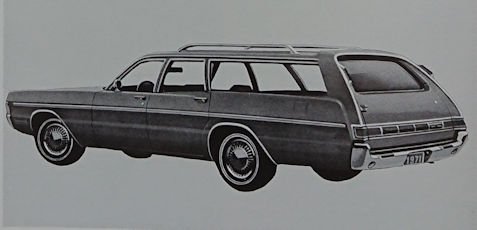
|
Featured
|
|
