
About
Technical
-
Technical data
Opel record:
1,7 N
1.9 N
2,0 N
2,0 S
Engine:
4-cylinder in-line engine (four-stroke)
displacement:
1698 cc
1897 cm³
1979 cm³
Bore × stroke:
88 × 69.8 mm
93 × 69.8 mm
95 × 69.8 mm
Power at 1 / min:
44 kW
(60 hp)
at 480055 kW (75 hp)
at 480066 kW
(90 hp)
at 520074 kW (100 hp)
at 5200Max. Torque at 1 / min:
112 Nm at 2600
132 Nm at 2800
142 Nm at 3400
165 Nm at 3600
Compression:
8.0: 1
7,9: 1
8.0: 1
9.0: 1
Fuel supply:
1 downdraft carburettor
1 register downdraft carburettor
Valve control:
Hanging valves, hydraulic tappets and rocker arms (overhead camshaft, duplex chain)
Cooling:
water cooling
Transmission:
4-speed gearbox, stick control (a.W (except 1,7 N) three-speed automatic (Opel))
Front suspension:
MacPherson struts, tie rods, coil springs
Rear suspension:
Rigid axle on four trailing links and Panhard rod, coil springs
Body:
Sheet steel, self-supporting
Track front / rear:
1435/1412 mm
Wheelbase:
2668 mm
Length:
4620 mm
Empty weight:
1145-1370 kg
maximum speed:
143 km / h
147-152 km / h
157-162 km / h
165-170 km / h
0-100 km / h:
21.5 s
17,5-19 s
15-16.5 s
13.5-15 s
Consumption (liters / 100 kilometers):
12.0 N
12-13,0 N
12.5-13.5 N
12.5-13.5 s
Opel record:
2.0 E
2.2 i
2,3 D
2,3 TD
Engine:
4-cylinder in-line engine (four-stroke)
displacement:
1979 cm³
2197 cc
2260 cc
Bore × stroke:
95 × 69.8 mm
95 × 77.5 mm
92 × 85 mm
Power at 1 / min:
81 kW (110 hp)
at 540085 kW
(115 hp)
at 480048-52 kW
(65-73 hp)
at 4200-440063 kW
(86 hp)
at 4200Max. Torque at 1 / min:
162 Nm at 3000
178 Nm at 2800
126-132 Nm at 2400-2500
185 Nm at 2200
Compression:
9.4: 1
22.0: 1
23.0: 1
Fuel supply:
electronic injection (Bosch LE-Jetronic)
Bosch diesel distributor pump
Valve control:
Hanging valves, hydraulic tappets (overhead camshaft, duplex chain)
Cooling:
water cooling
Transmission:
4- or 5-speed gearbox, mid-range
(a.W (except 1.8 N) three-speed automatic (Opel))5-speed transmission, middle shift
Front suspension:
MacPherson struts, tie rods, coil springs
Rear suspension:
Rigid axle on four trailing links and Panhard rod, coil springs
brakes:
Disc brakes front, Ø 244 mm, drums
Body:
Sheet steel, self-supporting
Track front / rear:
1435/1412 mm
Wheelbase:
2668 mm
Length:
4652 mm
Empty weight:
1140-1305 kg
maximum speed:
175-181 km / h
180-187 km / h
145-153 km / h
165 km / h
0-100 km / h:
13-14.5 s
12-13 s
22-28 s
16 s
Consumption (liters / 100 kilometers):
12.5-13.5 s
12.5-13.5 s
10.5-11.0 D
10.0 D
Technical data
Opel record:
1,7 N
1.9 N
2,0 N
2,0 S
2.0 E
2.1 D
2,3 D
Engine:
4-cylinder in-line engine (four-stroke)
displacement:
1698 cc
1897 cm³
1979 cm³
2068 cc
2260 cc
Bore × stroke:
88 × 69.8 mm
93 × 69.8 mm
95 × 69.8 mm
88 × 85 mm
92 × 85 mm
Power at 1 / min:
44 kW
(60 hp)
at 480055 kW (75 hp)
at 480066 kW
(90 hp)
at 520074 kW (100 hp)
at 520081 kW (110 hp)
at 540044 kW
(60 hp)
at 400048 kW
(65 hp)
at 4200Max. Torque at 1 / min:
112 Nm at 2600
132 Nm at 2800
142 Nm at 3400
165 Nm at 3600
159 Nm at 3000
118 Nm at 2500
126 Nm at 2500
Compression:
8.0: 1
7,9: 1
8.0: 1
9.0: 1
9.4: 1
22.0: 1
22.0: 1
Fuel supply:
1 downdraft carburettor
1 register downdraft carburettor
electronic injection (Bosch L-, from model year '82 LE-Jetronic)
Bosch diesel injection pump
Valve control:
Hanging valves, hydraulic tappets and rocker arms (overhead camshaft, duplex chain)
Cooling:
water cooling
Transmission:
4-speed gearbox, stick control (a.W (except 1,7 N) three-speed automatic (Opel))
Front suspension:
MacPherson struts, tie rods, coil springs
Rear suspension:
Rigid axle on four trailing links and Panhard rod, coil springs
Body:
Sheet steel, self-supporting
Track front / rear:
1435/1412 mm
Wheelbase:
2668 mm
Length:
4620 mm
Empty weight:
1145-1370 kg
maximum speed:
143 km / h
147-152 km / h
157-162 km / h
165-170 km / h
171-176 km / h
130-135 km / h
132-137 km / h
0-100 km / h:
21.5 s
17,5-19 s
15-16.5 s
13.5-15 s
13-14.5 s
26.5-31.5 s
25-29 s
Consumption (liters / 100 kilometers):
12.0 N
12-13,0 N
12.5-13.5 N
12.5-13.5 s
12.5-13.5 s
10,0-10,5 D
10.5-11.0 D
Technical data
Opel record:
1.8 N
1.8 s
1.8 i cat
2,0 S
2.0 E
2.2 i
2,3 D
2,3 TD
Engine:
4-cylinder in-line engine (four-stroke)
displacement:
1796 cm³
1979 cm³
2197 cc
2260 cc
Bore × stroke:
84.8 × 79.5 mm
95 × 69.8 mm
95 × 77.5 mm
92 × 85 mm
Power at 1 / min:
55 kW
(75 hp)
at 540066 kW (90 hp)
at 540074 kW
(100 hp)
at 560074 kW (100 hp)
at 520081 kW (110 hp)
at 540085 kW
(115 hp)
at 480048-52 kW
(65-73 hp)
at 4200-440063 kW
(86 hp)
at 4200Max. Torque at 1 / min:
132 Nm at 3000
140 Nm at 3200
137 Nm at 3000
156 Nm at 3800
162 Nm at 3000
178 Nm at 2800
126-132 Nm at 2400-2500
185 Nm at 2200
Compression:
8.2: 1
9.2: 1
8.9: 1
9.0: 1
9.4: 1
22.0: 1
23.0: 1
Fuel supply:
1 downdraft carburetor
1 register downdraft carburetor
electronic injection (Bosch LE-Jetronic)
1 register downdraft carburetor
electronic injection (Bosch LE-Jetronic)
Bosch diesel distributor pump
Valve control:
Hanging valves, hydraulic tappets (overhead camshaft, timing belt)
Hanging valves, hydraulic tappets (overhead camshaft, duplex chain)
Cooling:
water cooling
Transmission:
4- or 5-speed gearbox, mid-range
(a.W (except 1.8 N) three-speed automatic (Opel))5-speed transmission, middle shift
Front suspension:
MacPherson struts, tie rods, coil springs
Rear suspension:
Rigid axle on four trailing links and Panhard rod, coil springs
brakes:
Disc brakes front, Ø 244 mm, drums
Body:
Sheet steel, self-supporting
Track front / rear:
1435/1412 mm
Wheelbase:
2668 mm
Length:
4652 mm
Empty weight:
1140-1305 kg
maximum speed:
154 km / h
160-165 km / h
167-177 km / h
169-175 km / h
175-181 km / h
180-187 km / h
145-153 km / h
165 km / h
0-100 km / h:
17,5 s
15-16.5 s
14-15.5 s
13.5-15 s
13-14.5 s
12-13 s
22-28 s
16 s
Consumption (liters / 100 kilometers):
12.5 N
12.5-13.5 s
13.0-14.5 s
12.5-13.5 s
12.5-13.5 s
12.5-13.5 s
10.5-11.0 D
10.0 D
Manuals
Opel Rekord E
 |
|
|
Production period: |
1977 to 1986 |
|
Class: |
Motor car |
|
Body versions: |
Saloon, station wagon, panel van |
|
Engines: |
Gasoline : 1.7-2.2 litres (44-85 kW) |
|
Length: |
4620-4678 mm |
|
Width: |
1720-1726 mm |
|
Height: |
1470 mm |
|
Wheelbase: |
2668 mm |
|
Curb weight: |
1145-1305 kg |
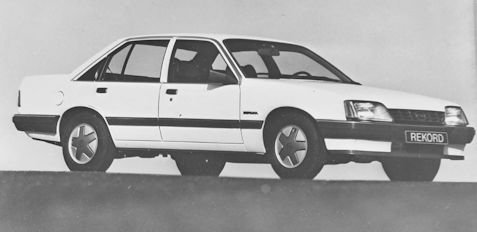
The Opel Rekord E is a car from Opel AG, which in August 1977 as a successor to the Opel Rekord D. Like its predecessor models, the type was also available as a car and estate" by Opel.
History
Until the facelift in October 1982, the model is called E1, after which it was called E2. The platform of the Opel Rekord E was also used in the models Opel Commodore C , Senator A and Monza .The vehicle with four-cylinder in - line engine , rear rigid axle and rear wheel drive was the last representative of the model series Opel Rekord offered since spring 1953 .After about 1.4 million vehicles produced record E by August 1986 .In Great Britain , the model was offered from the end of 1978 under the name Vauxhall Carlton .This model differed in the first series externally from the Opel Rekord by a (then Vauxhall-typical) flat front end similar to the Opel Manta B. From the end of 1982 (model E2) were only the emblems and the right control of the important distinguishing features, especially as the Carlton was produced as well as the record at the Russelsheim plant. In South Africa, the record E was still produced until 1990, at Daewoo this was offered as Royale and from 1993 to 1999 with revised body as Prince or Brougham.
The Adam Opel AG presented the newly developed record at the IAA 1977. This took over part of the technology of his predecessor. The Rekord E was a typical utility car with an unremitting but reliable technique and driving performance, decent road holding and a somewhat unsatisfactory suspension comfort were in addition to its pleasant appearance characteristics of this series.
The large-series engines (Opel CIH) of the E1 model existed as 1.7 N (60 hp), 1.9 N (75 hp, regular gasoline), and three 2.0-liter versions 2.0 N (66 kW / 90 hp), 2.0 S (super gasoline, 100 hp) and 2.0 E (injectors, 110 hp) and a 2.1-liter diesel variant (60 hp), which after only one year by a 2.3-liter version with 65 hp was replaced. In export there were z. As for Italy for tax purposes and a 2.0-liter diesel version with 58 hp, which in Germany only in Ascona B was offered. However, the small engines were ordered relatively rarely, in this vehicle class, a displacement of about two litres had established. The diesel models with characteristic hump on the hood were more in demand in Italy, the Benelux countries and France.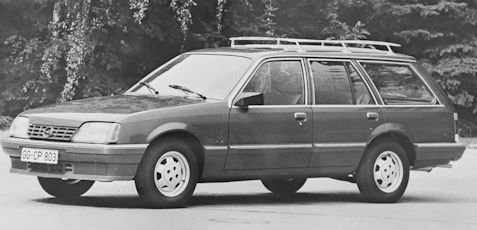
There were three equipment lines:
The record (basic model) as two- or four-door sedan and as a three- or five-door caravan.
The record L as a two- and four-door sedan and a five-door caravan.
The record Berlina as a two- and four-door sedan and from August 1980 as a five-door caravan. The Berlina is the highest quality equipment.
Optionally, there was an S package with alloy wheels and a firmer suspension. For a surcharge, a level control for the rear axle was available. The interior was available in beige, red, blue or black. The window parapets and dashboard tops were black. The Berlina was a darker red tone as well as used in Senator / Monza.
In July 1981, some model care measures were carried out. All models now got a plastic spoiler on the bow, all sedan rear lights with a black instead of a red plastic edging. The record L was now called record luxury and had a "luxury" lettering on the front fender, integrated mirrors and sedan as an extended rear bumper as in Senator, Monza and Commodore.
Also, the record Berlina got these innovations, in addition as a limousine from the senator or Monza wider side protection trim and rubber strips on the bumpers. From the Commodore got the Berlina the circumferential rear light chrome trim; the two-door record Berlina fell away. All models were available in new upholstery colours: beige, brown, dark green, dark blue or dark Gray. Standard and luxury models have now been fitted with the same material. The Berlina was again a suede equipment reserved.
From April 1982, the sporty model Rekord SR / E appeared on the basis of the record luxury with striking two-tone paint as a two- and four-door sedan and a five-door caravan as a replacement for the S package. In August 1982, the production of the record E1 was finished. This was followed by the E2.With the appearance of the revised E2 in October 1982, the body and dashboard were revised. The record received in addition to modern bumpers made of plastic, a higher-running rear and a flattened bonnet with a new front end. Opel followed the currently popular wedge shape, and was able to lower the drag coefficient compared to the E1 on.
The engines 1.7 N, 1.9 N and 2.0 N accounted for and were replaced by the Ascona C and Kadett D 1.6 liter first introduced OHC engines with cross-flow light-alloy cylinder head, here as carburettor models 1.8 N (55 kW) and 1.8 S (66 kW). The 1.8 S-OHC engine debuted a few months earlier in Manta-B. The 2.0 CIH engines (S and E) were taken over unchanged.
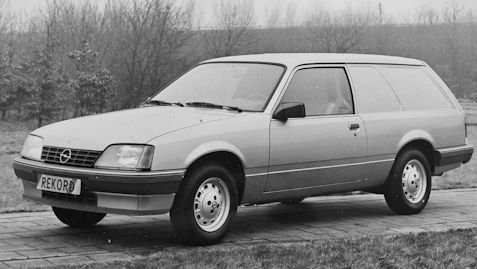
The record E2 was available as a sedan only four-door, the caravan continues in the basic version three- or five-door. The sedan in the Berlina equipment got a full-coverage wheel cover. The green interior was eliminated, as was the sporty variant SR / E. A variant as a three-door van with closed side windows was reserved for some export markets.
By March 1983 introduced the new top model of the record CD. It is based on the record Berlina with 2.0-E engine. It can be recognized by its aluminium trim on the hood, sill panels and a new full-surface hubcap (similar design to the Ascona C Series CD). The fine suede interior is similar to that of the Ascona CD. The record caravan Berlina had from model year 1984 known in the sedan hubcaps, as well as a split folding rear seat back. Optionally, there were also the simpler caravan models against extra charge with this special equipment. New was the record caravan in CD equipment.
The diesel program was further expanded: The 2.3 D was increased in August 1983 to 71 hp, 1984 came the 86 hp turbo variant, which was also available in the Senator.
The innovations of the model year 1985 are limited to equipment changes. The lettering on the trunk lid was now made of plastic, the interior light was enlarged, the new door panels came without chrome. The equipment variants were rearranged: The basic model record was now the record LS, the now full-coverage wheel covers, new fabrics, a fold-out centre armrest, a carpet-covered rear shelf and fabric-related headrests and door panels got and thus the previous record luxury was quite similar. The latter got a new high-quality suede equipment similar to the previous record Berlina and its wheel covers and now led the designation "record GL".
The record Berlina became the "record GLS" and optically orientated itself on the Rekord CD with its fine suede trim, hubcaps and sill covers made of plastic. The "Rekord CD" retained its name, it was now missing the trim on the hood and standard narrower tires were mounted. In addition, towards the end of production there was still the GLS Exclusive. The 2.0 E engine was in September 1984, replaced by the 2.2i engine, which extends from the 2.0 E only by an 8 mm extended piston stroke is different. This engine is characterized by a particularly strong start even at low speeds. For some export markets, the 2.0-E engine was due to divergent tax legislation in the program. From November 1984, the record was also available with ABS.
In June 1986, the production of the last record E2 models was completed. In addition, after Captain (1970) and Admiral (1976), another great tradition name was dropped from the Opel range. The successor was from September 1986 was now called the Omega.
|
Featured
|
|
