
About
Technical
-
Fuel economy
FUEL CONSUMPTION l/100 km (mpg)
1.5 CRTD
1.6 manual
1.6 automatic
1.8 manual
1.8 automatic
Urban
6.8 (41.5)
9.1 (31.0)
11.1(25.4)
10.8 (26.2)
12.2 (23.2)
Extra urban
4.6 (61.4)
6.3 (44.8)
6.6 (42.8)
6.7 (42.2)
7.0 (40.4)
Combined
5.4 (52.3)
7.1 (39.8)
8.3(34.0)
8.3 (34.0)
9.0 (31.4
DIMENSIONS
DIMENSIONS
HYUNDAI MATRIX (all models)
Length (mm)
4,025
Height (mm)
1,635 (with roof rack 1,685)
Width (mm)
1,740
Wheelbase (mm)
2,600
Track – front (mm)
1,485
Track – rear (mm)
1,485
Turning circle (m)
11.3
Tyre size
195/55 R15 (GSI models)
205/55 R15 (CDX models)
Wheels
15” steel or alloy
Cargo capacity – seats upright/reclined (l)
345/1,284
Fuel tank capacity (l)
55
Enginesmodel
capacity
power
Max. Torque
transmission
construction
gasoline engines
1.6
1599 cc
76 kW (103 hp) at 5800 min -1
141 Nm at 4500 rpm
Five-speed manual
4- speed automatic2001-2010
1.8
1795 cm³
90 kW (122 hp) at 6000 min -1
162 Nm at 4500 rpm
Five-speed manual
4-speed automatic2001-2010
diesel engines
1.5 CRDi
1493 cc
60 kW (82 hp) at 4000 min -1
187 Nm at 2000 rpm
Five-speed manual
2001-2005
1.5 CRDi VGT
1493 cc
75 kW (102 hp) at 4000 min -1
235 Nm at 2000 rpm
Five-speed manual
2005-2008
1.5 CRDi VGT
1493 cc
81 kW (110 hp) at 4000 min -1
235 Nm at 2000 rpm
Five-speed manual
2008-2010
Engine technical data
MODEL
1.6 GSI
1.5 CRTD GSI
1.8 CDX
Engine type
4 cylinder DOHC
4 cylinder SOHC
4 Cylinder DOHC
Displacement (cc)
1,599
1,493
1,795
Bore x stroke (mm)
75.6 x 87.0
75.0 x 84.5
82.0 x 85.0
Compression ratio
10.0:1
(10.1 auto)
17.8:1
10.1:1
Max. power (bhp)
102 @ 5,800 rpm
100 @ 4,000 rpm
121 @ 6,000 rpm
Max. torque (Nm)
141 @ 4,500 rpm
235 @ 2,000 rpm
160.9 @ 4,500rpm
Cylinder block
Iron
Iron
Iron
Cylinder head
Aluminium
Aluminium
Aluminium
Brakes
System
Dual diagonal split circuit, power assisted with ABS and Electronic Brakeforce Distribution (EBD)
Front
10.1” ventilated discs, floating calliper with pad warning device
Rear
8.0” drums
Suspension
Front
Independent MacPherson struts with gas filled dampers
Rear
Dual link with gas filled dampers
CO2 Emissions
Carbon dioxide emissions and Vehicle Excise Duty bands for the new Matrix are as follows:
MODEL
CO2 EMISSIONS
VED BAND
1.6 GSI
174 g/km
E
1.6 GSI automatic
198 g/km
F
1.8 CDX
198 g/km
F
1.8 CDX automatic
215 g/km
F
1.5 CRTD GSI
142 g/km
C
Noise levels
MODEL
NOISE LEVEL
1.6 GSI manual/automatic
74 dB(A)
1.8 CDX manual
74 dB(A)
1.8 CDX automatic
72 dB(A)
1.5 CRTD GSI
74 dB(A)
Note: Full Specifications and Service Repair Manuals available for registered users
© Motor-car.net
Manuals
Hyundai Matrix
 |
|
|
Manufacturer |
Hyundai |
|
Production |
2001 to 2007 |
|
Assembly |
South Korea, Turkey., Malaysia ,Egypt, Greece Taiwan |
|
Designer |
Pininfarina |
|
Class |
Motor Car |
|
Body style |
5-door hatchback |
|
Layout |
Front-engine, front-wheel-drive |
|
Engine |
Petrol engines: |
|
Transmission |
5-speed manual |
|
Wheelbase |
2,600 mm (102.4 in) |
|
Length |
4,035 mm (158.9 in) |
|
Width |
1,740 mm (68.5 in) |
|
Height |
1,625 mm (64.0 in) (without roof rack) |
|
Curb weight |
1,223–1,316 kg (2,696.3–2,901.3 lb) |
|
Successor |
Hyundai ix20 |
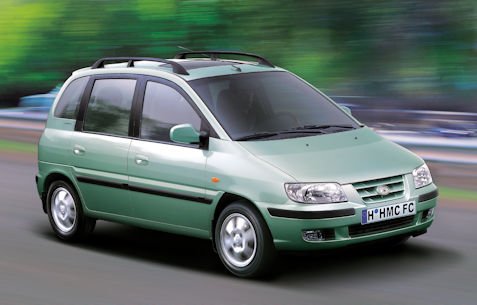
The Hyundai Matrix is from spring 2001 to mid-2010 from the Korean car manufacturers Hyundai -built minivan based on the Elantra also known as the Hyundai Lavita .
In April 2001, the car with the internal abbreviation FC ( Family Concept ) was presented for the first time at the Auto Mobil International in Leipzig. It is a model specially developed for Europe, which was made in Turkey. The characteristic design with the step in the side window line comes from Pininfarina . The interior with space for five people offers a split folding and sliding rear seat, whose backrest tilt can be adjusted. The exclusively available equipment version standard with four airbags, ABS with electronic brake force distribution, belt tension and belt force limiters and three height-adjustable rear headrests. For the market launch in August 2001, two gasoline engines and from September 2001 a diesel engine were available. Simultaneously with the launch of the Matrix, Hyundai's European Headquarters in Eschborn were opened, designed to optimize models for Europe, better support importers and more efficiently research and development.
The aerodynamic front end features a large, steeply raked windscreen which offers the driver an excellent front view and strong European lines were penned by one of Europe's most prestigious styling Pininfarina, which gave it instantly recognizable look. In an innovative design touch, the gauge cluster has been relocated to the centre where its easier to see. The cluster features a standard four-dial setup with large speedometer finished in a silver tone. heated door mirrors are standard on all three Matrix models.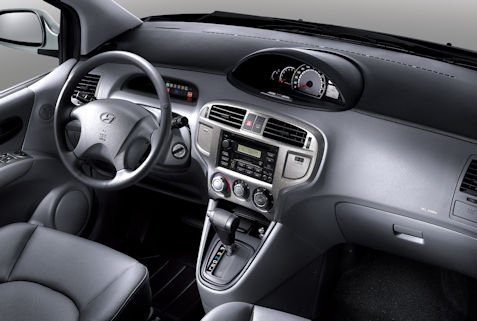
In 2003, there was a special model called 1.6 GLS Edition + , in which, among other things, an air conditioner, an on-board computer, central locking with remote control, 15-inch alloy wheels and a metallic paint were standard. The special model was about 1000 euros cheaper compared to a similarly equipped production model.
Matrix has a choice of three powerplants two petrol engines and a CRDi diesel. Also on offers is a 1.6 litre Alpha II engine, 1.8 litre Beta II engine and 1.5 litre CRDi (turbocharged and intercooler) diesel engineand meet US and European emission standards. The Matrix 1.6 GSI has a torque figure of 141 Nm/104 lb ft @ 4,500 rpm, the 1.8 CDX has 160.9 Nm/119 lb ft of torque, while the CRTD GSI has a handy 235 Nm/173 lb ft of torque.
the 1.8 Beta II engine offers better performance, it also returns respectable fuel economy. Like the 1.6, the 1.8 is a DOHC unit with multi-point fuel-injection and distributorless ignition. Optimal combustion chambers and cylinder head ports help deliver better performance and fuel economy and a mechanical lash adjuster reduces friction loss. It has a top speed of 114.3 mph and does the 0-62 mph run in 11.3 seconds.The two petrol engined Matrixes return good fuel economy: the 1.6 is capable of 44.8 mpg on the Extra Urban run, 31 mpg Urban and 40 mpg Combined. The 1.8 returns 42.2 mpg Extra Urban, 26.2 mpg on the Urban Cycle and 34 mpg combined.The SOHC 1.5 TD engine, part of a family of common-rail turbodiesels developed in-house by the Hyundai Motor Company. Qualities of this engine include reduced emissions, respectable hill climbing ability and acceleration for overtaking. The CRTD GSI will only be sold in Europe.The CRTD GSI returns 60.1 mpg on the extra urban run, 37.7 mpg urban and 49.6 mpg combined. It has a top speed of 99.4 mph and goes from 0 to 62 mph in 17.9 seconds.
Two transmission options: a five speed manual, or a four speed automatic available as an option (petrol models only, the diesel comes exclusively with a five speed manual). The manual gearbox has been redesigned, and uses a double-cone synchroniser design for first and second gears, and a keyless synchroniser for first to fourth gears, which gives smoother shift and better response.The four speed automatic has a wide gear ratio for improved performance and fuel economy, while improvements to the lubrication pressure system means no loss of power.
SAFETY
The front seatbelts have pretensioners and load limiters, to minimise the risk of injury in the event of a collision. The load limiter helps control the amount of pressure over the torso when the seatbelt pretensioner is activated, thus reducing the risk of secondary injury. All three rear passengers have full three-point seatbelts.All models feature depowered driver, passenger and side airbags as standard equipment. Other safety features include doors with child safety locks and central door locking across the range, and keyless entry and anti-theft alarm systems on the CDX. The front seats have been designed to include ‘anti-submarining’ technology to prevent driver/passenger sliding under the belt in a front collision. All Matrix models have childproof locks.To maximise body strength, the outer side panels have been produced from a single metal stamping, as are the front door frames, while high-tensile strength steel beams are used for the side outer reinforcements and side inner panels to minimise intrusion into the cabin in the event of a collision.
All models have an automatic fuel cut-off system, which in the event of a collision will shut off supply from the fuel pump thanks to a sensor.Anti-lock brakes with Electronic Brake Force Distribution, always regarded as an essential item in the promotion of driving safety, is standard across the Matrix range.
In the fall of 2005, the matrix was subjected to a facelift and the body with a new honeycomb grille, a modified front apron and provided new taillights. In addition, the three-cylinder diesel engine was replaced by a four-cylinder now with 75 kW (102 hp), which accelerates the matrix in 14.3 seconds from 0 to 100 km / h and a top speed of 164 km / h. The standard fuel consumption is on average 5.4 liters of diesel per 100 kilometres’, an open particulate filter is available as a retrofit kit. The prices were raised only slightly in relation to the smaller diesel engine compared to the original model.
At the Geneva Motor Show in March 2008, a revised version of the Matrix was introduced. The front design is now based on other Hyundai models such as the i10 . The air intake, grille and fog lights have been changed, and the step in the side window line is now covered by a black foil. In addition, the previously uneven front wheel arches have been redesigned, the exterior mirrors enlarged and omitted the protective strip on the rear bumper. Inside, new materials and colours are used. In addition to ABS and six airbags, an ESP is now also included in the standard safety equipment. The gasoline engines have not changed, but the diesel now provides 81 kW (110 hp) and has an open particulate filter system. Furthermore, there are now the three equipment variants Classic (basic model), Comfort (medium equipment) and Style (top model). The gasoline engines of 1.6-liter 76 kW up to 1.8-liter engine with 90 kW. There is also a common rail - diesel engine with three cylinders, 1.5 liters of displacement and 60 kW, by a four-cylinder engine with 81 kW and 2005 VTG was replaced.
Mid-2010, the production of the matrix was completed. The successor was introduced in autumn 2010 ix20.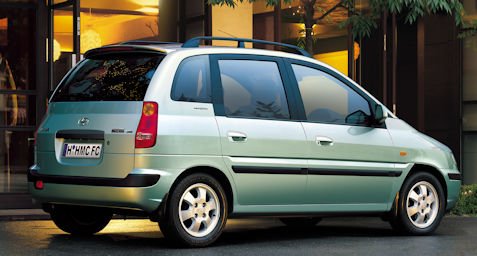
|
Featured
|
|

